




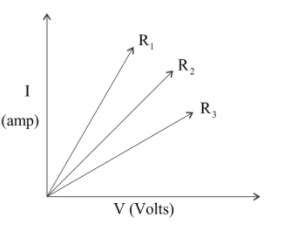
A student carries out an experiment and plots the V-I graph of three samples of nichrome wire with resistance ${R_1},{R_2},{R_3}$ respectively (see in figure). Which of the following is true?
A) ${R_1} = {R_2} = {R_3}$
B) ${R_1} = {R_2} = {R_3}$
C) ${R_1} < {R_2} < {R_3}$
D) ${R_2} > {R_3} > {R_1}$
Answer
 Verified
528.4k+ views
Hint: This question can be solved by using ohm’s law and slope determining method as more the angle with the x-axis more will be the slope .As we know slope for any graph $ = \tan \theta $
Or in other words it is ratio of Y coordinate to the X coordinate
Hence, $\tan \theta = \dfrac{y}{x}$
Complete step by step answer:
According to the question given we have information from the graph as follows:
Resistance, Angle or slope for current and potential difference
As discussed above no calculative value is given so we will proceed with slope method
Always assumes of normal temperature if not given in the question because as temperature rises Ohms law will no longer be valid
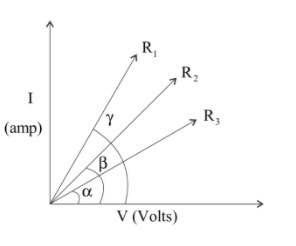
According to Ohm’s Law, $V = IR$ where v is the voltage, $I$ is the current and R is the resistance
Let’s study the graph above,
Slope $ = \tan \theta = \dfrac{V}{I} = \dfrac{1}{R}$
(by ohm's law)
As $\alpha > \beta > \gamma $
So, $\tan \gamma > \tan \beta > \tan \alpha $
That means $\dfrac{1}{{{R_1}}} > \dfrac{1}{{{R_2}}} > \dfrac{1}{{{R_3}}}$
On reciprocating we get,
${R_3} > {R_2} > {R_1}$
So, the conclusion is more the angle lesser will be the resistance only for this graph
Hence option (C) is correct.
Note: Ohm's law is only valid for normal temperatures, at high temperatures it fails as wire develops lots of heat due to which resistance automatically increases and the uniformity in ohm's Law destroys. In that case resistance changes depending on the nature of material that is metal, non-metal and semiconductors.
Or in other words it is ratio of Y coordinate to the X coordinate
Hence, $\tan \theta = \dfrac{y}{x}$
Complete step by step answer:
According to the question given we have information from the graph as follows:
Resistance, Angle or slope for current and potential difference
As discussed above no calculative value is given so we will proceed with slope method
Always assumes of normal temperature if not given in the question because as temperature rises Ohms law will no longer be valid
According to Ohm’s Law, $V = IR$ where v is the voltage, $I$ is the current and R is the resistance
Let’s study the graph above,
Slope $ = \tan \theta = \dfrac{V}{I} = \dfrac{1}{R}$
(by ohm's law)
As $\alpha > \beta > \gamma $
So, $\tan \gamma > \tan \beta > \tan \alpha $
That means $\dfrac{1}{{{R_1}}} > \dfrac{1}{{{R_2}}} > \dfrac{1}{{{R_3}}}$
On reciprocating we get,
${R_3} > {R_2} > {R_1}$
So, the conclusion is more the angle lesser will be the resistance only for this graph
Hence option (C) is correct.
Note: Ohm's law is only valid for normal temperatures, at high temperatures it fails as wire develops lots of heat due to which resistance automatically increases and the uniformity in ohm's Law destroys. In that case resistance changes depending on the nature of material that is metal, non-metal and semiconductors.
Recently Updated Pages
JEE Main 2026 Session 2 Registration Open, Exam Dates, Syllabus & Eligibility

JEE Main 2023 April 6 Shift 1 Question Paper with Answer Key
JEE Main 2023 April 6 Shift 2 Question Paper with Answer Key
JEE Main 2023 (January 31 Evening Shift) Question Paper with Solutions [PDF]
JEE Main 2023 January 30 Shift 2 Question Paper with Answer Key
JEE Main 2023 January 25 Shift 1 Question Paper with Answer Key
Trending doubts
JEE Main Marking Scheme 2026- Paper-Wise Marks Distribution and Negative Marking Details
Why does capacitor block DC and allow AC class 12 physics JEE_Main
Understanding Average and RMS Value in Electrical Circuits
Understanding Collisions: Types and Examples for Students
Ideal and Non-Ideal Solutions Explained for Class 12 Chemistry
Understanding Atomic Structure for Beginners
Other Pages
JEE Advanced Weightage 2025 Chapter-Wise for Physics, Maths and Chemistry
CBSE Class 12 Physics Set 2 (55/2/2) 2025 Question Paper & Solutions
Inductive Effect and Its Role in Acidic Strength
Degree of Dissociation: Meaning, Formula, Calculation & Uses
Units and Measurements Mock Test for JEE Main 2025-26 Preparation
Chemistry Question Papers for JEE Main, NEET & Boards (PDFs)