




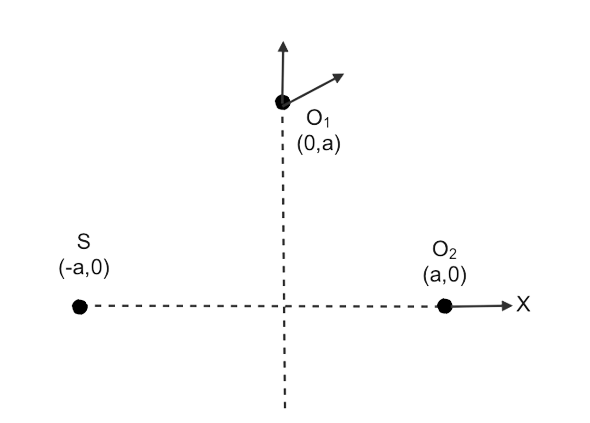
A sound source S and observers O1, O2 are placed as shown S is always at rest and $O_1$, $O_2$ start moving with velocity $v_0$ at t=0. At t=5 sec, $f_1$ and $f_2$ represent apparent frequencies of sound received by $O_1$ and $O_2$ respectively. The ratio of $f_1$ and $f_2$ is:
A. Zero
B. Between 0 and 1
C. 1
D. >1
Answer
 Verified
232.8k+ views
Hint: To solve this question we will use the concept of doppler effect. Here we will need the relative speed of sound waves when the listener and sources are in motion with respect to each other. With the help of the equation for apparent frequency one can easily solve this problem.
Formula used:
The equation of apparent frequency in doppler effect is:
${f^{'}}=f\left( \dfrac{v-{{v}_{0}}}{v-{{v}_{s}}} \right)$
Complete answer:
For a listener, sound waves are the disturbance of air around his ears and the pressure varies between maximum and minimum. The pitch of the sound heard by the observer depends on this pressure variation.
If the observer or source or both are in motion with respect to each other, the frequency observed will be different from that of the frequency of source. This apparent change in frequency of wave due to motion of the observer or source is called doppler effect.
The general equation for apparent frequency in doppler effect is:
${f^{'}}=f\left( \dfrac{v-{{v}_{0}}}{v-{{v}_{s}}} \right)$
Where,
${f^’}$ is the apparent frequency
f is the actual frequency
v is the velocity of sound in air
$v_0$ is the velocity of observer
$v_s$ is the velocity of the source
In this question the velocity of the source is zero since the source is at rest. For observer 1, if $\theta$ is the angle between the axis and velocity of sound then the velocity of observer is ${v_0} \cos \theta$.
Then the apparent frequency of observer 1 is:
${{f}_{1}}=\dfrac{v-{{v}_{0}}\cos \theta }{v}-(1)$
The apparent frequency of observer 2 is:
${{f}_{2}}=\dfrac{v-{{v}_{0}}}{v}-(2)$
$\therefore \dfrac{{{f}_{_{1}}}}{{{f}_{2}}}=\dfrac{v-{{v}_{0}}\cos \theta }{v-{{v}_{0}}}$
And we all know that the maximum value of cosϴ is always greater than or equal to one.
\[\therefore \dfrac{{{f}_{1}}}{{{f}_{2}}}>1\]
Therefore, the answer is (D).
Note: In the doppler effect we are only concerned about relative motion between source and observer when the numerator is larger than the denominator then the ratio will always be greater than one.
Formula used:
The equation of apparent frequency in doppler effect is:
${f^{'}}=f\left( \dfrac{v-{{v}_{0}}}{v-{{v}_{s}}} \right)$
Complete answer:
For a listener, sound waves are the disturbance of air around his ears and the pressure varies between maximum and minimum. The pitch of the sound heard by the observer depends on this pressure variation.
If the observer or source or both are in motion with respect to each other, the frequency observed will be different from that of the frequency of source. This apparent change in frequency of wave due to motion of the observer or source is called doppler effect.
The general equation for apparent frequency in doppler effect is:
${f^{'}}=f\left( \dfrac{v-{{v}_{0}}}{v-{{v}_{s}}} \right)$
Where,
${f^’}$ is the apparent frequency
f is the actual frequency
v is the velocity of sound in air
$v_0$ is the velocity of observer
$v_s$ is the velocity of the source
In this question the velocity of the source is zero since the source is at rest. For observer 1, if $\theta$ is the angle between the axis and velocity of sound then the velocity of observer is ${v_0} \cos \theta$.
Then the apparent frequency of observer 1 is:
${{f}_{1}}=\dfrac{v-{{v}_{0}}\cos \theta }{v}-(1)$
The apparent frequency of observer 2 is:
${{f}_{2}}=\dfrac{v-{{v}_{0}}}{v}-(2)$
$\therefore \dfrac{{{f}_{_{1}}}}{{{f}_{2}}}=\dfrac{v-{{v}_{0}}\cos \theta }{v-{{v}_{0}}}$
And we all know that the maximum value of cosϴ is always greater than or equal to one.
\[\therefore \dfrac{{{f}_{1}}}{{{f}_{2}}}>1\]
Therefore, the answer is (D).
Note: In the doppler effect we are only concerned about relative motion between source and observer when the numerator is larger than the denominator then the ratio will always be greater than one.
Recently Updated Pages
JEE Main 2023 April 6 Shift 1 Question Paper with Answer Key

JEE Main 2023 April 6 Shift 2 Question Paper with Answer Key
JEE Main 2023 (January 31 Evening Shift) Question Paper with Solutions [PDF]
JEE Main 2023 January 30 Shift 2 Question Paper with Answer Key
JEE Main 2023 January 25 Shift 1 Question Paper with Answer Key
JEE Main 2023 January 24 Shift 2 Question Paper with Answer Key
Trending doubts
JEE Main 2026: Session 2 Registration Open, City Intimation Slip, Exam Dates, Syllabus & Eligibility
JEE Main 2026 Application Login: Direct Link, Registration, Form Fill, and Steps
Understanding the Angle of Deviation in a Prism
Hybridisation in Chemistry – Concept, Types & Applications
How to Convert a Galvanometer into an Ammeter or Voltmeter
Understanding Uniform Acceleration in Physics
Other Pages
JEE Advanced Marks vs Ranks 2025: Understanding Category-wise Qualifying Marks and Previous Year Cut-offs
Laws of Motion Class 11 Physics Chapter 4 CBSE Notes - 2025-26
Waves Class 11 Physics Chapter 14 CBSE Notes - 2025-26
Mechanical Properties of Fluids Class 11 Physics Chapter 9 CBSE Notes - 2025-26
Thermodynamics Class 11 Physics Chapter 11 CBSE Notes - 2025-26
Units And Measurements Class 11 Physics Chapter 1 CBSE Notes - 2025-26