




A ray of light is incident on a \[60^\circ \] prism at the minimum deviation position. The angle of refraction at the first face (i.e. incident face) of the prism is:
(A) Zero
(B) \[30^\circ \]
(C) \[45^\circ \]
(D) \[60^\circ \]
Answer
 Verified
233.1k+ views
Hint: Generally, the angle of refraction from the first face plus the incident angle on the second face (which is due to the refracted light from the first face) is equal to the angle of prism. For minimum deviation, the first refraction angle (refraction from first face), and the second incident angle (incidence on second face) are equal.
Formula used: In this solution we will be using the following formulae;
\[A = {r_1} + {i_2}\] where \[A\] is the angle of prism, \[{r_1}\] is the angle of refraction from the first face, and \[{i_2}\] is the angle of incidence on the second face.
Complete Step-by-Step Solution:
Generally, when light enters a prism from one side, there is refraction towards the normal. Now this refracted light travels in the prism, and becomes an incident ray on the second face of the prism. Then the light gets refracted as it exits the prism, and the refraction is away from the normal. This second refracted light is called an emergent ray.
Generally, in a prism of a particular angle, the following equation is obeyed
\[A = {r_1} + {i_2}\] where \[A\] is the angle of prism, \[{r_1}\] is the angle of refraction from the first face, and \[{i_2}\] is the angle of incidence on the second face.
Now, for minimum deviation, the refraction angle \[{r_1}\] is equal to the incident angle \[{i_2}\] i.e. \[{r_1} = {i_2} = r\]
Then
\[A = r + r = 2r\]
Then the refraction angle is
\[r = \dfrac{A}{2}\]
By substitution of known values, we get
\[r = \dfrac{{60^\circ }}{2} = 30^\circ \]
Hence, the correct option is B
Note: For clarity, the angle of prism formula can be proven from the diagram as shown below
The angle between the normal and the prism is 90 degrees, hence, the angle between the first refracted ray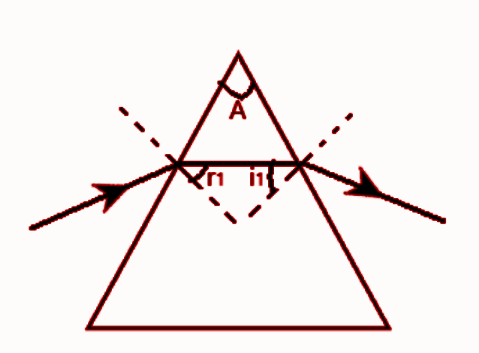
and the first face of prism would be
\[z = 90 - {r_1}\]
Similarly for the second face of prism,
\[y = 90 - {i_2}\]
But the total angle in a triangle is 180 degrees, hence
\[A + z + y = 180\]
\[ \Rightarrow A = 180 - (90 - {r_1}) - 90 - {i_2}\]
By simplifying, we obtain
\[A = {r_1} + {i_2}\]
Formula used: In this solution we will be using the following formulae;
\[A = {r_1} + {i_2}\] where \[A\] is the angle of prism, \[{r_1}\] is the angle of refraction from the first face, and \[{i_2}\] is the angle of incidence on the second face.
Complete Step-by-Step Solution:
Generally, when light enters a prism from one side, there is refraction towards the normal. Now this refracted light travels in the prism, and becomes an incident ray on the second face of the prism. Then the light gets refracted as it exits the prism, and the refraction is away from the normal. This second refracted light is called an emergent ray.
Generally, in a prism of a particular angle, the following equation is obeyed
\[A = {r_1} + {i_2}\] where \[A\] is the angle of prism, \[{r_1}\] is the angle of refraction from the first face, and \[{i_2}\] is the angle of incidence on the second face.
Now, for minimum deviation, the refraction angle \[{r_1}\] is equal to the incident angle \[{i_2}\] i.e. \[{r_1} = {i_2} = r\]
Then
\[A = r + r = 2r\]
Then the refraction angle is
\[r = \dfrac{A}{2}\]
By substitution of known values, we get
\[r = \dfrac{{60^\circ }}{2} = 30^\circ \]
Hence, the correct option is B
Note: For clarity, the angle of prism formula can be proven from the diagram as shown below
The angle between the normal and the prism is 90 degrees, hence, the angle between the first refracted ray
and the first face of prism would be
\[z = 90 - {r_1}\]
Similarly for the second face of prism,
\[y = 90 - {i_2}\]
But the total angle in a triangle is 180 degrees, hence
\[A + z + y = 180\]
\[ \Rightarrow A = 180 - (90 - {r_1}) - 90 - {i_2}\]
By simplifying, we obtain
\[A = {r_1} + {i_2}\]
Recently Updated Pages
JEE Main 2023 April 6 Shift 1 Question Paper with Answer Key

JEE Main 2023 April 6 Shift 2 Question Paper with Answer Key
JEE Main 2023 (January 31 Evening Shift) Question Paper with Solutions [PDF]
JEE Main 2023 January 30 Shift 2 Question Paper with Answer Key
JEE Main 2023 January 25 Shift 1 Question Paper with Answer Key
JEE Main 2023 January 24 Shift 2 Question Paper with Answer Key
Trending doubts
JEE Main 2026: Session 2 Registration Open, City Intimation Slip, Exam Dates, Syllabus & Eligibility
JEE Main 2026 Application Login: Direct Link, Registration, Form Fill, and Steps
Understanding the Angle of Deviation in a Prism
Hybridisation in Chemistry – Concept, Types & Applications
How to Convert a Galvanometer into an Ammeter or Voltmeter
Understanding Uniform Acceleration in Physics
Other Pages
JEE Advanced Marks vs Ranks 2025: Understanding Category-wise Qualifying Marks and Previous Year Cut-offs
Laws of Motion Class 11 Physics Chapter 4 CBSE Notes - 2025-26
Waves Class 11 Physics Chapter 14 CBSE Notes - 2025-26
Mechanical Properties of Fluids Class 11 Physics Chapter 9 CBSE Notes - 2025-26
Thermodynamics Class 11 Physics Chapter 11 CBSE Notes - 2025-26
Units And Measurements Class 11 Physics Chapter 1 CBSE Notes - 2025-26