




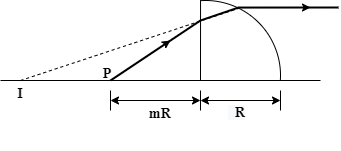
A quarter cylinder of radius R and refractive index 1.5 is placed on a table. A point object P is kept at a distance of mR from it as shown in figure. For what value of m for which a ray from P will emerge parallel to the table?
A) $\dfrac{3}{4}$
B) $\dfrac{3}{2}$
C) $\dfrac{4}{3}$
D) $\dfrac{3}{4}$
Answer
 Verified
233.1k+ views
Hint: To solve this question, the students should understand that when light travels from rarer medium to denser medium, it bends towards the normal and in the reverse case i.e. denser to rarer medium, the light bends away from the normal.
Formulae used:
Refraction at a spherical surface is given by the formula –
\[\dfrac{{{\eta _2}}}{v} - \dfrac{{{\eta _1}}}{u} = \dfrac{{\left( {{\eta _2} - {\eta _1}} \right)}}{R}\]
Where,
\[{\eta _2}\] is refractive index of the second medium,
\[{\eta _1}\] is refractive index of the first medium,
R is the radius of curvature of the surface,
u is the object distance from the lens,
v is the image distance from the lens.
Complete step by step answer:
Given:
Refractive index of the quarter cylindrical lens is \[{\eta _1} = 1\].
First surface is a plain surface. Hence, its radius of curvature is $R = \infty $.
Second surface has a radius of curvature of $ - R$.
The point object is placed at a distance, $u = - mR$ for the first plane surface and outward rays are parallel to the table.
Hence, the image is formed at distance, $v = \infty $ for the curved surface.
To find m:
Using the values of \[{\eta _2} = 1\],\[{\eta _1} = \dfrac{3}{2}\],$u = - mR$,$R = \infty $ in equation of refraction at spherical surfaces to get:
\[\dfrac{{\dfrac{3}{2}}}{v} - \dfrac{1}{{( - mR)}} = \dfrac{{\left( {\dfrac{3}{2} - 1} \right)}}{\infty }\]
\[ \Rightarrow \dfrac{3}{{2v}} = 0 - \dfrac{1}{{mR}}\]
\[ \Rightarrow v = - \dfrac{{3mR}}{2}\]
Now, this image will act as the object for the curved surface.
Step 2
Now, use the values \[{\eta _1} = \dfrac{3}{2}\],\[{\eta _2} = 1\],$u = - \left( {\dfrac{{3mR}}{2} + R} \right),$,$v = \infty $and radius of curvature –R in equation of refraction at spherical surfaces to obtain the value of m as:
\[\dfrac{1}{\infty } - \dfrac{{\dfrac{3}{2}}}{{ - \left( {\dfrac{{3mR}}{2} + R} \right)}} = \dfrac{{\left( {1 - \dfrac{3}{2}} \right)}}{{ - R}}\]
\[ \Rightarrow \dfrac{3}{{\left( {3mR + 2R} \right)}} = \dfrac{1}{{2R}}\]
\[ \Rightarrow 3mR + 2R = 6R\]
\[ \Rightarrow 3mR = 4R\]
\[\therefore m = \dfrac{4}{3}\]
Value of m is (C), $\dfrac{4}{3}$.
Note: As previously told, the image created by the first plain surface will act as the object for the second curved surface. While putting the object distance for the curved surface there is a high chance that a student might make a mistake by putting it the same as the image distance of the plain surface. You must notice that the second surface is R distance apart from the first plain surface. So, you need to modify the distance accordingly (here you have to add R).
Formulae used:
Refraction at a spherical surface is given by the formula –
\[\dfrac{{{\eta _2}}}{v} - \dfrac{{{\eta _1}}}{u} = \dfrac{{\left( {{\eta _2} - {\eta _1}} \right)}}{R}\]
Where,
\[{\eta _2}\] is refractive index of the second medium,
\[{\eta _1}\] is refractive index of the first medium,
R is the radius of curvature of the surface,
u is the object distance from the lens,
v is the image distance from the lens.
Complete step by step answer:
Given:
Refractive index of the quarter cylindrical lens is \[{\eta _1} = 1\].
First surface is a plain surface. Hence, its radius of curvature is $R = \infty $.
Second surface has a radius of curvature of $ - R$.
The point object is placed at a distance, $u = - mR$ for the first plane surface and outward rays are parallel to the table.
Hence, the image is formed at distance, $v = \infty $ for the curved surface.
To find m:
Using the values of \[{\eta _2} = 1\],\[{\eta _1} = \dfrac{3}{2}\],$u = - mR$,$R = \infty $ in equation of refraction at spherical surfaces to get:
\[\dfrac{{\dfrac{3}{2}}}{v} - \dfrac{1}{{( - mR)}} = \dfrac{{\left( {\dfrac{3}{2} - 1} \right)}}{\infty }\]
\[ \Rightarrow \dfrac{3}{{2v}} = 0 - \dfrac{1}{{mR}}\]
\[ \Rightarrow v = - \dfrac{{3mR}}{2}\]
Now, this image will act as the object for the curved surface.
Step 2
Now, use the values \[{\eta _1} = \dfrac{3}{2}\],\[{\eta _2} = 1\],$u = - \left( {\dfrac{{3mR}}{2} + R} \right),$,$v = \infty $and radius of curvature –R in equation of refraction at spherical surfaces to obtain the value of m as:
\[\dfrac{1}{\infty } - \dfrac{{\dfrac{3}{2}}}{{ - \left( {\dfrac{{3mR}}{2} + R} \right)}} = \dfrac{{\left( {1 - \dfrac{3}{2}} \right)}}{{ - R}}\]
\[ \Rightarrow \dfrac{3}{{\left( {3mR + 2R} \right)}} = \dfrac{1}{{2R}}\]
\[ \Rightarrow 3mR + 2R = 6R\]
\[ \Rightarrow 3mR = 4R\]
\[\therefore m = \dfrac{4}{3}\]
Value of m is (C), $\dfrac{4}{3}$.
Note: As previously told, the image created by the first plain surface will act as the object for the second curved surface. While putting the object distance for the curved surface there is a high chance that a student might make a mistake by putting it the same as the image distance of the plain surface. You must notice that the second surface is R distance apart from the first plain surface. So, you need to modify the distance accordingly (here you have to add R).
Recently Updated Pages
JEE Main 2026 Session 2 Registration Open, Exam Dates, Syllabus & Eligibility

JEE Main 2023 April 6 Shift 1 Question Paper with Answer Key
JEE Main 2023 April 6 Shift 2 Question Paper with Answer Key
JEE Main 2023 (January 31 Evening Shift) Question Paper with Solutions [PDF]
JEE Main 2023 January 30 Shift 2 Question Paper with Answer Key
JEE Main 2023 January 25 Shift 1 Question Paper with Answer Key
Trending doubts
JEE Main Marking Scheme 2026- Paper-Wise Marks Distribution and Negative Marking Details
Why does capacitor block DC and allow AC class 12 physics JEE_Main
Understanding Average and RMS Value in Electrical Circuits
Understanding Collisions: Types and Examples for Students
Ideal and Non-Ideal Solutions Explained for Class 12 Chemistry
Understanding Atomic Structure for Beginners
Other Pages
JEE Advanced Weightage 2025 Chapter-Wise for Physics, Maths and Chemistry
CBSE Class 12 Physics Set 2 (55/2/2) 2025 Question Paper & Solutions
Inductive Effect and Its Role in Acidic Strength
Degree of Dissociation: Meaning, Formula, Calculation & Uses
Units and Measurements Mock Test for JEE Main 2025-26 Preparation
Chemistry Question Papers for JEE Main, NEET & Boards (PDFs)