




A cube of side $10cm$ is floating in water kept in a cylindrical beaker of base area $1500c{m^2}$. When a mass m is kept on a wooden block the level of water rises in the beaker by $2mm$. Find them mass m.
$\left( A \right)200g$
$\left( B \right)300g$
$\left( C \right)400g$
$\left( D \right)500g$
Answer
 Verified
233.1k+ views
Hint: Here to solve the above question we have to make use of Archimedes principle. The weight immersed in a fluid by a body is equal to the weight of the fluid displaced due to the body. Using the above statements find the displacement. Then by substituting the displacement determine the mass $m$ that is placed in the wooden block.
Formula used:
$mg = \delta Vg$
$\delta $ is the density, $V$ is the volume, $g$ is the acceleration of gravity.
Complete step by step answer:
When a body is immersed in a liquid, this fluid will exert a force due its weight on the body and it will experience an upward force due to the fluid. A balance will be reached when the body displaces fluid weight equal to its weight. This upward force is called the buoyancy force. If they have different density then the body may sink or float. The weight immersed in a fluid by a body is equal to the weight of the fluid displaced due to the body.
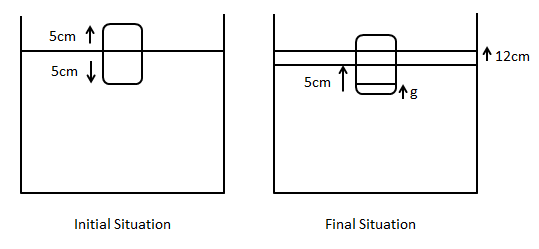
Area of the cube $A = 10 \times 10 = 100c{m^2}$
Water rises by $\dfrac{2}{{10}}cm\left( {2mm} \right)$
The weight immersed in a fluid by a body is equal to the weight of the fluid displaced due to the body.
$100y = \left( {1500 - 100} \right) \times \dfrac{2}{{10}}$
$\Rightarrow y = 2.8cm$
Then the mass kept on the wooden block
$mg = \delta Vg$
$\Rightarrow mg = {\delta _{water}} \times \left( {2.8 + 0.2} \right)100g$
$\Rightarrow mg = 1 \times \left( {2.8 + 0.2} \right)100g$
$\Rightarrow m = 300g$
Then option $\left( B \right)$ is the right option.
Note: The weight immersed in a fluid by a body is equal to the weight of the fluid displaced due to the body. A balance will be reached when the body displaces fluid weight equal to its weight. This upward force is called the buoyancy force. Buoyancy is not dependent on mass, density and size of the body.
Formula used:
$mg = \delta Vg$
$\delta $ is the density, $V$ is the volume, $g$ is the acceleration of gravity.
Complete step by step answer:
When a body is immersed in a liquid, this fluid will exert a force due its weight on the body and it will experience an upward force due to the fluid. A balance will be reached when the body displaces fluid weight equal to its weight. This upward force is called the buoyancy force. If they have different density then the body may sink or float. The weight immersed in a fluid by a body is equal to the weight of the fluid displaced due to the body.
Area of the cube $A = 10 \times 10 = 100c{m^2}$
Water rises by $\dfrac{2}{{10}}cm\left( {2mm} \right)$
The weight immersed in a fluid by a body is equal to the weight of the fluid displaced due to the body.
$100y = \left( {1500 - 100} \right) \times \dfrac{2}{{10}}$
$\Rightarrow y = 2.8cm$
Then the mass kept on the wooden block
$mg = \delta Vg$
$\Rightarrow mg = {\delta _{water}} \times \left( {2.8 + 0.2} \right)100g$
$\Rightarrow mg = 1 \times \left( {2.8 + 0.2} \right)100g$
$\Rightarrow m = 300g$
Then option $\left( B \right)$ is the right option.
Note: The weight immersed in a fluid by a body is equal to the weight of the fluid displaced due to the body. A balance will be reached when the body displaces fluid weight equal to its weight. This upward force is called the buoyancy force. Buoyancy is not dependent on mass, density and size of the body.
Recently Updated Pages
JEE Main 2023 April 6 Shift 1 Question Paper with Answer Key

JEE Main 2023 April 6 Shift 2 Question Paper with Answer Key
JEE Main 2023 (January 31 Evening Shift) Question Paper with Solutions [PDF]
JEE Main 2023 January 30 Shift 2 Question Paper with Answer Key
JEE Main 2023 January 25 Shift 1 Question Paper with Answer Key
JEE Main 2023 January 24 Shift 2 Question Paper with Answer Key
Trending doubts
JEE Main 2026: Session 2 Registration Open, City Intimation Slip, Exam Dates, Syllabus & Eligibility
JEE Main 2026 Application Login: Direct Link, Registration, Form Fill, and Steps
JEE Main Marking Scheme 2026- Paper-Wise Marks Distribution and Negative Marking Details
Understanding the Angle of Deviation in a Prism
Hybridisation in Chemistry – Concept, Types & Applications
How to Convert a Galvanometer into an Ammeter or Voltmeter
Other Pages
JEE Advanced Marks vs Ranks 2025: Understanding Category-wise Qualifying Marks and Previous Year Cut-offs
Laws of Motion Class 11 Physics Chapter 4 CBSE Notes - 2025-26
Waves Class 11 Physics Chapter 14 CBSE Notes - 2025-26
Mechanical Properties of Fluids Class 11 Physics Chapter 9 CBSE Notes - 2025-26
Thermodynamics Class 11 Physics Chapter 11 CBSE Notes - 2025-26
Units And Measurements Class 11 Physics Chapter 1 CBSE Notes - 2025-26