




A body weighing ${{0}}{{.4 kg}}$ is whirled in a vertical circle making ${{3 rps}}$. If the radius of the circle is ${{1}}{{.2 m}}$, find the tension in the string at
(i) top of the circle,
(ii) bottom of the circle.
Answer
 Verified
232.8k+ views
Hint: The best approach to solve these types of questions in which tension is asked, first of all draw a free body diagram. After drawing a free body diagram, write the related equations and then try to solve it. After solving the equation in a simpler form, substitute the given values.
Complete step by step solution:
Given: Mass of the body, ${{m = 0}}{{.4 kg}}$
As the body is making 3 revolutions per second so time period, ${{T = }}\dfrac{{{1}}}{{{3}}}{{ sec}}$
Radius of the circle, ${{r = 1}}{{.2 m}}$
In order to find the tension in the string first we need to calculate angular velocity and the formula of angular velocity is given by
${{\omega = }}\dfrac{{{{2\pi }}}}{{{T}}}$
Now, on substituting the value of time-period in above formula, we get
$
{{\omega = }}\dfrac{{{{2\pi }}}}{{\dfrac{1}{2}}} \\
\therefore {{\omega = 4\pi rad }}{{{s}}^{ - 1}} $
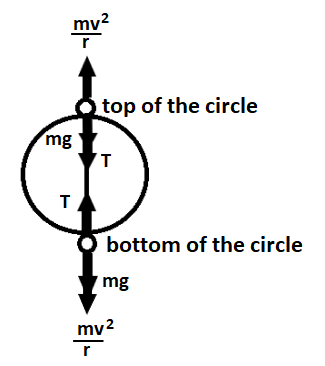
(i) To find the tension in the string at the top of the circle
$\Rightarrow {{T = }}\dfrac{{{{m}}{{{v}}^{{2}}}}}{{{r}}}{{ - mg}}$
The above relation can be written in the form of angular velocity as
$\Rightarrow {{T = mr}}{{{\omega }}^{{2}}}{{ - mg}}$
On taking term “m” common, the above relation can be rewritten as
$\Rightarrow {{T = m(r}}{{{\omega }}^{{2}}}{{ - g)}}$
On substituting the values, we get
\[
\Rightarrow {{T = 0}}{{.4[1}}{{.2 \times (4\pi }}{{{)}}^{{2}}}{{ - 9}}{{.8]}} \\
\therefore {{T = 71}}{{.8 N}} \]
(ii) To find the tension in the string at the bottom of the circle
$\Rightarrow {{T = }}\dfrac{{{{m}}{{{v}}^{{2}}}}}{{{r}}}{{ + mg}}$
The above relation can be written in the form of angular velocity as
$\Rightarrow {{T = mr}}{{{\omega }}^{{2}}}{{ + mg}}$
On taking term “m” common, the above relation can be rewritten as
$\Rightarrow {{T = m(r}}{{{\omega }}^{{2}}}{{ + g)}}$
On substituting the values, we get
\[
\Rightarrow {{T = 0}}{{.4[1}}{{.2 \times (4\pi }}{{{)}}^{{2}}}{{ + 9}}{{.8]}} \\
\therefore {{T = 79}}{{.6 N}} \]
Thus, tension in the string at the top of the circle is ${{71}}{{.8 N}}$ and tension in the string at the bottom of the circle is ${{79}}{{.8 N}}$.
Note: The tension force points towards the center of the circle the entire time because tension can only act along the cord which is always a radius of the circle. Therefore in the free body diagram tension always acts towards the center of the circle for both the cases i.e. for top of the circle and for bottom of the circle.
Complete step by step solution:
Given: Mass of the body, ${{m = 0}}{{.4 kg}}$
As the body is making 3 revolutions per second so time period, ${{T = }}\dfrac{{{1}}}{{{3}}}{{ sec}}$
Radius of the circle, ${{r = 1}}{{.2 m}}$
In order to find the tension in the string first we need to calculate angular velocity and the formula of angular velocity is given by
${{\omega = }}\dfrac{{{{2\pi }}}}{{{T}}}$
Now, on substituting the value of time-period in above formula, we get
$
{{\omega = }}\dfrac{{{{2\pi }}}}{{\dfrac{1}{2}}} \\
\therefore {{\omega = 4\pi rad }}{{{s}}^{ - 1}} $
(i) To find the tension in the string at the top of the circle
$\Rightarrow {{T = }}\dfrac{{{{m}}{{{v}}^{{2}}}}}{{{r}}}{{ - mg}}$
The above relation can be written in the form of angular velocity as
$\Rightarrow {{T = mr}}{{{\omega }}^{{2}}}{{ - mg}}$
On taking term “m” common, the above relation can be rewritten as
$\Rightarrow {{T = m(r}}{{{\omega }}^{{2}}}{{ - g)}}$
On substituting the values, we get
\[
\Rightarrow {{T = 0}}{{.4[1}}{{.2 \times (4\pi }}{{{)}}^{{2}}}{{ - 9}}{{.8]}} \\
\therefore {{T = 71}}{{.8 N}} \]
(ii) To find the tension in the string at the bottom of the circle
$\Rightarrow {{T = }}\dfrac{{{{m}}{{{v}}^{{2}}}}}{{{r}}}{{ + mg}}$
The above relation can be written in the form of angular velocity as
$\Rightarrow {{T = mr}}{{{\omega }}^{{2}}}{{ + mg}}$
On taking term “m” common, the above relation can be rewritten as
$\Rightarrow {{T = m(r}}{{{\omega }}^{{2}}}{{ + g)}}$
On substituting the values, we get
\[
\Rightarrow {{T = 0}}{{.4[1}}{{.2 \times (4\pi }}{{{)}}^{{2}}}{{ + 9}}{{.8]}} \\
\therefore {{T = 79}}{{.6 N}} \]
Thus, tension in the string at the top of the circle is ${{71}}{{.8 N}}$ and tension in the string at the bottom of the circle is ${{79}}{{.8 N}}$.
Note: The tension force points towards the center of the circle the entire time because tension can only act along the cord which is always a radius of the circle. Therefore in the free body diagram tension always acts towards the center of the circle for both the cases i.e. for top of the circle and for bottom of the circle.
Recently Updated Pages
JEE Main 2023 April 6 Shift 1 Question Paper with Answer Key

JEE Main 2023 April 6 Shift 2 Question Paper with Answer Key
JEE Main 2023 (January 31 Evening Shift) Question Paper with Solutions [PDF]
JEE Main 2023 January 30 Shift 2 Question Paper with Answer Key
JEE Main 2023 January 25 Shift 1 Question Paper with Answer Key
JEE Main 2023 January 24 Shift 2 Question Paper with Answer Key
Trending doubts
JEE Main 2026: Session 2 Registration Open, City Intimation Slip, Exam Dates, Syllabus & Eligibility
JEE Main 2026 Application Login: Direct Link, Registration, Form Fill, and Steps
JEE Main Marking Scheme 2026- Paper-Wise Marks Distribution and Negative Marking Details
Understanding the Angle of Deviation in a Prism
Hybridisation in Chemistry – Concept, Types & Applications
How to Convert a Galvanometer into an Ammeter or Voltmeter
Other Pages
JEE Advanced Marks vs Ranks 2025: Understanding Category-wise Qualifying Marks and Previous Year Cut-offs
Laws of Motion Class 11 Physics Chapter 4 CBSE Notes - 2025-26
Waves Class 11 Physics Chapter 14 CBSE Notes - 2025-26
Mechanical Properties of Fluids Class 11 Physics Chapter 9 CBSE Notes - 2025-26
Thermodynamics Class 11 Physics Chapter 11 CBSE Notes - 2025-26
Units And Measurements Class 11 Physics Chapter 1 CBSE Notes - 2025-26