




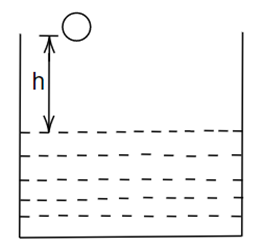
A ball of radius r and density \[\rho \] falls freely under gravity through a distance h before entering the water. The velocity of the ball does not change even on entering the water. The viscosity of water is \[\eta \], and the value of h is given by?
A. \[\dfrac{2}{9}{r^2}\left( {\dfrac{{1 - \rho }}{\eta }} \right)g\]
B. \[\dfrac{2}{{81}}{r^2}\left( {\dfrac{{\rho - 1}}{\eta }} \right)g\]
C. \[\dfrac{2}{{81}}{r^4}{\left( {\dfrac{{\rho - 1}}{\eta }} \right)^2}g\]
D. \[\dfrac{2}{9}{r^4}{\left( {\dfrac{{\rho - 1}}{\eta }} \right)^2}g\]
Answer
 Verified
233.1k+ views
Hint: The property of a fluid that opposes the relative motion between its different layers is known as viscosity. The force that opposes the motion between the layers of fluid is known as viscous force.
Formula Used:
To find the terminal velocity the formula is,
\[{v_T} = \dfrac{{2{r^2}\left( {\rho - \sigma } \right)g}}{{9\eta }}\]
Here,
r is radius of ball
\[\rho \] is density of ball
\[\sigma \] is density of liquid
\[\eta \] is coefficient of viscosity of liquid
g is acceleration due to gravity
Complete step by step solution:
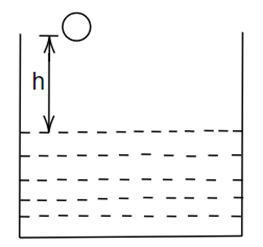
Image: A ball falling freely under gravity through a distance h before entering the water.
Once the ball enters into the liquid, the speed remains the same, it will not change. Here the velocity is nothing but \[v = \sqrt {2gh} \]. We are using this formula since the fall is free fall we can use the equations of motion.
Once it enters the liquid the velocity of the ball will not change but usually what happens the acceleration of the ball continuously decreases and at one particular instant the acceleration will be completely ceased by the resultant forces, one is buoyancy force and the other one is the viscous force. Here the coefficient of viscosity is \[\eta \].
Now, the formula for the terminal velocity is,
\[{v_T} = \dfrac{{2{r^2}\left( {\rho - \sigma } \right)g}}{{9\eta }}\]
The velocity just before entering the water is,
\[v = \sqrt {2gh} \]
When, \[v = {v_T}\]
\[\sqrt {2gh} = \dfrac{{2{r^2}\left( {\rho - 1} \right)g}}{{9\eta }}\]
Squaring on both the sides we obtain,
\[2gh = \dfrac{{4{r^4}{{\left( {\rho - 1} \right)}^2}{g^2}}}{{{9^2}{\eta ^2}}}\]
\[\Rightarrow h = \dfrac{{2{r^4}{{\left( {\rho - 1} \right)}^2}g}}{{81{\eta ^2}}}\]
\[\therefore h = \dfrac{2}{{81}}{r^4}{\left( {\dfrac{{\rho - 1}}{\eta }} \right)^2}g\]
Therefore, the value of h is \[\dfrac{2}{{81}}{r^4}{\left( {\dfrac{{\rho - 1}}{\eta }} \right)^2}g\].
Hence, option C is the correct answer.
Note: Remember that the viscous force and frictional force are similar, but they are not the same. In a moving fluid, the fluid consists of multiple layers. If we compare to the neighbouring layers each layer has a noticeable difference in speed. This force, called the frictional force, decreases the relative motion between the layers.
Formula Used:
To find the terminal velocity the formula is,
\[{v_T} = \dfrac{{2{r^2}\left( {\rho - \sigma } \right)g}}{{9\eta }}\]
Here,
r is radius of ball
\[\rho \] is density of ball
\[\sigma \] is density of liquid
\[\eta \] is coefficient of viscosity of liquid
g is acceleration due to gravity
Complete step by step solution:
Image: A ball falling freely under gravity through a distance h before entering the water.
Once the ball enters into the liquid, the speed remains the same, it will not change. Here the velocity is nothing but \[v = \sqrt {2gh} \]. We are using this formula since the fall is free fall we can use the equations of motion.
Once it enters the liquid the velocity of the ball will not change but usually what happens the acceleration of the ball continuously decreases and at one particular instant the acceleration will be completely ceased by the resultant forces, one is buoyancy force and the other one is the viscous force. Here the coefficient of viscosity is \[\eta \].
Now, the formula for the terminal velocity is,
\[{v_T} = \dfrac{{2{r^2}\left( {\rho - \sigma } \right)g}}{{9\eta }}\]
The velocity just before entering the water is,
\[v = \sqrt {2gh} \]
When, \[v = {v_T}\]
\[\sqrt {2gh} = \dfrac{{2{r^2}\left( {\rho - 1} \right)g}}{{9\eta }}\]
Squaring on both the sides we obtain,
\[2gh = \dfrac{{4{r^4}{{\left( {\rho - 1} \right)}^2}{g^2}}}{{{9^2}{\eta ^2}}}\]
\[\Rightarrow h = \dfrac{{2{r^4}{{\left( {\rho - 1} \right)}^2}g}}{{81{\eta ^2}}}\]
\[\therefore h = \dfrac{2}{{81}}{r^4}{\left( {\dfrac{{\rho - 1}}{\eta }} \right)^2}g\]
Therefore, the value of h is \[\dfrac{2}{{81}}{r^4}{\left( {\dfrac{{\rho - 1}}{\eta }} \right)^2}g\].
Hence, option C is the correct answer.
Note: Remember that the viscous force and frictional force are similar, but they are not the same. In a moving fluid, the fluid consists of multiple layers. If we compare to the neighbouring layers each layer has a noticeable difference in speed. This force, called the frictional force, decreases the relative motion between the layers.
Recently Updated Pages
JEE Main 2023 April 6 Shift 1 Question Paper with Answer Key

JEE Main 2023 April 6 Shift 2 Question Paper with Answer Key
JEE Main 2023 (January 31 Evening Shift) Question Paper with Solutions [PDF]
JEE Main 2023 January 30 Shift 2 Question Paper with Answer Key
JEE Main 2023 January 25 Shift 1 Question Paper with Answer Key
JEE Main 2023 January 24 Shift 2 Question Paper with Answer Key
Trending doubts
JEE Main 2026: Session 2 Registration Open, City Intimation Slip, Exam Dates, Syllabus & Eligibility
JEE Main 2026 Application Login: Direct Link, Registration, Form Fill, and Steps
JEE Main Marking Scheme 2026- Paper-Wise Marks Distribution and Negative Marking Details
Understanding the Angle of Deviation in a Prism
Hybridisation in Chemistry – Concept, Types & Applications
How to Convert a Galvanometer into an Ammeter or Voltmeter
Other Pages
JEE Advanced Marks vs Ranks 2025: Understanding Category-wise Qualifying Marks and Previous Year Cut-offs
Laws of Motion Class 11 Physics Chapter 4 CBSE Notes - 2025-26
Waves Class 11 Physics Chapter 14 CBSE Notes - 2025-26
Mechanical Properties of Fluids Class 11 Physics Chapter 9 CBSE Notes - 2025-26
Thermodynamics Class 11 Physics Chapter 11 CBSE Notes - 2025-26
Units And Measurements Class 11 Physics Chapter 1 CBSE Notes - 2025-26