




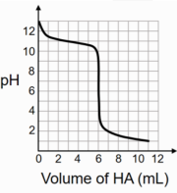
A 0.1 M weak base (B) solution is titrated with 0.1 M of a strong acid (HA). The image below depicts the change in pH of the solution as a function of the amount of HA added. What is the \[p{k_b}\] of the base? The neutralisation reaction is given by \[B + HA - \]\[B{H^ + } + {A^ - }\].
Answer
 Verified
232.8k+ views
Hint: In general, titration is a type of quantitative analysis that involves measuring the volume of a chemical species' solution in a suitable solvent in order to estimate its quantity. The Law of Equivalence underpins this strategy. As a result, titration can be defined as the process of calculating the volume of reagents by bringing a specific reaction to a close. The titrant is the solution used in titration that has an accurate concentration and the titrated substance is the substance whose volume needs to be determined.
Complete Step by Step Solution:
The given chemical reaction is \[B + HA \to B{H^ + } + {A^ - }\]
At Equivalence Point:
Total vol. = 12 ml
Concentration of salt = \[\dfrac{{0.6}}{{12}}\]
pH = 6 = \[\sqrt {\dfrac{{{k_w}}}{{{k_b}}}} \times c = \sqrt {\dfrac{{{{10}^{ - 14}} \times 0.6}}{{{k_b} \times 12}}} \]
{ pH = 0.6, \[[{H^ + }] = {10^{ - 6}}\]}
\[ \Rightarrow \]pH = 0.6 = \[\sqrt {\dfrac{{{k_w}}}{{{k_b}}} \times \dfrac{{0.1 \times 6}}{{12}}} \]
\[{10^{ - 12}} = \dfrac{{{{10}^{ - 14}} \times {{10}^{ - 1}}}}{{{k_b}}} \times \dfrac{1}{2}\]
$ \Rightarrow {k_b} = 5 \times {10^{ - 4}} \\$
$ \Rightarrow p{k_b} = - \log {k_b} = - \log (5 \times {10^{ - 4}}) = - \log 5 + 4\log 10 \\$
$ \Rightarrow p{k_b} = 4 - 0.7 \\$
$ \Rightarrow p{k_b} = 3.3 \\ $
Note: \[p{k_b}\] is the symbol which is used to estimate the alkalinity of the molecule. It is used to determine the base's strength. The lesser the \[p{k_b}\] value, the more potential the base will be having to dilute an acid. It is equivalent to the negative of logarithm of the base dissociation constant i.e. \[{k_b}\].
\[p{k_b} = - \log {k_b}\]; \[{k_b}\] or base dissociation constant is the symbol used to estimate a base’s strength. It indicates the amount of dissociation of a base in an aqueous solution. \[{k_b}\] is used to distinguish a strong base from a weaker one. More the value of \[{k_b}\] more would be its dissociation.
Complete Step by Step Solution:
The given chemical reaction is \[B + HA \to B{H^ + } + {A^ - }\]
| Conditions | B (0.1 M) | HA (0.1 M) | pH |
| At V = 0 ml | 0 ml | 13 | |
| At V = 3 ml | 3 ml → 50% neutralisation | 11 | |
| At V = 6 ml | 6 ml → Equivalence Point | 3 to 9 |
At Equivalence Point:
| B | HA | BH+ | A- |
| $0.1 \times 6$ = 0.6 mmol | $0.1 \times 6$ = 0.6 mmol | ||
| 0 | 0 | 0.6 mmol |
Total vol. = 12 ml
Concentration of salt = \[\dfrac{{0.6}}{{12}}\]
pH = 6 = \[\sqrt {\dfrac{{{k_w}}}{{{k_b}}}} \times c = \sqrt {\dfrac{{{{10}^{ - 14}} \times 0.6}}{{{k_b} \times 12}}} \]
{ pH = 0.6, \[[{H^ + }] = {10^{ - 6}}\]}
\[ \Rightarrow \]pH = 0.6 = \[\sqrt {\dfrac{{{k_w}}}{{{k_b}}} \times \dfrac{{0.1 \times 6}}{{12}}} \]
\[{10^{ - 12}} = \dfrac{{{{10}^{ - 14}} \times {{10}^{ - 1}}}}{{{k_b}}} \times \dfrac{1}{2}\]
$ \Rightarrow {k_b} = 5 \times {10^{ - 4}} \\$
$ \Rightarrow p{k_b} = - \log {k_b} = - \log (5 \times {10^{ - 4}}) = - \log 5 + 4\log 10 \\$
$ \Rightarrow p{k_b} = 4 - 0.7 \\$
$ \Rightarrow p{k_b} = 3.3 \\ $
Note: \[p{k_b}\] is the symbol which is used to estimate the alkalinity of the molecule. It is used to determine the base's strength. The lesser the \[p{k_b}\] value, the more potential the base will be having to dilute an acid. It is equivalent to the negative of logarithm of the base dissociation constant i.e. \[{k_b}\].
\[p{k_b} = - \log {k_b}\]; \[{k_b}\] or base dissociation constant is the symbol used to estimate a base’s strength. It indicates the amount of dissociation of a base in an aqueous solution. \[{k_b}\] is used to distinguish a strong base from a weaker one. More the value of \[{k_b}\] more would be its dissociation.
Recently Updated Pages
JEE Main 2023 April 6 Shift 1 Question Paper with Answer Key

JEE Main 2023 April 6 Shift 2 Question Paper with Answer Key
JEE Main 2023 (January 31 Evening Shift) Question Paper with Solutions [PDF]
JEE Main 2023 January 30 Shift 2 Question Paper with Answer Key
JEE Main 2023 January 25 Shift 1 Question Paper with Answer Key
JEE Main 2023 January 24 Shift 2 Question Paper with Answer Key
Trending doubts
JEE Main 2026: Session 2 Registration Open, City Intimation Slip, Exam Dates, Syllabus & Eligibility
JEE Main 2026 Application Login: Direct Link, Registration, Form Fill, and Steps
Understanding the Angle of Deviation in a Prism
Hybridisation in Chemistry – Concept, Types & Applications
How to Convert a Galvanometer into an Ammeter or Voltmeter
Understanding the Electric Field of a Uniformly Charged Ring
Other Pages
JEE Advanced Marks vs Ranks 2025: Understanding Category-wise Qualifying Marks and Previous Year Cut-offs
Hydrocarbons Class 11 Chemistry Chapter 9 CBSE Notes - 2025-26
Thermodynamics Class 11 Chemistry Chapter 5 CBSE Notes - 2025-26
Equilibrium Class 11 Chemistry Chapter 6 CBSE Notes - 2025-26
Organic Chemistry Some Basic Principles And Techniques Class 11 Chemistry Chapter 8 CBSE Notes - 2025-26
NCERT Solutions For Class 11 Chemistry Chapter 7 Redox Reactions (2025-26)