






BAMS Course 2026 Fees, Subjects, Top Colleges and Admission
If you want to build a career in Ayurveda and work as an Ayurvedic doctor, the BAMS course is one of the main options after Class 12 Science. BAMS stands for Bachelor of Ayurvedic Medicine and Surgery, a recognised undergraduate medical degree that focuses on India’s traditional system of medicine.
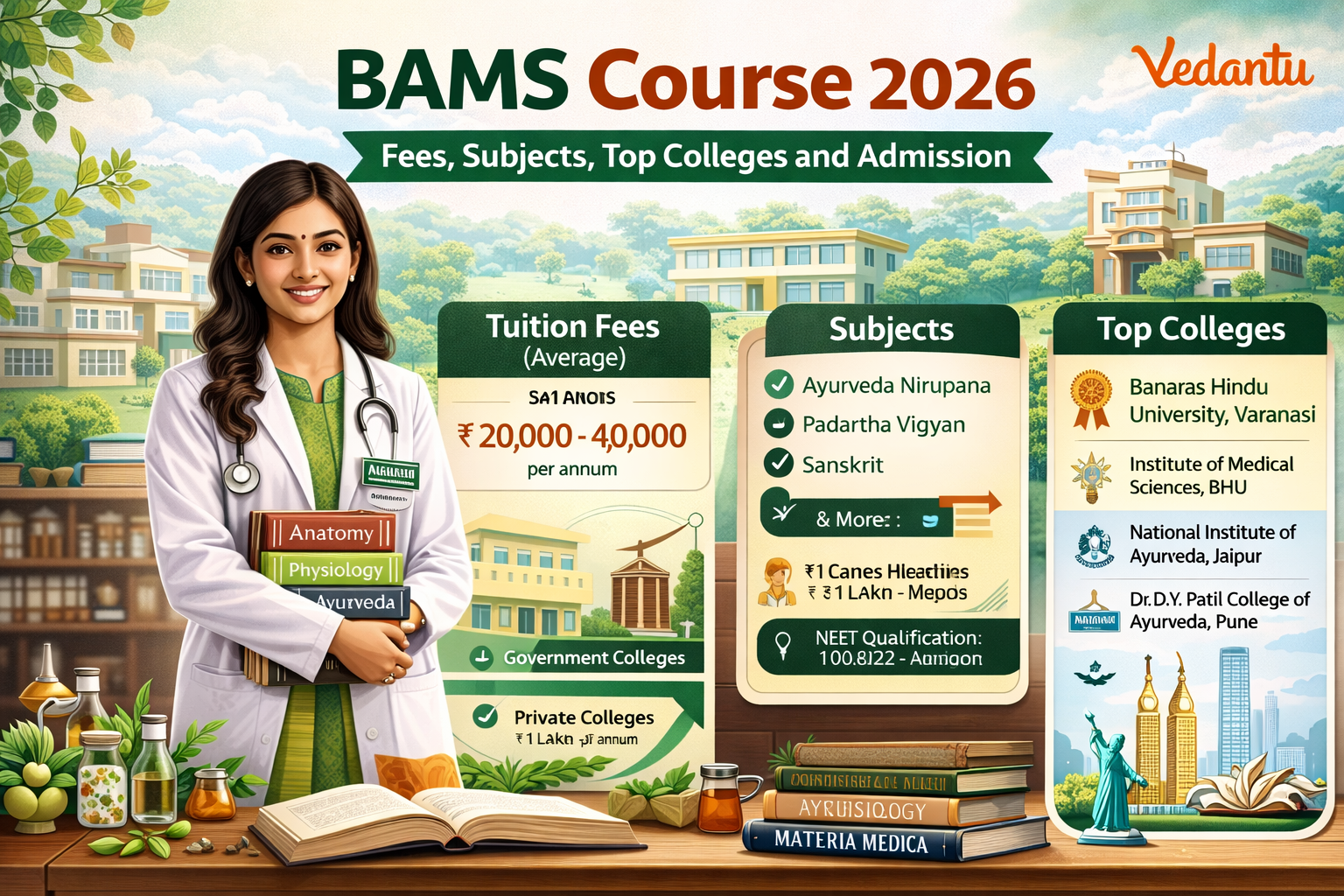
The BAMS course combines classical Ayurvedic concepts with basic modern medical knowledge. Over the full 5-year BAMS course (including an internship), students learn how the human body works, how to diagnose illnesses, and how to treat patients using Ayurvedic medicines, therapies, and lifestyle-based treatments.
BAMS is open to students who have studied Physics, Chemistry, and Biology (PCB) in Class 12. Admission to most reputed colleges is based on NEET, so your entrance exam score is very important for getting a seat in a good government or private college.
In this comprehensive guide, we will explore:
BAMS Full Form & Core Philosophy: Understanding the "Science of Life."
Admission Roadmap: How to navigate BAMS admission through NEET 2026.
Fee Structures: Comparing BAMS course fees in Government vs. Private institutions.
Cutoff Analysis: Using NEET 2025 BAMS cutoffs to set your 2026 target scores.
State-wise Insights: Deep dive into popular hubs like BAMS colleges in Maharashtra and Karnataka.
Syllabus & Career Scope: What you will study and your earning potential as a Medical Officer or Researcher.
BAMS Course Highlights 2026
BAMS Eligibility Criteria 2026
Students who want to take admission in the BAMS course 2026 must meet the basic eligibility requirements set for AYUSH admissions. While exact criteria can differ slightly by counselling authority or institution, the general eligibility conditions are:
candidates must pass Class 12 or equivalent
Subjects must include Physics, Chemistry, Biology or Biotechnology, and English
candidates must qualify for NEET UG
The minimum age should be 17 years by 31 December of the admission year
Category-wise qualifying conditions may apply during counselling
The official counselling framework for AYUSH UG courses is handled through AACCC for relevant seats, and students should always verify the latest eligibility requirements through official counselling notices before applying.
BAMS Admission Process 2026
Admission to the Bachelor of Ayurvedic Medicine and Surgery (BAMS) in 2026 is primarily based on NEET UG. Seats in recognised government and private colleges are filled through central and state counselling processes. Candidates should be cautious of any claims of direct admission where regulated counselling is applicable.
Below is the broad admission procedure for BAMS through NEET UG 2026.
Step 1: Appear for NEET UG 2026
Candidates must register for NEET UG 2026 through the official NTA website.
NEET UG 2026 is scheduled for 3 May 2026 (as per current notification; candidates should verify any updates).
Step 2: Qualify the Examination
To become eligible for BAMS counselling, students must score at or above the qualifying cutoff (category-wise) declared by NTA.
Only candidates who meet this qualifying percentile can participate in subsequent counselling rounds for AYUSH/BAMS seats.
Step 3: Register for Counselling
After the declaration of NEET results, eligible candidates must register for the appropriate counselling authority:
AACCC (AYUSH Admissions Central Counselling Committee) for relevant AYUSH UG seats at the national level.
Respective state counselling authorities for state quota and certain private college seats.
During this stage, candidates should carefully read the latest eligibility conditions, reservation rules, and counselling schedule published in official notices.
Step 4: Choice Filling and Seat Allotment
Registered candidates are required to fill in their preferences for colleges and courses (BAMS and other AYUSH programmes, where applicable).
Seat allotment is carried out based on:
NEET All India Rank / State Rank
Category and reservation norms
Availability of seats in each round
Choices submitted by the candidate
Specific counselling rules of the authority
Provisional and final allotment results are declared online for each counselling round.
Step 5: Document Verification and Reporting
Candidates who receive a BAMS seat must report to the allotted college or designated reporting centre within the given timeframe.
They are required to:
Undergo document verification (Class 10 and 12 mark sheets, NEET scorecard, admit card, category certificate if applicable, ID proof, etc.).
Pay the prescribed admission fee as per the college’s fee structure.
Complete all remaining formalities for admission confirmation.
Failure to report within the stipulated deadline or incomplete documentation can lead to cancellation of the allotted seat. Candidates should regularly check official websites for updates on counselling dates, rounds, and reporting instructions.
BAMS Course Duration and Structure
The Bachelor of Ayurvedic Medicine and Surgery (BAMS) is a long-duration professional programme designed to provide both strong theoretical grounding and extensive clinical exposure.
Course Duration
Total duration: Approximately 5.5 years
Academic study: 4.5 years (divided into professional years)
Compulsory rotatory internship: 1 year in recognised hospitals/clinics
During the academic years, students study a combination of classical Ayurvedic texts and modern medical sciences. The internship focuses on practical training, case handling, and exposure to various departments.
BAMS Course Duration and Structure
The Bachelor of Ayurvedic Medicine and Surgery (BAMS) is a long-duration professional programme designed to provide both strong theoretical grounding and extensive clinical exposure.
Course Duration
Total duration: Approximately 5.5 years
Academic study: 4.5 years (divided into professional years)
Compulsory rotatory internship: 1 year in recognised hospitals/clinics
During the academic years, students study a combination of classical Ayurvedic texts and modern medical sciences. The internship focuses on practical training, case handling, and exposure to various departments.
BAMS Syllabus: Year-wise Overview
The syllabus is prescribed by the Central Council of Indian Medicine (CCIM) / NCISM and remains broadly similar across recognised universities. Below is a general outline; specific subject names and distribution may vary slightly from one institution to another.
BAMS Syllabus for First Professional Year
Focus: Fundamentals of Ayurveda, language, and basic human sciences
Key subjects include:
Padartha Vigyan and Aynext
AyurVeda Itihas: (Basic principles, philosophical foundations, and history of Ayurveda)
Sanskrit: (To enable reading and understanding of classical Ayurvedic texts)
Kriya Sharir (Physiology): (Functional aspects of the human body as per Ayurvedic concepts)
Rachana Sharir (Anatomy): (Structural organisation of the body, including bones, muscles, organs, and embryology)
BAMS Syllabus for Second Professional Year
Focus: Pharmacology, pathology, and formulation of medicines
Key subjects include:
Dravyaguna Vigyan: (Study of Ayurvedic drugs, their properties and actions)
Roga Nidana: (Basic pathology and diagnostic principles)
Rasashastra and Bhaishajya Kalpana: (Processing of minerals and metals, preparation and storage of formulations)
BAMS Syllabus for Third Professional Year
Focus: Community health, specialised branches, and paediatrics
Key subjects include:
Agadtantra: (Medical jurisprudence and toxicology)
Swasthavritta: (Preventive and social medicine, lifestyle and public health)
Prasuti Tantra and Stri Roga: (Obstetrics and gynaecology from an Ayurvedic perspective)
Kaumarbhritya Parichaya / Balaroga: (Paediatrics and child health)
Yoga and Nisargopachara: (in some curricula) (Yogic practices and nature cure therapies)
BAMS Syllabus for Fourth Professional Year
Focus: Clinical management, specialised therapies, and surgery
Key subjects include:
Kayachikitsa: (Internal medicine – diagnosis and management of systemic disorders)
Panchakarma: (Detoxification and bio-purification therapies)
Shalya Tantra: (Principles of surgery and para-surgical procedures)
Shalakya Tantra: (Diseases of the eye, ear, nose, throat, head and neck)
Netra Roga Vigyan and Shira–Karna–Nasa–Mukha Rogas: (Special focus on ocular and ENT disorders)
Research Methodology and Medical Statistics: (Basics of clinical research, data analysis, and evidence-based practice)
Throughout all professional years, students undergo practicals, clinical postings, viva voce, and internal assessments to develop diagnostic skills and clinical competence.
In the next section, we can present a concise list of core subjects with brief descriptions or detail the recommended books for each major area, depending on how deep you want this page to go for NEET aspirants.
Score Required for BAMS Government Colleges (State and Category Wise)
Students preparing for AYUSH admissions often ask about the NEET score required for BAMS government colleges. The required marks are not fixed and vary every year based on factors such as state quota, category, number of applicants, seat availability, and college preference.
Since the official cutoff is released only during counselling, the ranges below are expected safe scores based on previous trends and competition levels.
Expected NEET Score for BAMS Government Colleges (Category Wise)
Expected NEET Score Based on College Type
Key Insights for BAMS Admission Through NEET
Top institutes such as Banaras Hindu University and the National Institute of Ayurveda usually require higher NEET scores due to national-level competition.
State quota seats may have relatively lower cutoffs depending on domicile rules and local competition.
Reserved category candidates may get admission at comparatively lower scores, but top colleges still remain competitive.
Cutoffs may change each year depending on exam difficulty and counselling dynamics.
BAMS Course Fees 2026
The BAMS course fees depend heavily on the type of institution (government, private, or deemed university), the state, and the quota (AIQ, state quota, management, etc.). In general, government colleges charge significantly lower fees than private institutions.
Fees in Government Colleges (Approximate)
Government and government-aided colleges usually have a much lower fee structure, making them highly preferred by NEET aspirants.
Annual or total fees can range from a few thousand rupees per year to around ₹1–5 lakh for the entire course, depending on the state and university.
Additional costs may include hostel charges, exam fees, books, and other miscellaneous expenses. Expenses.
Government seats are typically allotted through NEET-based AYUSH/State counselling, and the cutoff is usually higher due to lower fees and greater clinical exposure.
BAMS Fees in Private and Deemed Colleges (Approximate)
Private colleges and deemed universities have a higher fee range for BAMS.
Total course fees can range from ₹1.5–2 lakh and may go up to ₹20–25 lakh or more at some well-known institutes.
The fee structure may vary across state, management, and NRI quota seats.
Students should also consider hostel, mess, and other living costs when evaluating private options.
Note: Before taking admission, candidates are strongly advised to:
Check the official fee structure on the college or university website.
Confirm whether the fees shown are per year or for the full course.
Verify if there are additional charges for hostel, exams, and clinical facilities.
Top BAMS Colleges in India
Students searching for the best BAMS colleges in India should compare colleges based on fee, recognition, location, counselling route, hospital training, and internship exposure. Based on your draft, some of the commonly searched institutions include:
Banaras Hindu University
Dr D.Y. Patil Vidyapeeth
DMIHER
Parul University
LNCT University
Rama University
MUHS-affiliated options
Career Scope After BAMS
The career scope after BAMS has expanded beyond traditional private practice. Graduates can explore roles in healthcare, wellness, research, academics, public health, Ayurveda product companies, and medical tourism. Your draft is right to highlight that BAMS is not limited to one path.
Career Options After BAMS
Ayurvedic Doctor or Practitioner
Resident Medical Officer
Panchakarma Specialist
Clinical Research Associate
Medical Officer
Wellness Consultant
Lecturer or Academic Role
Herbal Product and Pharma Roles
Industries Hiring BAMS Graduates
Healthcare industry
Pharmaceutical industry
Education sector
Medical tourism
Wellness and lifestyle sector
Life sciences and herbal product companies
Salary After BAMS
The salary after BAMS depends on role, city, sector, experience, and whether the graduate works in a clinic, hospital, company, or wellness setup. The figures in your draft are best presented as indicative estimates rather than fixed salary promises.
Top Recruiters for BAMS Graduates
Some of the commonly known recruiters and brands associated with Ayurveda and herbal healthcare include:
Patanjali Ayurved Limited
Dabur
The Himalaya Drug Company
Hamdard Laboratories
Baidyanath
Charak Pharma
Vicco Laboratories
Emami
Zandu Pharmaceuticals
Courses After BAMS
Students who want to continue their studies after BAMS can choose higher education or management-based options depending on their career goals. Popular options include:
MD in Ayurveda
MS in Ayurveda
MBA in Hospital Administration
Clinical Research
Public Health
Nutrition and Dietetics
Your draft also mentions that specialisation happens mainly at the postgraduate level, which is the right way to explain it.
Conclusion: Is BAMS the Right Choice for You?
The Bachelor of Ayurvedic Medicine and Surgery (BAMS) is a strong option for students who are genuinely interested in medicine but also drawn to holistic, traditional approaches to health. The course demands consistent study, clinical training, and comfort with both classical Ayurvedic texts and basic modern medical concepts.
If you are a NEET aspirant from the Science stream and wish to:
build a medical career rooted in Ayurveda,
work in hospitals, clinics, wellness centres, or research, and
explore opportunities in India’s growing AYUSH and wellness sector,
Then BAMS can be a suitable and rewarding path.
What Should You Do Next?
Understand the syllabus and exam pattern for NEET UG and set a realistic target score for the type of BAMS college you want (government vs private).
Check recent BAMS cutoffs for your preferred states and colleges to know the level of competition.
Shortlist colleges in advance based on fees, location, hospital tie‑ups, and recognition by AYUSH/NCISM.
Create a focused study plan for NEET with regular mock tests and analysis.
With the right preparation and clear understanding of the course, BAMS can open the door to a stable medical career in Ayurveda. If you are serious about this path, start planning early for both NEET preparation and BAMS college selection so you can make informed choices when counselling begins.
FAQs on What is BAMS? Course Details, Fees 2026, Syllabus, Colleges, Admission & Career Scope
1. What is the full form of BAMS?
BAMS full form is Bachelor of Ayurvedic Medicine and Surgery. It is an undergraduate degree in Ayurveda.
2. Who is eligible for the BAMS course?
You must:
Pass Class 12 (10+2) or equivalent with Physics, Chemistry, Biology/Biotechnology and English.
Be at least 17 years old by 31 December of the admission year.
Qualify for NEET UG with the required cutoff for your category.
3. Is NEET compulsory for BAMS admission?
Yes. For recognised BAMS seats in most government and private colleges, NEET UG is mandatory. Only candidates who qualify for NEET can participate in AYUSH/BAMS counselling.
4. What is the duration of the BAMS course?
The BAMS course duration is about 5.5 years:
4.5 years of academic study (divided into professional years)
1 year of compulsory rotatory internship in recognised hospitals/clinics
5. What is the approximate BAMS course fee in government colleges?
Fees in government and government‑aided colleges are comparatively low. Depending on the state and college, total fees may range from a few thousand rupees to around ₹1–5 lakh for the entire course, excluding hostel and other expenses.
6. How much are BAMS fees in private colleges?
BAMS fees in private colleges are higher. The total course cost can range from ₹1.5–2 lakh to ₹20–25 lakh or more at some reputed institutes, depending on the quota and location.
7. What is the expected NEET cutoff for BAMS 2025 in government colleges?
The BAMS cutoff for NEET 2025 will depend on factors such as the exam's difficulty level, the number of applicants, and seat availability. Typically, government colleges require higher NEET scores/ranks than private colleges. Aspirants should check previous years’ state‑wise cutoffs for a realistic idea.
8. What is the scope after BAMS in India?
After BAMS, you can work as:
Ayurvedic physician / BAMS doctor
Resident Medical Officer (RMO)
Panchakarma specialist/therapist
Clinical research associate
Medical officer in government AYUSH services (through relevant exams)
Lecturer or academician (after MD/MS in Ayurveda)
There are also opportunities in pharma, wellness, and medical tourism.
9. What is the average starting salary after BAMS?
A fresh BAMS graduate may earn around ₹3–5 lakh per annum in many setups. With experience, location advantage, higher qualifications (MD/MS), or own practice, earnings can increase significantly.
10. What is BAMS called in Hindi?
BAMS full form in Hindi is commonly described as ‘बैचलर ऑफ आयुर्वेदिक मेडिसिन एंड सर्जरी’, which is generally referred to as बीएएमएस कोर्स in Hindi.
