









What is Euglena? Classification, Structure and Characteristics Explained
Euglena is a unicellular, flagellated microorganism that shows a fascinating combination of plant-like and animal-like features. It is a eukaryotic protist that can behave like both a plant and an animal. It performs photosynthesis when light is available, but under certain conditions it also feeds on organic matter. Because of this mixed mode of life, Euglena is often described as mixotrophic.
Euglena Classification
The euglena classification is often discussed because it has been considered controversial or flexible in different classification systems. Euglena is a genus of euglenoids. It may be placed in the phylum Euglenozoa or sometimes in Euglenophyta because of the presence of chlorophyll and photosynthetic ability in many species. However, not all species of Euglena contain chloroplasts, which is one reason why many systems prefer to place it in Euglenozoa.
At the school level, students usually learn that Euglena belongs to:
Kingdom: Protista
Group: Euglenoids
Genus: Euglena
Habitat of Euglena
Euglena is found in a variety of moist and aquatic habitats. It commonly occurs in:
freshwater
saltwater
marshes
moist soil
This wide habitat range shows that Euglena is adaptable and can survive in different environmental conditions. Since water is essential for its movement and life processes, it is most commonly associated with wet surroundings.
Structure of Euglena
The structure of Euglena is highly specialised for survival, locomotion, nutrition, and environmental response. Even though it is unicellular, it contains many organelles and structural adaptations.
General Shape and Size
Euglena has an elongated body and usually measures about 15 to 500 micrometres. It is mostly green in colour because of the presence of chlorophyll. Some species also contain carotenoid pigments, which may give them a different, sometimes reddish colour.
Unicellular and Eukaryotic Nature
Euglena is unicellular and contains one well-defined nucleus. Since it has membrane-bound organelles such as mitochondria, endoplasmic reticulum, Golgi bodies, and chloroplasts, it is clearly a eukaryotic organism.
Absence of Cellulose Cell Wall
One of the most important facts in the structure of Euglena is that it does not have a cellulose cell wall like plant cells. Instead, it has a flexible outer covering called the pellicle.
Pellicle
The pellicle is a flexible proteinaceous layer supported by microtubules. It lies beneath or supports the plasma membrane and gives flexibility to the cell. Because of the pellicle, Euglena can contract and alter its shape. This is a very important structural feature and one of the key euglena characteristics.
Plasma Membrane and Cytoplasm
A thin plasma membrane surrounds the cytoplasm and encloses the cell organelles. The internal cell machinery functions within this enclosed cytoplasm, just as in other eukaryotic cells.
Contractile Vacuole and Reservoir
Euglena contains a contractile vacuole that removes excess water. This is especially important for osmoregulation in aquatic habitats. There is also an inward pocket near the base of the flagella called the reservoir, through which the contractile vacuole expels excess water.
Other Organelles
The cell also contains:
chloroplasts in photosynthetic forms
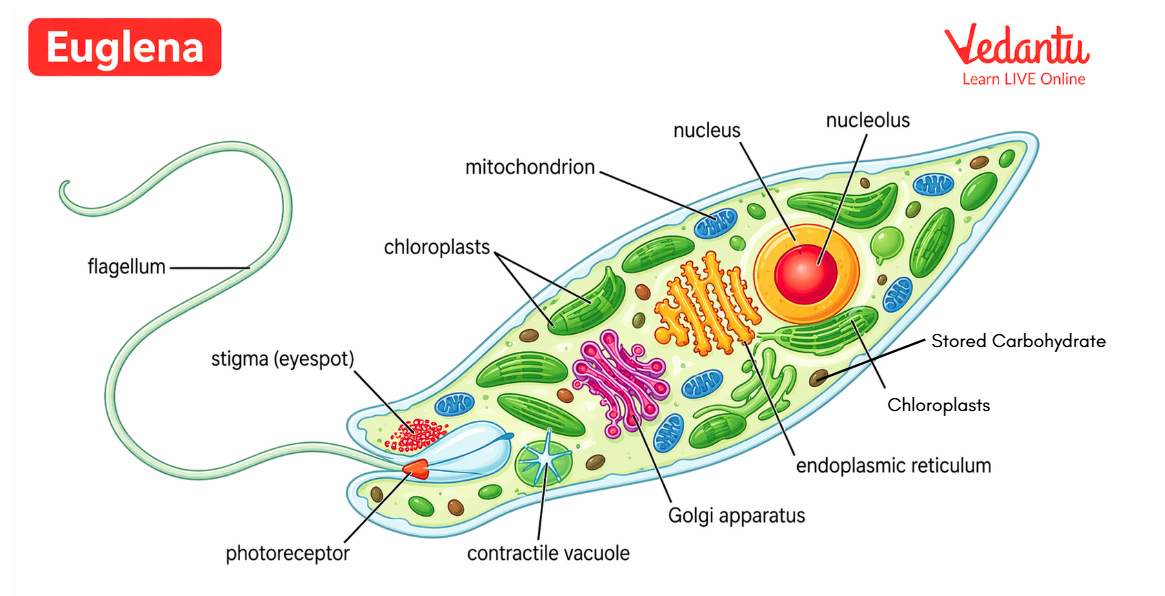
Euglena Diagram Explanation
A good euglena diagram usually labels the major parts of the organism and helps students understand how a single cell can perform many complex functions.
A labelled euglena diagram generally includes:
flagellum
eyespot or stigma
pellicle
chloroplast
nucleus
contractile vacuole
reservoir
cytoplasm
paramylon bodies or stored food region
1. Flagellum
This is the long thread-like structure that helps in locomotion.
2. Eyespot
Also called the stigma, it helps detect light.
3. Chloroplasts
These are the sites of photosynthesis.
4. Pellicle
This gives shape and flexibility.
5. Contractile Vacuole
This removes excess water.
Euglena Characteristics
The main euglena characteristics include a combination of structural and functional features that make it distinct from many other protists.
unicellular organism
eukaryotic cell structure
elongated body
flexible pellicle instead of cellulose wall
one nucleus
chloroplasts present in many forms
contractile vacuole for osmoregulation
flagellum for movement
eyespot for light detection
both autotrophic and heterotrophic nutrition
asexual reproduction by binary fission
Nutrition in Euglena
Nutrition in Euglena is one of its most interesting features. Euglena contains chloroplasts with chlorophyll and performs photosynthesis. This means it can prepare food in the presence of light like green plants. The chloroplasts are believed to be of green algal origin and likely acquired through an endosymbiotic relationship.
However, photosynthesis is not its only mode of nutrition.
1. Heterotrophic Nutrition
Some species of Euglena are heterotrophic. Even photosynthetic forms may lose chlorophyll when grown in the dark and then obtain nutrients from organic matter. Heterotrophic species may:
absorb organic compounds from surrounding water
engulf bacteria and protists by phagocytosis within food vacuoles
2. Storage Food
In Euglena, food is stored in the form of paramylon, which is a β-1,3 polymer of glucose. The chloroplast contains pyrenoids, which help in the synthesis of paramylon. This stored food provides energy when there is no light.
Why is Euglena Called Mixotrophic?
Euglena is called mixotrophic because it shows both autotrophic and heterotrophic modes of nutrition. In light, it performs photosynthesis. In darkness or in chlorophyll-deficient conditions, it can feed on organic matter.
This mixed nutrition is the main reason why Euglena is so often used as an example when teaching biological classification and adaptation.
Locomotion in Euglena
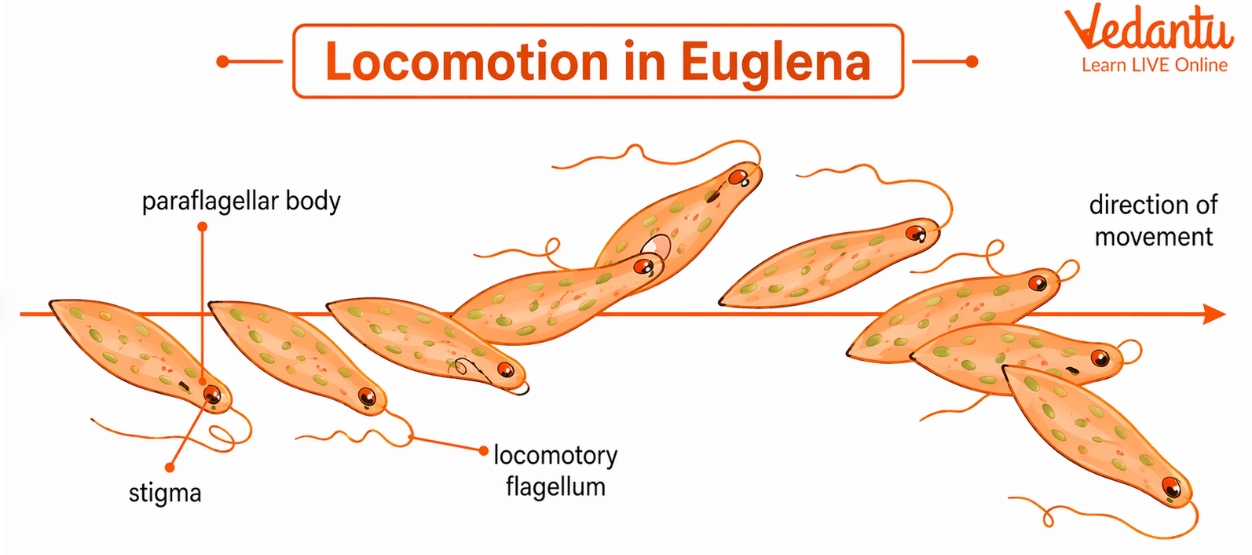
Locomotion is another major feature of Euglena. It moves with the help of flagella.
Usually, Euglena has one or two flagella. In most cases, two flagella arise from a small reservoir inside the cell. One is short and does not project outside the cell, while the longer flagellum protrudes out and is used for swimming.
This flagellar movement allows Euglena to change location, respond to stimuli, and search for suitable environmental conditions. Locomotion makes Euglena appear animal-like in behaviour.
Eyespot and Phototaxis
Euglena has an eyespot, also called the stigma, which contains photoreceptors. It helps detect light and plays a key role in phototaxis, or movement in response to light. The light detected by the eyespot is focused on the paraflagellar body. This adaptation helps Euglena move toward light when photosynthesis is needed.
Reproduction in Euglena
Euglena reproduces asexually by binary fission, and the division occurs longitudinally. This means the cell splits lengthwise to produce daughter cells.
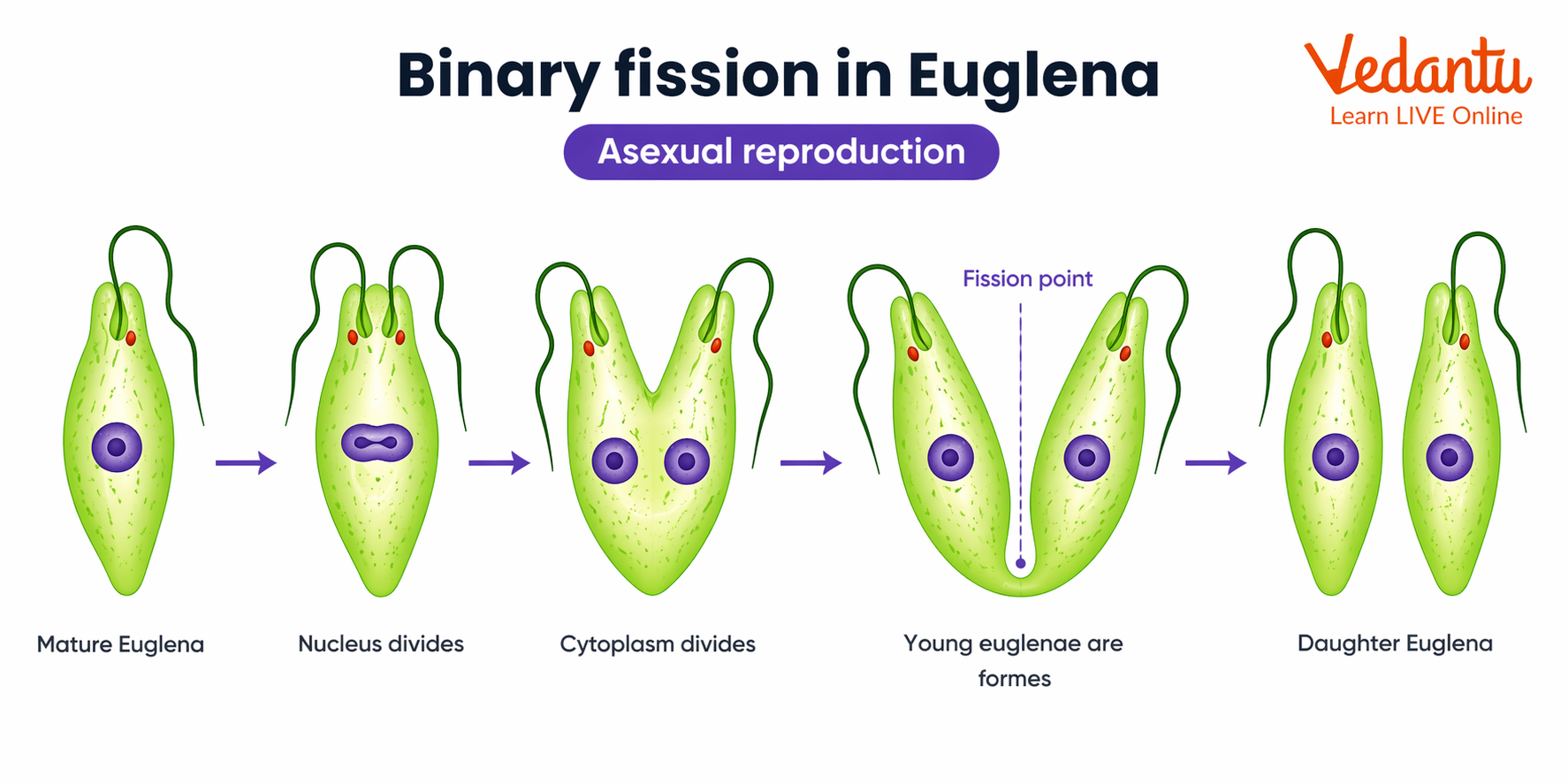
reproduction is asexual
binary fission is longitudinal
one parent cell gives rise to daughter cells
favourable conditions promote active division
This simple reproductive process helps Euglena multiply rapidly under suitable environmental conditions.
Palmelloid Stage and Cyst Formation
The life cycle of Euglena may include both a free-swimming stage and a non-motile stage. Under unfavourable conditions, Euglena can form a thick-walled protective cyst. This cyst helps it survive stress.
Some euglenoids gather together, lose their flagella, and become enclosed in a gelatinous material. Individual Euglena then form reproductive cysts that produce daughter cells by binary fission. When conditions improve, these cells become flagellated again and emerge. This stage is known as the palmelloid stage.
Plant-Like and Animal-Like Features of Euglena
Euglena is famous because it shows both plant-like and animal-like features.
Plant-Like Features
chloroplasts present
chlorophyll present
photosynthesis occurs in light
food stored as paramylon
Animal-Like Features
no cellulose cell wall
movement by flagellum
heterotrophic nutrition possible
phagocytosis in some forms
phototactic behaviour
This combination is exactly why Euglena is so important in discussions of Protista and evolutionary biology.
Importance of Euglena
Euglena is important not only in biology teaching but also in ecological and commercial contexts.
Biological Importance
helps explain Protista
shows mixed nutritional modes
demonstrates adaptation in unicellular organisms
useful in teaching structure-function relationships
Commercial and Scientific Importance
Some species are cultivated for large-scale production of paramylon in countries such as Japan. Some species have also been found to contain vitamin E and high levels of astaxanthin. On the other hand, some species produce an alkaloid called euglenophycin, which can kill fish.
So, Euglena has importance in both ecology and applied biology.
Related Internal Links for NEET Biology Practice
Amoeba – Compare protist structures in NEET MCQs.
Protista – Detailed kingdom context for Euglena classification.
Plant Cell – Understand differences in cell wall and storage.
Cell Structure and Function – Reinforces NEET cell biology fundamentals.
Unicellular Organisms – Broad context for single-celled life.
Photosynthesis Process – Connects chloroplast function from Euglena.
Nucleus – Review eukaryotic cell features for classification.
Difference Between Plant and Animal Cell – Clarifies Euglena’s unique mixotrophic features.
Five Kingdoms Classification – Taxonomic context in MCQs.
Kingdom Animalia Classification – Avoids misclassification in NEET exams.
FAQs on Euglena: Classification, Structure, Characteristics, Diagram and Life Processes
1. Is a Euglena a plant or animal?
Euglena is neither a true plant nor a true animal. It is a protist that shows both plant-like and animal-like features.
2. What is a Euglena simple definition?
Euglena is a single-celled, flagellated protist that can make its own food by photosynthesis and can also feed like an animal when needed.
3. Is an Euglena a protozoan?
Euglena was earlier grouped with protozoans because it moves with a flagellum, but it is now generally placed under Protista as a euglenoid.
4. What is the function of the Euglena?
Euglena helps in:
photosynthesis using chloroplasts
movement using a flagellum
light detection using the eyespot
osmoregulation using the contractile vacuole
survival in changing conditions through mixed nutrition
5. What is the function of the Euglena?
The main functions of Euglena are to:
make food by photosynthesis
move with the help of a flagellum
detect light through the eyespot
remove excess water with the contractile vacuole
take in organic food when light is absent
6. What are 5 characteristics of Euglena?
Five important characteristics of Euglena are:
unicellular
eukaryotic
has a flagellum
contains chloroplasts
has a flexible pellicle instead of a cell wall
7. What is another name for Euglena?
Euglena is often called a plant-animal because it shows characteristics of both plants and animals.
8. How is a Euglena classified?
Euglena is classified as:
Kingdom: Protista
Group: Euglenoids
Phylum: Euglenozoa
9. Why is Euglena important?
Euglena is important because it:
acts as a producer in aquatic ecosystems
can also behave as a heterotroph
helps in studying classification and evolution
is useful in some commercial and health-related applications
10. What is the special character of Euglena?
The special character of Euglena is that it has a flexible pellicle and shows both autotrophic and heterotrophic nutrition.
11. What are the benefits of Euglena?
Euglena is useful because it can provide:
antioxidants
omega-3 fatty acids
vitamins A, C, and E
paramylon, which is studied for health benefits
