



Class 9 Maths Chapter 2 Exercise 2.6: Exploring Linear Polynomials


Question 1.
Draw the graphs of the following sets of lines. In each case, reflect on the role of ‘a’ and ‘b’.
(i) y = 4x, y = 2x, y = x
Solution:
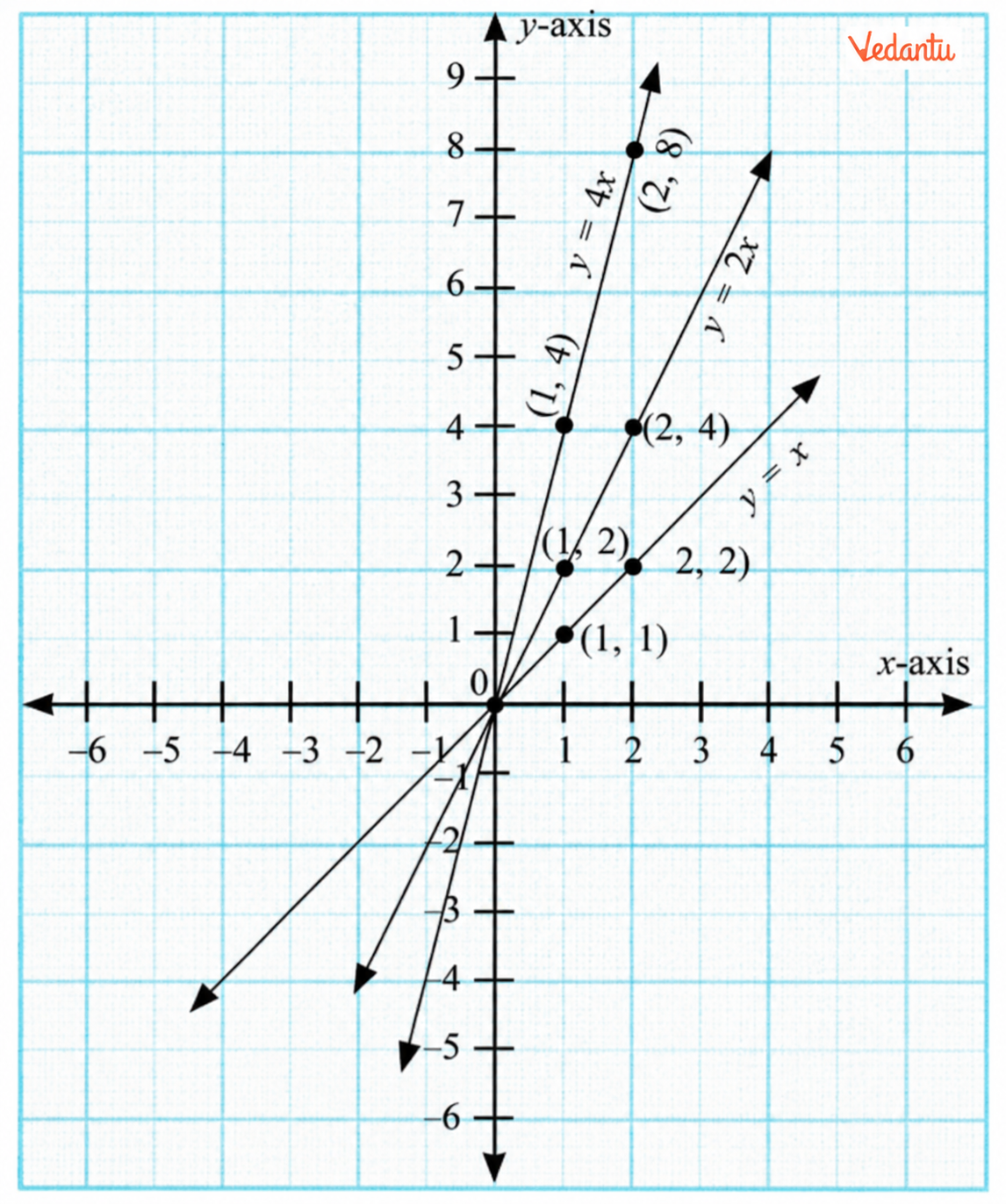
The given equations are y = 4x, y = 2x, and y = x.
All three equations are in the form y = ax, where b = 0.
Observation:
All the lines pass through the origin (0, 0) because b = 0. The value of a determines how steep the line is. A greater value of a gives a steeper line. So, y = 4x is the steepest, followed by y = 2x and then y = x.
(ii) y = – 6x, y = – 3x, y = – x
Solution:
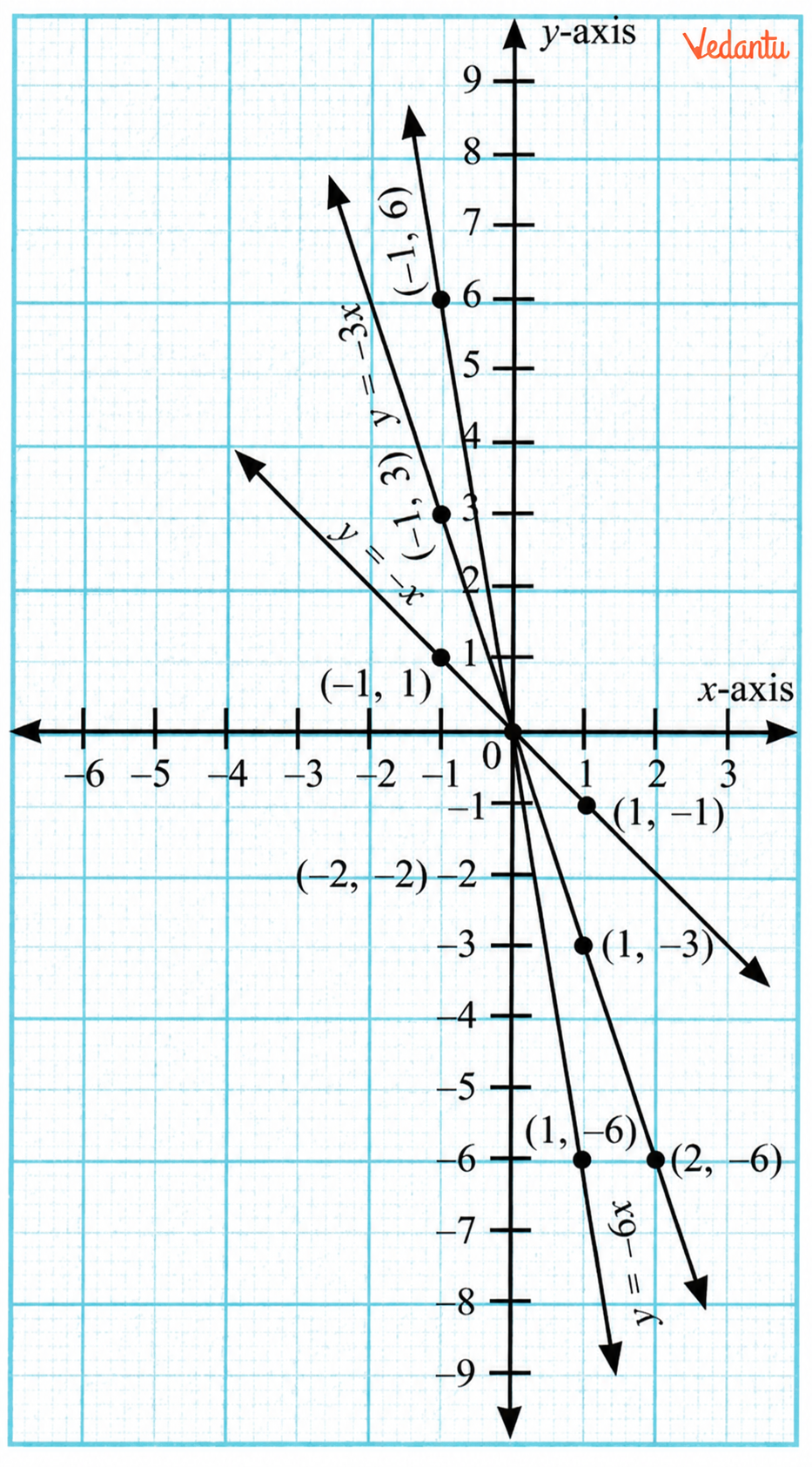
The given equations are y = -6x, y = -3x, and y = -x.
All three equations are in the form y = ax, where b = 0 and a is negative.
Observation:
All the lines pass through the origin because b = 0. Since the value of a is negative, all the lines slope downward from left to right. The greater the magnitude of a, the steeper the downward slope. So, y = -6x is the steepest, followed by y = -3x and then y = -x.
(iii) y = 5x, y = -5x
Solution:
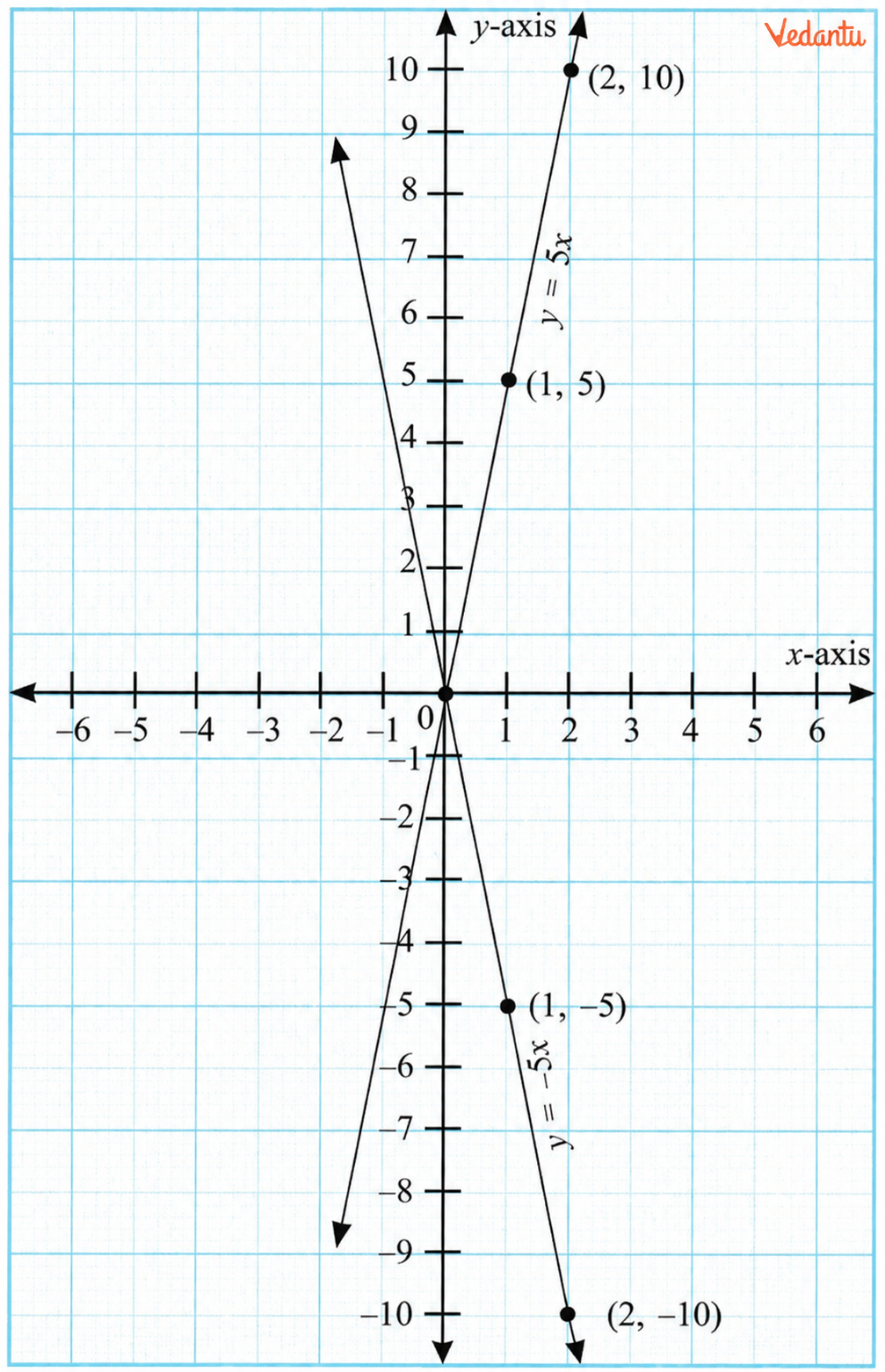
The given equations are y = 5x and y = -5x.
Both equations are in the form y = ax, where b = 0.
Observation:
Both lines pass through the origin because their y-intercept is 0. The line y = 5x slopes upward from left to right, while y = -5x slopes downward from left to right. Since the magnitude of a is the same in both equations, the two lines have equal steepness but in opposite directions.
(iv) y = 3x – 1, y = 3x, y = 3x + 1
Solution:
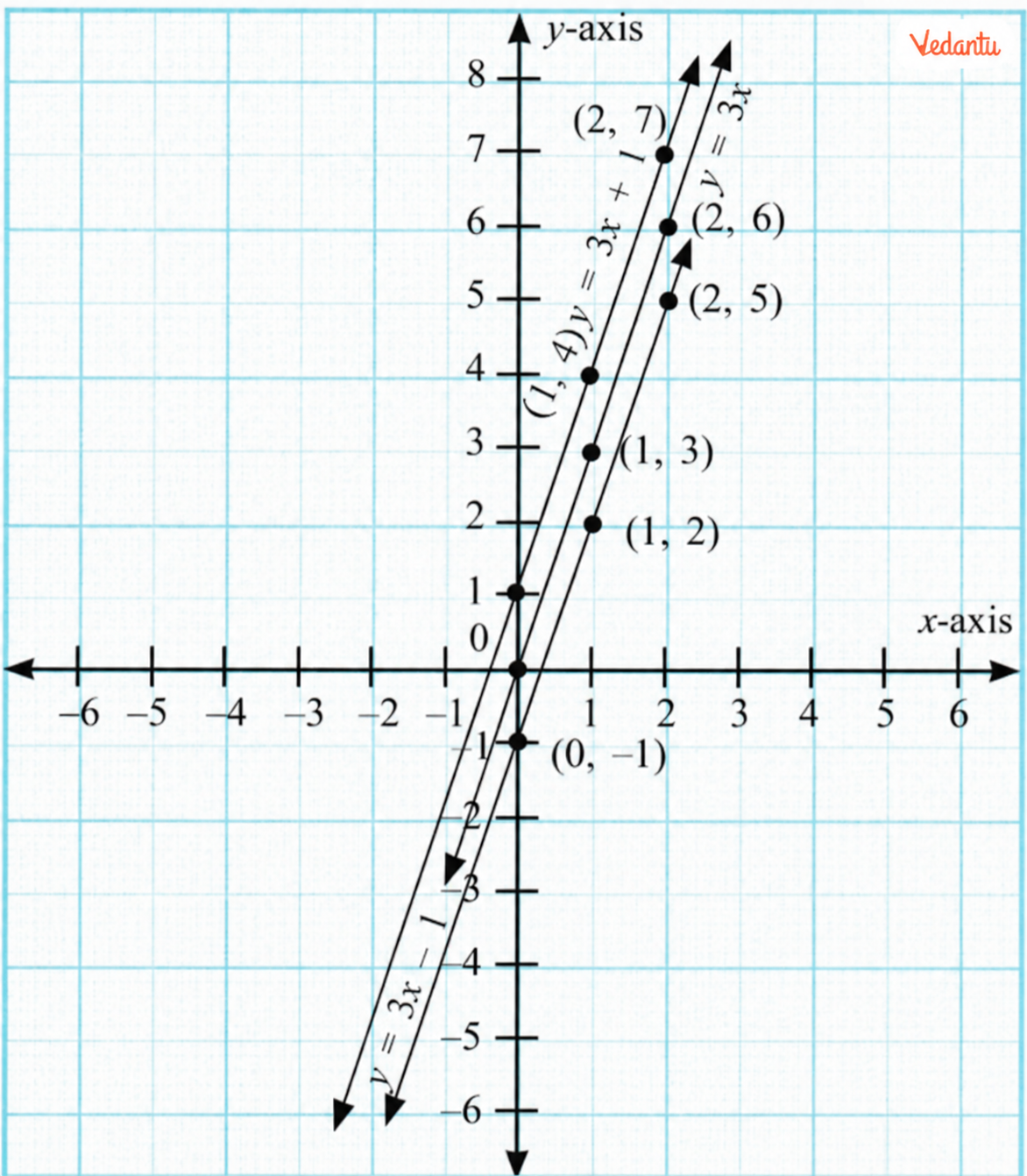
The given equations are y = 3x - 1, y = 3x, and y = 3x + 1.
All three equations have the same value of a 3.
Observation:
Since all three lines have the same slope, they are parallel. The value of b decides where the line cuts the y-axis. For y = 3x - 1, the line cuts the y-axis at -1. For y = 3x, it passes through the origin. For y = 3x + 1, the line cuts the y-axis at 1. Thus, changing b shifts the line up or down without changing its slope.
(v) y = -2x – 3, y = -2x, y = 2x + 3
Solution:
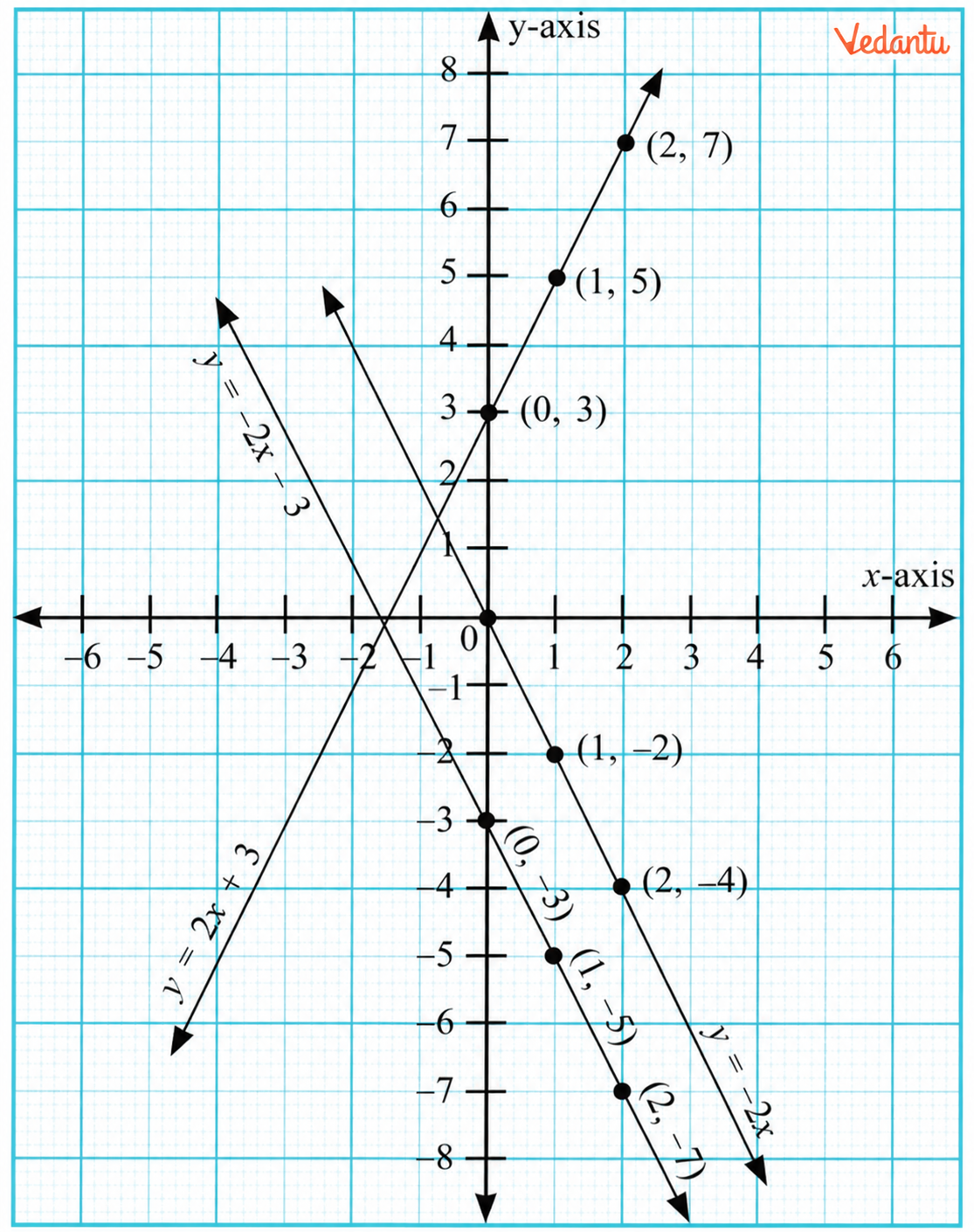
The given equations are y = -2x - 3, y = -2x, and y = 2x + 3.
Observation:
The equations y = -2x - 3 and y = -2x have the same slope (- 2). So, their graphs are parallel lines. The only difference is the value of b, which changes the position of the line on the y-axis.
The equation y = 2x + 3 has a positive slope, so its graph rises from left to right. This line has a different direction from the first two lines.
Conclusion:
The value of a, the coefficient of x, decides the slope, steepness, and direction of the line.
The value of b, the constant term, decides the vertical shift and the point where the line cuts the y-axis.
Think and Reflect (NCERT Textbook Page No. 28)
Identify other points on the line by completing the following table.
Solution:
The equation of the straight line is y = 2x + 1.
When x = 2:
y = 2(2) + 1 = 5
When x = 5:
y = 2(5) + 1 = 11
When x = 9:
y = 2(9) + 1 = 19
When x = 12:
y = 2(12) + 1 = 25
When x = 20:
y = 2(20) + 1 = 41
So, the corresponding points are (2, 5), (5, 11), (9, 19), (12, 25), and (20, 41).
Think and Reflect (NCERT Textbook Page No. 33)
Differentiate between the graphs of the equations y = 3x + 1, and y = –3x + 1
Solution:
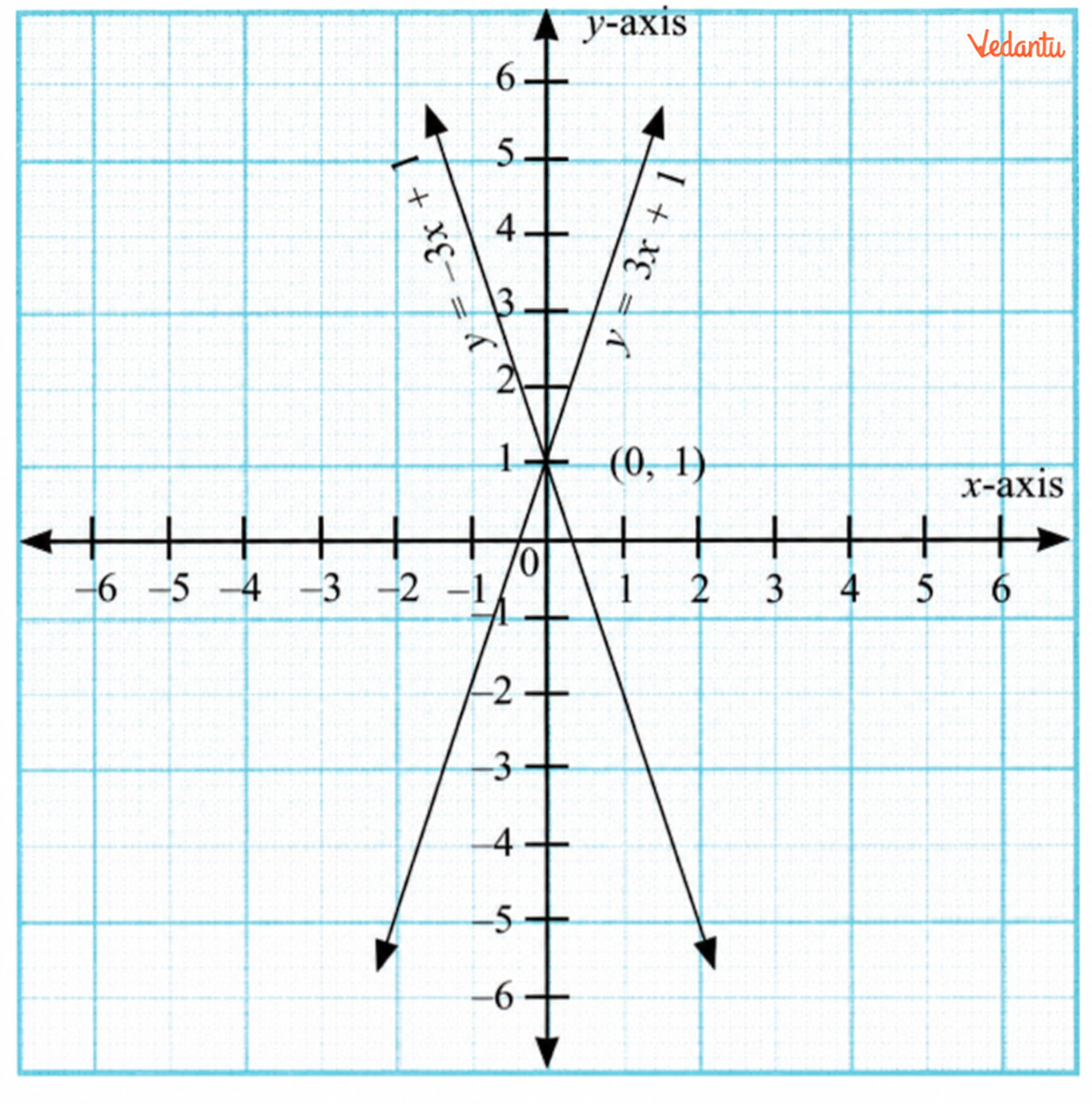
Both y = 3x + 1 and y = -3x + 1 represent straight lines, but their slopes are different.
For y = 3x + 1, the slope is positive. This means the line rises from left to right.
For y = -3x + 1, the slope is negative. This means the line falls from left to right.
Both lines have the same y-intercept, 1, because both pass through the point (0, 1). However, one line slopes upward, while the other slopes downward.
Think and Reflect (NCERT Textbook Page No. 35)
Does this help you to conclude anything about the linear equation y = ax + b when a is fixed but b varies?
Solution:
Yes. In the equation y = ax + b, if a stays fixed and b changes, the slope of the line stays the same. This means the lines are parallel to each other. Only their position changes because the value of b shifts the line up or down on the graph.
Key Takeaways from Vedantu’s Class 9 Maths Chapter 2 Exercise 2.6
Learn how to represent linear equations in the form y = ax + b on a graph.
See how the value of a changes the direction and steepness of a line.
Understand the role of b in deciding the y-intercept of a graph.
Identify parallel lines by comparing their slopes.
Use given x-values to calculate corresponding y-values and plot points.
Distinguish between graphs with positive and negative slopes.
Observe how changing b moves a line upward or downward while keeping its slope unchanged.
Build a clear connection between an equation and the straight-line graph it represents.
Access Exercise Wise NCERT Solutions for Chapter 2 Maths Class 9
CBSE Class 9 Maths Chapter 2 Introduction to Linear Polynomials Other Study Materials
Additional Study Materials for Class 9 Maths
FAQs on NCERT Solutions for Class 9 Maths Chapter 2 Exercise 2.6 (2026-27)
1. What does the value of a tell us about the graph of a linear equation?
The value of a determines the slope of the line. It tells us whether the line rises or falls and how steep it is.
2. Why does the graph of y = 4x look steeper than y = x?
Both lines pass through the origin, but their slopes are different. Since 4 is greater than 1, y = 4x has a steeper slope than y = x.
3. How can you tell the direction of a line from its equation?
Check the sign of a in y = ax + b. A positive a means the line rises from left to right, while a negative a means it falls.
4. Why do the graphs of y = 5x and y = -5x have the same steepness?
Their slopes have the same magnitude, 5, but opposite signs. So the lines have the same steepness but point in opposite directions.
5. What happens when b changes but a remains the same?
The slope does not change, so the lines remain parallel. Changing b only shifts the line up or down.
6. How do you identify parallel lines from equations in Exercise 2.6?
Compare the coefficients of x. If two different linear equations have the same coefficient of x, their graphs have the same slope and are parallel.
7. How can a table help in drawing a linear graph?
A table gives corresponding x and y values. You can plot these ordered pairs on the coordinate plane and join them to form a straight-line graph.
8. What points are obtained for x = 9 and x = 12 in the table of Exercise 2.6?
Using y = 2x + 1, when x = 9, y = 19, giving the point (9, 19). When x = 12, y = 25, giving the point (12, 25).
9. Why do y = 3x + 1 and y = -3x + 1 intersect at the same y-axis point?
Both equations have b = 1. Therefore, both graphs pass through the same y-intercept, (0, 1), even though their slopes are opposite.
10. What is the role of b when drawing the graph of y = ax + b?
The value of b determines the y-intercept. It tells us where the graph crosses the y-axis.
11. What is the main idea covered in Class 9 maths chapter 2 exercise 2.6 solutions?
The exercise mainly helps students understand how a linear equation behaves on a graph by comparing its slope, y-intercept, direction, and position.
12. How does Class 9 Maths NCERT Solutions Chapter 2 Exercise 2.6 help with graph-based questions?
They make it easier to connect the equation with its graph and understand how changes in a or b affect the resulting line.
13. What should I observe when comparing two linear graphs?
Look at their slopes and y-intercepts. The slope shows the direction and steepness, while the y-intercept shows where the line crosses the y-axis.
14. Why is Exercise 2.6 important in Class 9 Maths Chapter 2?
It helps students move from simply working with linear equations to understanding them visually through graphs and coordinate points.
15. Where can I find Class 9 Maths Chapter 2 Exercise 2.6 solutions?
The Class 9 Maths Chapter 2 solutions for Exercise 2.6 are available on this Vedantu page, including the graph-based questions, table activity, and Think and Reflect questions.
