


Class 7 Maths Ganita Prakash II Chapter 1 Geometric Twins Solutions
1.1 Geometric Twins
Figure It Out (Pages 3-4)
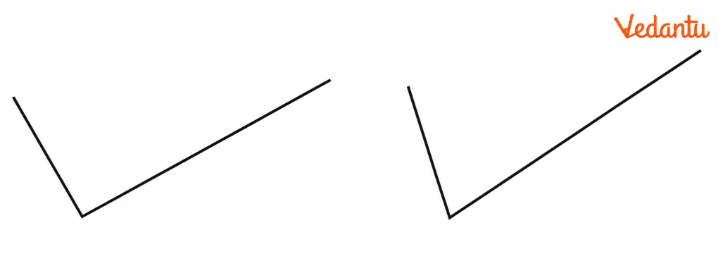
Question 1. Check if the two figures are congruent.
Answer:
Measure the corresponding angles in both figures using a protractor.
We find that:
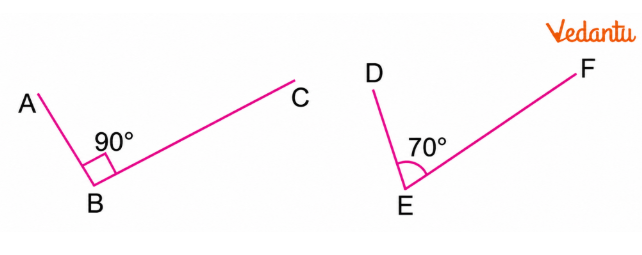
∠ABC does not coincide with ∠DEF.
Therefore, the two given figures are not congruent.
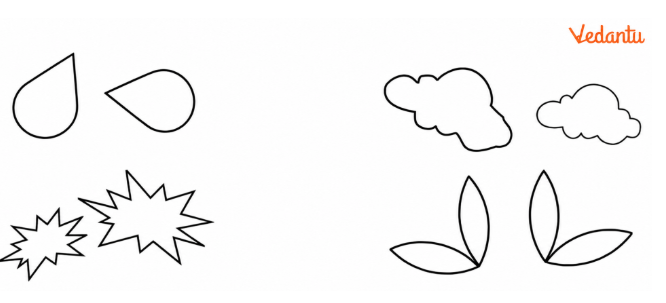
Question 2. Circle the pairs that appear congruent.
Answer:
Pairs (a) and (d) are congruent because the figures in each pair have the same shape and size. You can place them exactly over each other.
Question 3. What measurements would you take to create a figure congruent to a given:
(a) Circle
(b) Rectangle
Using this, state how you would check if two
(a) Are circles congruent?
(b) Rectangles are congruent?
Answer:
(a) Circle: Measure the radius or diameter of the given circle. To check whether two circles are congruent, compare their radii. If their radii are equal, the circles are congruent.
(b) Rectangle: Measure the length and breadth of the given rectangle. To check whether two rectangles are congruent, compare their corresponding lengths and breadths. If both measurements are equal, the rectangles are congruent.
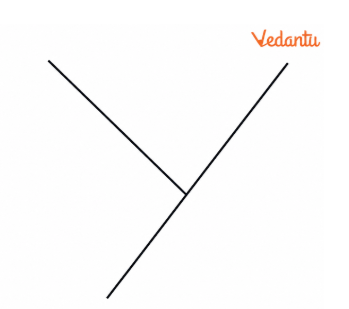
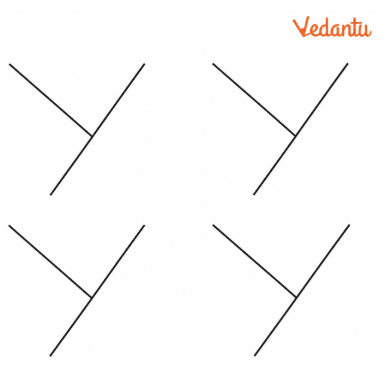
Question 4. How would we check if two figures like the one below are congruent?
Use this to identify whether each of the following pairs is congruent.
Answer:
To check whether the figures are congruent, compare the lengths of their corresponding line segments and the angle between them.
In the given figures:
Horizontal line segment = 3.3 cm
Vertical line segment = 2.3 cm
Angle between the line segments = 82°
Since the corresponding measurements are equal, the given figures are congruent.
1.2 Congruence of Triangles
Figure It Out (Pages 8-9)
Question 1. Suppose ∆HEN is congruent to ∆BIG. List all the other correct ways of expressing this congruence.
Answer:
Given:
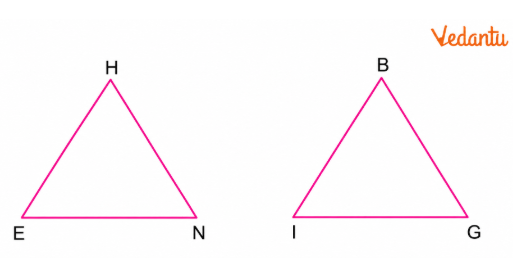
∆HEN ≅ ∆BIG
The corresponding vertices are:
H ↔ B
E ↔ I
N ↔ G
Keeping the corresponding vertices in the correct order, the other five ways of expressing the congruence are:
(i) ∆HNE ≅ ∆BGI
(ii) ∆EHN ≅ ∆IBG
(iii) ∆ENH ≅ ∆IGB
(iv) ∆NHE ≅ ∆GBI
(v) ∆NEH ≅ ∆GIB
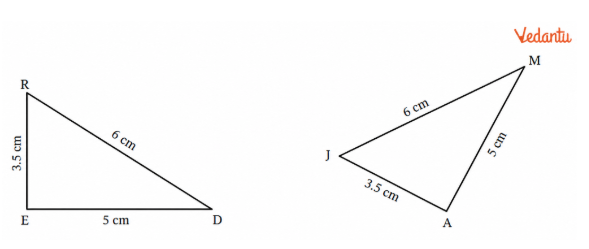
Question 2. Determine whether the triangles are congruent. If yes, express the congruence.
Answer:
From the given figure:
RE = JA = 3.5 cm
ED = AM = 5 cm
RD = JM = 6 cm
All three corresponding sides are equal.
Therefore, by the SSS congruence condition:
∆RED ≅ ∆JAM
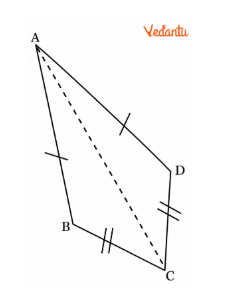
Question 3. In the figure below, AB = AD, CB = CD. Can you identify any pair of congruent triangles? If yes, explain why they are congruent. Does AC divide ∠BAD and ∠BCD into two equal parts? Give reasons.
Answer:
Consider ∆ABC and ∆ADC.
Given:
AB = AD
CB = CD
AC = AC (common side)
Thus, all three corresponding sides are equal.
Therefore, by the SSS congruence condition:
∆ABC ≅ ∆ADC
Since corresponding angles of congruent triangles are equal:
∠BAC = ∠DAC
and
∠BCA = ∠DCA
Therefore, AC bisects ∠BAD and ∠BCD.
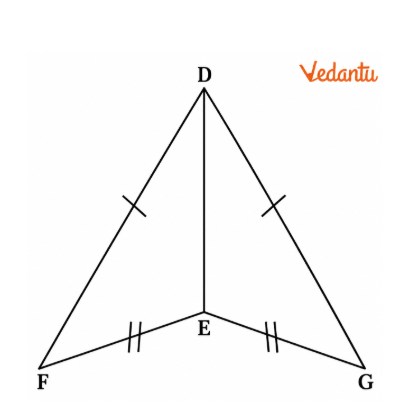
Question 4. In the figure below, are ∆DFE and ∆GED congruent to each other? Given that DF = DG and FE = GE.
Answer:
Given:
DF = DG
FE = GE
DE = DE (common side)
Therefore, by the SSS congruence condition:
∆DFE ≅ ∆DGE
However, ∆DFE cannot be written as congruent to ∆GED because the corresponding vertices are not written in the correct order.
Hence, the correct congruence is:
∆DFE ≅ ∆DGE
Figure It Out (Pages 13-14)
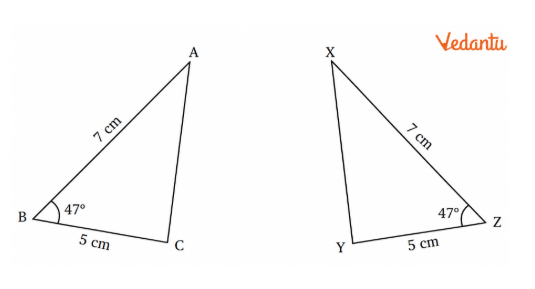
Question 1. Identify whether the triangles below are congruent. What conditions did you use to establish their congruence? Express the congruence.
Answer:
From the given figure:
BC = ZY = 5 cm
BA = ZX = 7 cm
∠ABC = ∠XZY = 47°
Here, two corresponding sides and the included angle are equal.
Therefore, by the SAS congruence condition:
∆ABC ≅ ∆XZY
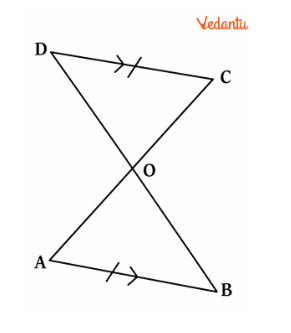
Question 2. Given that CD and AB are parallel, and AB = CD, what are the other equal parts in this figure?
(Hint: When the lines are parallel, the alternate angles are equal. Are the two resulting triangles congruent? If so, express the congruence.)
Answer:
Given:
CD ∥ AB
AB = CD
Since CD ∥ AB:
∠OCD = ∠OAB
∠ODC = ∠OBA
These are alternate interior angles.
Therefore, the two triangles are congruent.
∆AOB ≅ ∆COD
Hence, the other corresponding equal parts are:
OA = OC
OB = OD
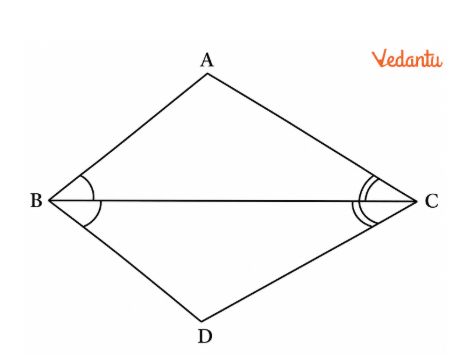
Question 3. Given that ∠ABC = ∠DBC and ∠ACB = ∠DCB, show that ∠BAC = ∠BDC. Are the two triangles congruent?
Answer:
Consider ∆ABC and ∆DBC.
Given:
∠ABC = ∠DBC
∠ACB = ∠DCB
BC = BC (common side)
Therefore, by the ASA congruence condition:
∆ABC ≅ ∆DBC
Since corresponding parts of congruent triangles are equal:
∠BAC = ∠BDC
Hence, the two triangles are congruent.
Question 4. Identify the equal parts in the following figure, given that ∠ABD = ∠DCA and ∠ACB = ∠DBC.
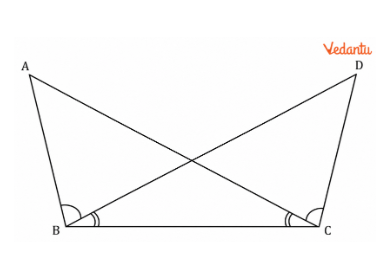
Answer:
Given:
∠ABD = ∠DCA
∠ACB = ∠DBC
Also:
∠AOB = ∠DOC
because they are vertically opposite angles.
Therefore, the triangles are congruent by ASA.
∆AOB ≅ ∆DOC
Hence:
AO = DO
BO = CO
1.3 Angles of Isosceles and Equilateral Triangles
Figure It Out (Pages 20-21)
Question 1. ∆AIR ≅ ∆FLY. Identify the corresponding vertices, sides, and angles.
Answer:
Given:
∆AIR ≅ ∆FLY
Corresponding vertices:
A ↔ F
I ↔ L
R ↔ Y
Corresponding sides:
AI ↔ FL
IR ↔ LY
AR ↔ FY
Corresponding angles:
∠A ↔ ∠F
∠I ↔ ∠L
∠R ↔ ∠Y
Question 2. Each of the following cases contains certain measurements taken from two triangles. Identify the pairs in which the triangles are congruent to each other, with reason. Express the congruence whenever they are congruent.
(a) AB = DE
BC = EF
CA = DF
(b) AB = EF
∠A = ∠E
AC = ED
(c) AB = DF
∠B = ∠D = 90°
AC = FE
(d) ∠A = ∠D
∠B = ∠E
AC = DF
(e) AB = DF
∠B = ∠F
AC = DE
Answer:
(a)
AB = DE
BC = EF
CA = FD
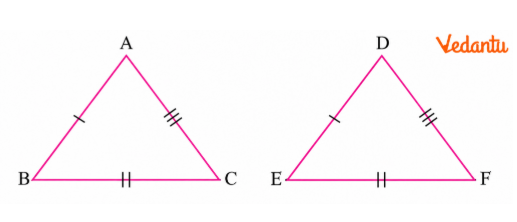
All three corresponding sides are equal.
Therefore, by the SSS congruence condition:
∆ABC ≅ ∆DEF
(b)
AB = EF
∠A = ∠E
AC = ED
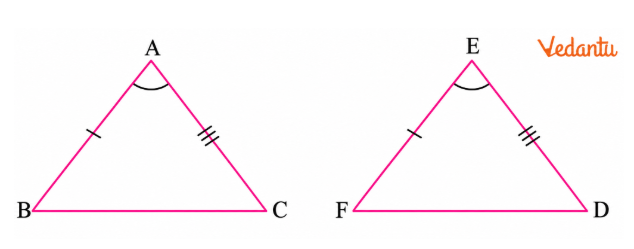
Two corresponding sides and the included angle are equal.
Therefore, by the SAS congruence condition:
∆ABC ≅ ∆EFD
(c)
AB = DF
∠B = ∠D = 90°
AC = FE
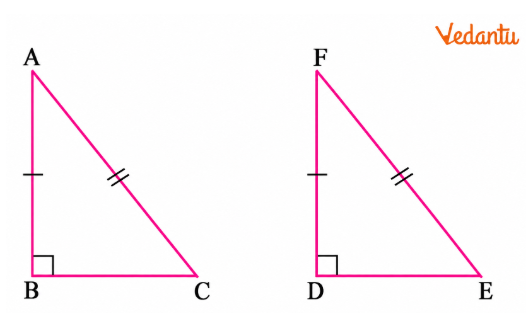
The triangles have equal right angles, equal hypotenuses and one equal corresponding side.
Therefore, by the RHS congruence condition:
∆ABC ≅ ∆FDE
(d)
∠A = ∠D
∠B = ∠E
AC = DF
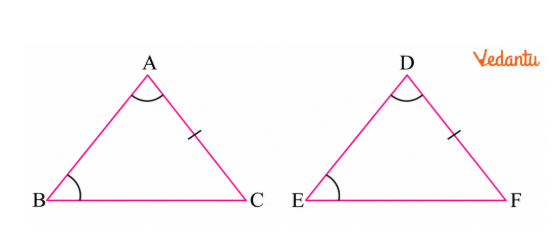
Two corresponding angles and one corresponding side are equal.
Therefore, by the AAS congruence condition:
∆ABC ≅ ∆DEF
(e)
AB = DF
∠B = ∠F
AC = DE
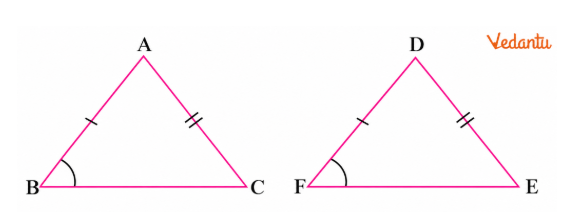
Here, two corresponding sides and a non-included angle are equal. This is the SSA condition, which is not a valid congruence condition.
Therefore, the two triangles need not be congruent.
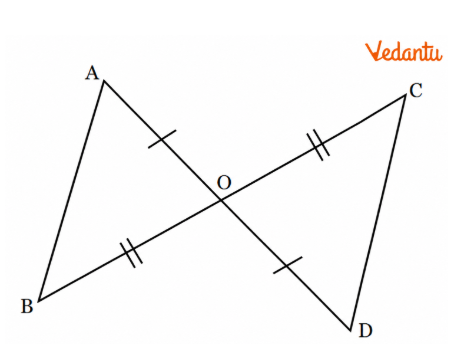
Question 3. Given OB = OC and OA = OD. Show that AB is parallel to CD.
[Hint: AD is a transversal for these two lines. Are there any equal alternate angles?]
Answer:
Consider ∆AOB and ∆DOC.
Given:
OB = OC
OA = OD
Also:
∠AOB = ∠DOC
because they are vertically opposite angles.
Therefore, by the SAS congruence condition:
∆AOB ≅ ∆DOC
Hence, corresponding angles are equal:
∠BAO = ∠CDO
These are alternate angles formed by transversal AD.
Therefore:
AB ∥ CD
Question 4. ABCD is a square. Show that ∆ABC ≅ ∆ADC. Is ∆ABC also congruent to ∆CDA?
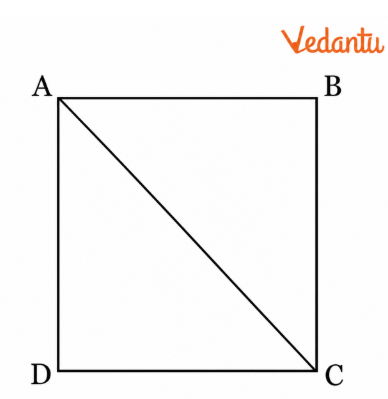
Give more examples of two triangles where one triangle is congruent to the other in two different ways, as in the case above. Can you give an example of two triangles where one is congruent to the other in six different ways?
Answer:
Since ABCD is a square:
AB = AD
BC = DC
AC = AC (common side)
Therefore, by the SSS congruence condition:
∆ABC ≅ ∆ADC
Now, compare ∆ABC and ∆CDA.
AB = CD
BC = DA
AC = CA
Therefore, by the SSS congruence condition:
∆ABC ≅ ∆CDA
Hence, ∆ABC is congruent to ∆ADC and ∆CDA.
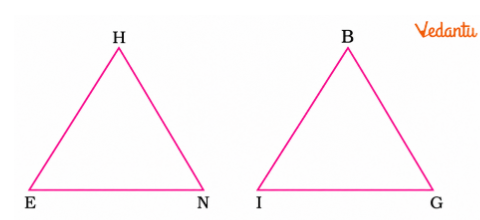
For example, consider two congruent equilateral triangles. Since their sides and angles are equal, any vertex of one triangle can correspond to any vertex of the other.
If ∆ABC and ∆DEF are congruent equilateral triangles, the six possible congruence statements are:
∆ABC ≅ ∆DEF
∆ABC ≅ ∆DFE
∆ABC ≅ ∆EDF
∆ABC ≅ ∆EFD
∆ABC ≅ ∆FDE
∆ABC ≅ ∆FED
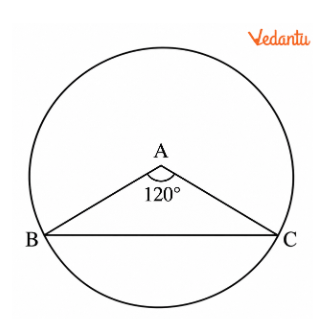
Question 5. Find ∠B and ∠C, if A is the centre of the circle.
Answer:
Since A is the centre of the circle:
AB = AC
because both are radii of the same circle.
Therefore, ∆ABC is an isosceles triangle.
So:
∠B = ∠C
Let:
∠B = ∠C = x
Given:
∠A = 120°
Using the angle sum property of a triangle:
x + x + 120° = 180°
2x = 60°
x = 30°
Therefore:
∠B = 30°
∠C = 30°
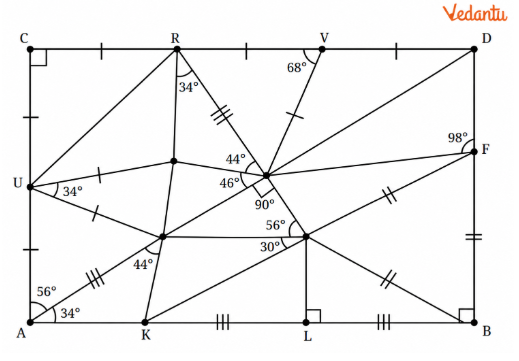
Question 6. Find the missing angles. Following the convention we have been using, all line segments marked with a single ‘|’ are equal to each other, and those marked with a double ‘|’ are equal to each other, etc.
Answer:
In ∆CUR:
Since CU = CR:
∠CUR = ∠CRU
Let:
∠CUR = ∠CRU = x
Using the angle sum property:
x + x + 90° = 180°
2x = 90°
x = 45°
Therefore:
∠CUR = ∠CRU = 45°
In ∆VRN:
Since VR = VN:
∠VRN = ∠VNR
Let:
∠VRN = ∠VNR = a
Using the angle sum property:
a + a + 68° = 180°
2a = 112°
a = 56°
Therefore:
∠VRN = ∠VNR = 56°
In ∆AUP:
∠UAP = ∠UPA = 56°
Using the angle sum property:
56° + 56° + ∠AUP = 180°
∠AUP = 180° − 112°
∠AUP = 68°
In ∆BOF:
∆BOF is an equilateral triangle.
Therefore:
∠FOB = ∠FBO = ∠OFB = 60°
Now:
∠RVN + ∠DVN = 180°
68° + ∠DVN = 180°
∠DVN = 112°
In ∆VND:
Since VN = VD:
∠VND = ∠VDN
Let:
∠VND = ∠VDN = c
Then:
c + c + 112° = 180°
2c = 68°
c = 34°
Therefore:
∠VND = ∠VDN = 34°
In ∆OLB:
∠OBL = 90° − 60°
∠OBL = 30°
Also, LO ∥ BF and BO is a transversal.
Therefore:
∠LOB = 60°
In ∆OPN:
∠OPN + ∠PON + ∠PNO = 180°
∠OPN + 56° + 90° = 180°
∠OPN = 34°
Now:
∠APK + ∠KPO + ∠OPN = 180°
44° + ∠KPO + 34° = 180°
∠KPO = 102°
In ∆KPO:
∠KPO + ∠POK + ∠PKO = 180°
102° + 30° + ∠PKO = 180°
∠PKO = 48°
In ∆AKP:
∠KAP + ∠KPA + ∠AKP = 180°
34° + 44° + ∠AKP = 180°
∠AKP = 102°
Now:
∠AKP + ∠PKO + ∠OKL = 180°
102° + 48° + ∠OKL = 180°
∠OKL = 30°
In ∆KOL:
∠OKL + ∠OLK + ∠KOL = 180°
30° + 90° + ∠KOL = 180°
∠KOL = 60°
Also:
∆OKL ≅ ∆OBL
Therefore:
KL = LB
and
∠OLK = ∠OLB = 90°
Revise Geometric Twins Easily with Ganita Prakash II NCERT Solutions
Build a clear understanding of the important geometry concepts in Chapter 1 Geometric Twins of Ganita Prakash II.
Check your answers with the NCERT Solutions for Class 7 Chapter 1 Maths after attempting the questions on your own.
Understand geometric figures and their properties by carefully studying the diagrams given in the chapter.
Practise textbook questions and activities regularly to build confidence in solving geometry problems.
Use the NCERT Solutions for Class 7 Maths Chapter 1 PDF for quick and convenient revision.
Keep the NCERT Solutions for Class 7 Maths Chapter 1 PDF download handy to revise questions whenever needed.
Refer to the NCERT Solutions for Maths Class 7 Chapter 1 to clear doubts and prepare better for school assessments.
Important Study Material Links for Chapter 1: Geometric Twins
NCERT Solutions for Class 7 Maths Ganita Prakash I and II (New Syllabus)
Important Related Links for NCERT Class 7 Maths
FAQs on NCERT Solutions for Class 7 Maths Chapter 1 - Geometric Twins
1. Which textbook has Class 7 Maths Chapter 1 Geometric Twins?
Geometric Twins is Chapter 1 of NCERT Class 7 Maths Ganita Prakash II. The chapter introduces students to geometric figures and their relationships through diagrams, activities and reasoning-based questions.
2. What should I focus on while studying Class 7 Maths Chapter 1: Geometric Twins?
Focus on understanding the properties and relationships shown through different geometric figures. Study the diagrams carefully and understand why a particular step or property is used, rather than memorising the solution.
3. How should I solve the questions in Geometric Twins?
Read each question carefully, observe the figure, and identify the information given. Solve the problem step by step and write the mathematical reasoning clearly. After attempting it yourself, compare your method with the NCERT solution.
4. Are the exercises in Class 7 Maths Chapter 1 important for exams?
Yes. Practising the textbook questions helps students understand the chapter concepts and become familiar with different types of geometry problems. It can also improve accuracy and mathematical reasoning for school assessments.
5. Why are diagrams important in Geometric Twins?
Diagrams help students visualise geometric relationships and understand the information given in a question. Drawing and labelling figures correctly can also make many geometry problems easier to analyse and solve.
6. How can I improve my understanding of geometry in Class 7?
Practise drawing figures, identify their properties, and regularly solve different types of textbook questions. More importantly, understand the reason behind each step instead of learning solutions by heart.
7. Where can I get the PDF solutions for Class 7 Maths Chapter 1 Geometric Twins?
Students can access the chapter solutions online from Vedantu and use the PDF option for convenient practice and revision. The PDF can be useful for reviewing textbook questions, methods and answers before assessments.