






How Can Oceans And Continents Class 6 NCERT Questions And Answers Help In Exam Preparation
NCERT Solutions for Class 6 Social Science Chapter 2 Oceans and Continents helps students explore the world’s major landforms and water bodies, understanding their location and significance. This chapter discusses continents, oceans, and their roles in shaping global geography. Vedantu provides easy-to-understand explanations for each topic, ensuring students comprehend the key concepts thoroughly. Class 6 Social Science NCERT Solutions offer detailed answers to all questions, helping exam preparation and boosting understanding.
 Table of Content
Download the FREE PDF for Class 6 Social Science Chapter 2 Question Answers, prepared by Vedantu Master Teachers and aligned with the latest CBSE Class 6 Social Science Syllabus, for a more engaging learning experience.
Glance on Class 6 Social Science Chapter 2 Oceans and Continents
In this chapter, "Oceans and Continents," students explore the major landforms and water bodies that make up our planet.
It introduces the seven continents (Asia, Africa, North America, South America, Antarctica, Europe, and Australia) and the five oceans (Pacific, Atlantic, Indian, Southern, and Arctic).
Class 6 Social Science Chapter 2 emphasises the significance of these geographical features and their impact on global ecosystems.
Chapter 2 Oceans and Continents discusses the location, importance, and role of continents and oceans in shaping human activities and the natural world.
The chapter includes detailed explanations, illustrations, and questions to help students understand and retain key concepts.
THE BIG QUESTIONS?
1. What are oceans and continents? What are their names and their distribution?
Ans: Oceans are vast bodies of saltwater that cover about 71% of the Earth's surface, while continents are large landmasses that form the Earth's land area. There are five major oceans and seven continents.
Oceans: Pacific, Atlantic, Indian, Southern, and Arctic.
Continents: Asia, Africa, North America, South America, Antarctica, Europe, and Australia.
These oceans and continents are distributed across the Earth’s surface, with oceans surrounding and separating the continents.
2. In what ways do oceans and continents impact life on Earth, including human life?
Ans: Oceans regulate Earth's climate, support marine life, and provide resources such as fish and salt. They also serve as major transportation routes for global trade. Continents provide habitats for humans, plants, and animals, and contain natural resources like minerals, forests, and freshwater. Together, oceans and continents shape ecosystems, weather patterns, and human activities like agriculture, trade, and urban development.
LET’S EXPLORE
1. What are the circular lines in each map called? And do you know what the lines radiating out of the two poles are called?
Ans: The circular lines on the map are called parallels of latitude, which run parallel to the equator. The lines radiating out from the poles are known as meridians of longitude. They help in identifying the exact location of places on Earth.
2. Which hemisphere holds more water?
Ans: The Southern Hemisphere holds more water, as it has a greater area covered by oceans compared to the Northern Hemisphere.
3. What do you think could be the approximate proportion of water to land in the Northern Hemisphere? And in the Southern Hemisphere?
Ans: In the Northern Hemisphere, the proportion of water to land is approximately 60% water and 40% land. In the Southern Hemisphere, the proportion is around 80% water and 20% land.
4. Are all the oceans connected, or are there separations between them?
Ans: Yes, all the oceans are connected, forming a global oceanic system. However, they are traditionally divided into separate oceans based on geographical and historical distinctions.
THINK ABOUT IT
1. If there is such an abundance of water on the planet, why is there so much talk of ‘water scarcity’ or a ‘water crisis’?
Ans: Even though Earth has a vast amount of water, most of it is saltwater in oceans and not suitable for drinking or agriculture. Only a small portion of the Earth's water is freshwater, and much of that is locked in glaciers or underground. Factors such as pollution, overuse, climate change, and unequal distribution of water resources contribute to water scarcity in many regions, creating a ‘water crisis.’
What ways of saving water are you aware of? Which ones have you seen practised at home, at your school, and in your village, town, or city?
Ans: Some ways to save water include:
At home: Turning off taps when not in use, using buckets instead of hoses for washing, fixing leaks promptly.
At school: Installing water-saving devices, ensuring taps are closed properly, and rainwater harvesting.
In towns or cities: Rainwater harvesting, water recycling, using efficient irrigation methods like drip irrigation in agriculture, and public awareness campaigns to reduce water wastage.
LET’S EXPLORE
Locate the five oceans and, in the table below, mark the hemisphere or hemispheres they belong to.
Ans:
LET’S EXPLORE
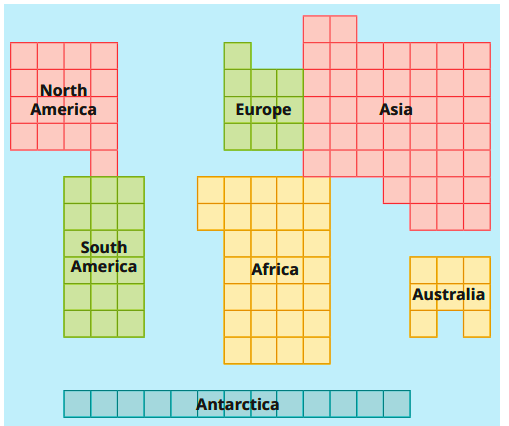
1. Counting the number of squares, name the largest continent and the smallest.
Ans:
The largest continent, based on the number of squares, is Asia.
The smallest continent is Australia.
2. Which one is larger — North America or South America? Africa or North America? Antarctica or Australia?
Ans:
North America is larger than South America.
Africa is larger than North America.
Antarctica is larger than Australia.
3. Re-colour the diagram by having a single colour for Europe and Asia and rename the result as ‘Eurasia’. Compare its size with South America’s.
Ans:
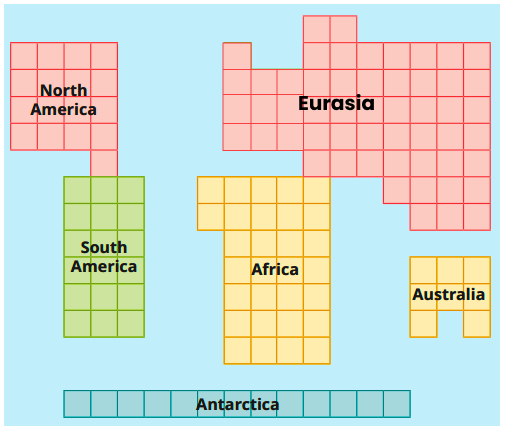
After combining Europe and Asia as ‘Eurasia’, it becomes significantly larger than South America.
Write down the list of continents from the smallest to the largest.
Ans:
From smallest to largest:
Australia
Europe
Antarctica
South America
North America
Africa
Asia (or Eurasia if combined with Europe)
Questions, activities, and projects
1. Explain the following terms:
(a) Continent:
Ans: A continent is a large, continuous landmass that forms a major part of the Earth's surface. There are seven continents on Earth: Asia, Africa, North America, South America, Antarctica, Europe, and Australia. These land masses vary in size and are home to different countries, cultures, and ecosystems.
(b) Ocean:
Ans: An ocean is a vast body of saltwater that covers about 71% of the Earth's surface. Oceans are interconnected and play a crucial role in regulating the Earth's climate, supporting marine life, and providing resources like fish and minerals. The five major oceans are the Pacific, Atlantic, Indian, Southern, and Arctic.
(c) Island:
Ans: An island is a landmass that is surrounded by water. Islands can vary in size from small patches of land to large areas like Greenland. Some islands are formed by volcanic activity, while others may be the result of rising sea levels or erosion. Examples include Madagascar and the Hawaiian Islands.
2. Let us draw – Without looking at the maps in this chapter, draw the continents free hand on a sheet of paper and colour them. Then compare your drawing with the map of oceans and continents in the chapter.
Ans: Do it Yourself
3. Let us do – On the outline map of the world given below, label all the continents and oceans.
Ans: Do it Yourself

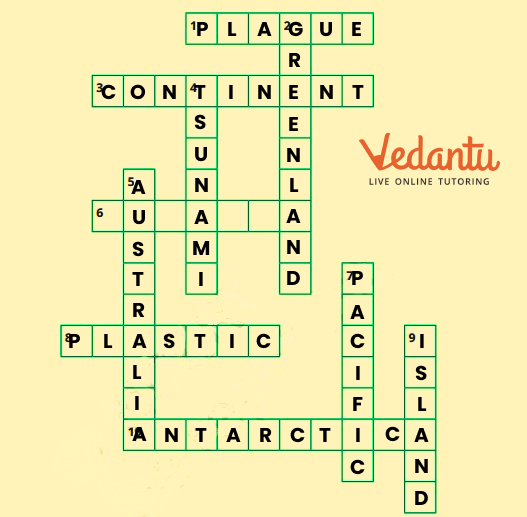
Across
1. Abundantly produced by the oceans
3. A large expanse of landmass
6. A large continent of which India is a part
8. A major source of pollution of the oceans
10. The coldest continent
Down
2. The largest island on Earth
4. A huge destructive wave from the ocean
5. The smallest continent
7. The largest body of water on the Earth
9. A landmass (but not a continent) surrounded by the sea or ocean
Ans:
Benefits of NCERT Solutions for Class 6 Social Science Chapter 2 Oceans and Continents
NCERT Solutions for Class 6 Social Science Chapter 2 Oceans and Continents provides clear and detailed explanations of key concepts, making it easier for students to understand the subject.
The solutions help students learn about the location and significance of continents and oceans in a simplified manner.
By offering answers to all textbook questions, Class 6 Social Science Chapter 2: Oceans and Continents helps in effective exam preparation.
The chapter encourages students to engage with world geography interactively.
These solutions help students develop important skills like map reading and spatial understanding.
NCERT Solutions for Class 6 Social Science Chapter 2 Oceans and Continents ensures a solid grasp of fundamental concepts for long-term retention.
Important Study Material Links for Social Science Chapter 2 Class 6
Conclusion
NCERT Solutions for Class 6 Social Science Chapter 2: Oceans and Continents offers comprehensive and easy-to-understand explanations, helping students grasp key concepts about the Earth's geography. These solutions ensure that students can effectively learn about the location, features, and significance of continents and oceans, while also developing essential map-reading skills. The detailed answers to textbook questions help in exam preparation and long-term retention of important information. With these solutions, students can build a strong foundation in geography, which will benefit them in higher studies.
Chapter-wise NCERT Solutions Class 6 Social Science
Related Important Links for Class 6 Social Science
Along with this, students can also download additional study materials provided by Vedantu for Social Science Class 6-

FAQs on NCERT Solutions For Class 6 Social Science Chapter 2 Oceans And Continents - 2026-27 Free PDF Download (Sign-in Required)
1. What are oceans and continents in simple terms?
Oceans are the vast water bodies that cover most of Earth's surface, while continents are the large land masses where people live. Understanding this basic geography helps students learn about Earth's structure and how different regions are connected. For example, the Pacific Ocean separates Asia from America, while the continent of Africa is surrounded by the Atlantic and Indian Oceans.
2. How many oceans are there on Earth according to NCERT Class 6?
There are five major oceans on Earth: Pacific, Atlantic, Indian, Southern, and Arctic Oceans. This classification is important for students studying world geography and understanding global weather patterns. The Pacific Ocean is the largest, covering about one-third of Earth's surface, while the Arctic Ocean is the smallest and coldest.
3. What are the seven continents mentioned in NCERT Solutions Class 6 Social Science Chapter 2?
The seven continents are Asia, Africa, North America, South America, Antarctica, Europe, and Australia. NCERT Solutions provide detailed explanations of each continent's location, size, and special features for comprehensive learning.
4. Which is the largest ocean and largest continent according to Class 6 SST?
The Pacific Ocean is the largest ocean, and Asia is the largest continent on Earth. These geographical facts help students understand the scale and distribution of land and water on our planet. The Pacific Ocean covers more area than all continents combined, while Asia houses over half of the world's population including countries like China and India.
5. How do oceans and continents affect climate and weather patterns?
Oceans regulate Earth's temperature by absorbing heat from the sun and distributing it through currents, while continents create different climate zones based on their location. This relationship is crucial for understanding seasonal changes, rainfall patterns, and why coastal areas have milder climates.
6. Where can students access free PDF of NCERT Solutions for oceans and continents chapter?
Students can download the free PDF of NCERT Solutions from Vedantu's official website and other educational platforms that provide authentic study materials. Having offline access to solutions helps students study without internet connectivity and prepare effectively for examinations. The PDF contains step-by-step answers to all textbook questions, additional practice problems, and clear explanations of geographical concepts.
7. What important features distinguish each continent from others?
Each continent has unique geographical features, climate patterns, cultures, and natural resources that make it distinct from others. Understanding these differences helps students appreciate global diversity and learn about various ecosystems worldwide.
8. How should students prepare answers for oceans and continents questions in Class 6 exams?
Students should focus on memorizing the names, locations, and key features of all oceans and continents while practicing map-based questions regularly. Effective preparation involves using NCERT textbooks, solving exercise questions, and referring to reliable study materials for comprehensive coverage.
9. Why do oceans and continents have different sizes and shapes?
Oceans and continents have different sizes and shapes due to geological processes like plate tectonics, volcanic activity, and erosion that occurred over millions of years. This scientific understanding helps students connect geography with Earth's history and natural processes.
10. What study tips help students remember all oceans and continents easily?
Using memory techniques like acronyms, visual maps, and regular practice helps students remember all oceans and continents effectively for exams. Creating mental connections between names and their characteristics makes memorization easier and more permanent.
