






What Are The Class 6 Social Science Chapter 6 NCERT Solutions for The Beginnings Of Indian Civilisation?
NCERT Solutions for Class 6 Social Science Chapter 6: The Beginnings of Indian Civilisation helps students understand the early stages of civilisation in India, focusing on the development of agriculture, trade, and urbanisation. This chapter discusses the influence of early civilisations on culture, social structures, and daily life in ancient India. Vedantu provides easy-to-understand explanations for each topic, ensuring students grasp these foundational concepts. Class 6 Social Science NCERT Solutions offer detailed answers to all questions, helping in exam preparation and deepening understanding.
 Table of Content
Download the FREE PDF for Class 6 Social Science Chapter 6 Question Answers, prepared by Vedantu experts and aligned with the latest CBSE Class 6 Social Science Syllabus, for an engaging learning experience.
Glance on Class 6 Social Science Chapter 6 The Beginnings of Indian Civilisation
In this chapter, "The Beginnings of Indian Civilisation," students explore the early development of civilization in India, focusing on the rise of agriculture, trade, and settlements like Harappa and Mohenjo-Daro.
It introduces the importance of agriculture and how it led to permanent settlements and the growth of cities.
Class 6 Social Science Chapter 6 emphasises the role of trade in connecting different regions and the development of early cities.
The chapter also discusses how early civilisations adapted to their environment, shaping their culture, governance, and way of life.
Detailed explanations, illustrations, and questions help students understand the key aspects of India's ancient civilisations and how they influenced modern India.
THE BIG QUESTIONS?
1. What is a civilisation?
Ans: A civilisation is a complex society characterised by urban development, social structures, advanced technology, a writing system, and cultural practices. Civilisations often have organised governments, trade systems, and religious beliefs.
2. What was the earliest civilisation of the Indian Subcontinent?
Ans: The earliest civilisation of the Indian Subcontinent was the Indus Valley Civilisation, also known as the Harappan Civilisation.
3. What were its major achievements?
Ans: The major achievements of the Indus Valley Civilisation include:
Well-planned cities like Harappa and Mohenjo-Daro.
Advanced drainage and sanitation systems.
Development of a standardised system of weights and measures.
Skilled craftsmanship in pottery, jewellery, and metallurgy.
Active trade with regions like Mesopotamia.
4. Which of the above characteristics do you think is the most fundamental — that is, a characteristic essential to the development of all others?
Ans: The most fundamental characteristic essential to the development of all others is productive agriculture. A stable and surplus food supply allows people to settle in one place, leading to the growth of villages and cities. Once basic needs like food are met, societies can focus on other activities such as trade, craft production, and the development of government, writing, and cultural practices. Without agriculture to sustain a population, it would be difficult to manage or grow a complex civilisation.
LET’S EXPLORE
For each characteristic in the list above, can you make a list of professions or occupations that might exist in such a society?
Ans:
Government and administration:
Kings or rulers
Administrators
Tax collectors
Judges
Military leaders
Urbanism (town planning, water management, and drainage systems):
Town planners
Engineers
Architects
Builders and masons
Sanitation workers
Variety of crafts (management of raw materials and production of goods):
Blacksmiths
Potters
Jewellers
Weavers
Carpenters
Trade (internal and external):
Merchants
Traders
Shipbuilders
Caravan leaders
Accountants
Some form of writing:
Scribes
Scholars
Record keepers
Priests
Teachers
Cultural expression (art, architecture, literature, oral traditions, social customs):
Artists
Sculptors
Poets and writers
Musicians
Dancers and storytellers
Productive agriculture:
Farmers
Irrigation specialists
Animal herders
Toolmakers
Grain storage managers
LET’S EXPLORE
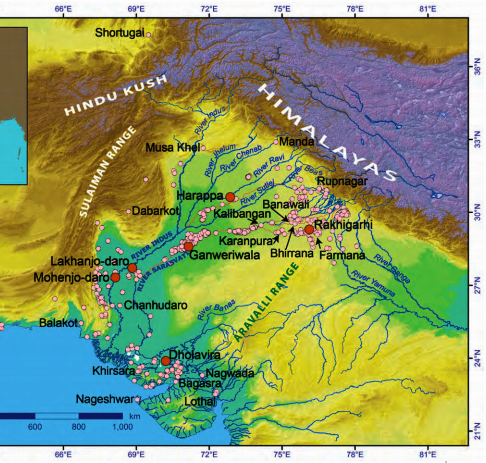
Some of the important cities of this civilisation are marked on the map (Fig. 6.3). As a class activity, can you try to match these cities with the modern states or regions in the table on the next page?
Ans:
THINK ABOUT IT
1. You may have come across the term ‘Indus Valley civilisation’ and noticed that we have not used it. A look at the map (Fig. 6.3 on page 89) explains why the term ‘Valley’ is obsolete, as we now know that the civilisation extended much beyond the Indus region.
Ans: The term "Indus Valley Civilisation" was used because people first thought that this civilisation was only around the Indus River. But now, after looking at maps like Fig. 6.3, we know that the civilisation spread far beyond the Indus region, reaching parts of India, Pakistan, and Afghanistan. It also included areas around the Ghaggar-Hakra River (Sarasvati River). Because it covered such a large area, the term "Valley" doesn't fully describe civilization anymore, which is why we no longer use it.
LET’S EXPLORE
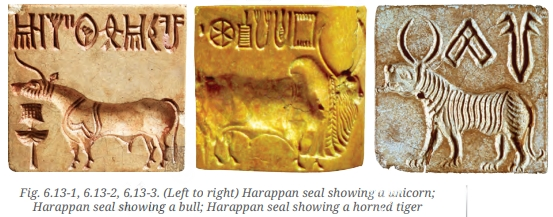
Looking at these three Harappan seals with some writing signs, what goes through your mind? Would you like to suggest any interpretations? Let your imagination run!
Ans: Looking at these three Harappan seals, several thoughts and interpretations come to mind. The presence of animals such as the unicorn, bull, and horned tiger may suggest that these creatures had special significance in Harappan culture, possibly representing power, protection, or religious beliefs. The symbols around the animals could indicate a form of early writing or a system of communication that is yet to be fully deciphered. These seals might have been used for trade, ownership, or religious rituals. The uniqueness of each animal could also symbolise different social or tribal identities within the civilisation. Overall, these seals provide a glimpse into the daily life, beliefs, and practices of the Harappan people.
THINK ABOUT IT
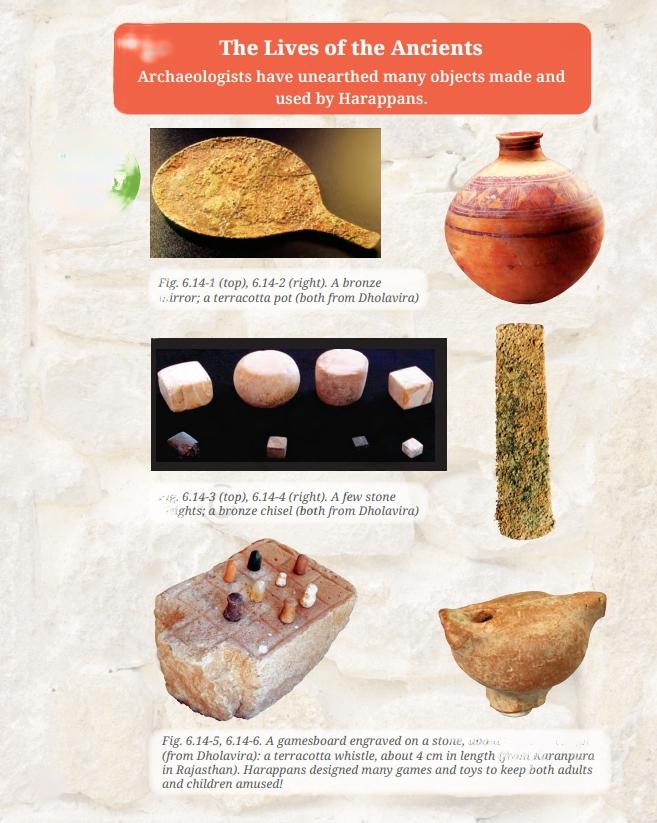
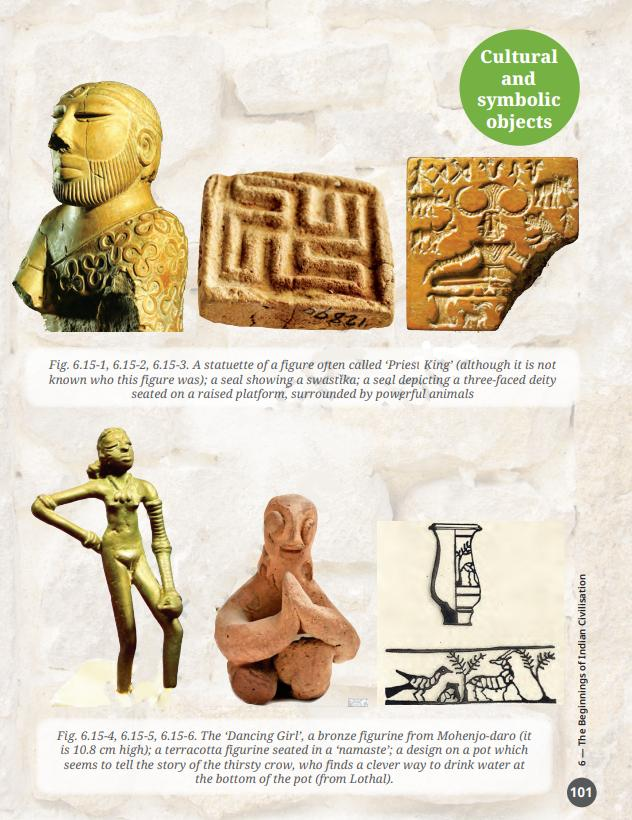
Looking at the objects on pages 100 and 101 — or any other picture in this chapter — can you make out what activities or aspects of life were important for the Harappans?
Ans:
Daily Use and Utilities: Items such as the bronze mirror, terracotta pots, and stone weights suggest that grooming, storage, and trade were key aspects of their daily lives. The precision in making stone weights points to a structured trade system.
Craftsmanship and Technology: Tools like the bronze chisel and the carefully designed objects, such as the whistle and games board, show that the Harappans were skilled artisans who created tools for specific purposes and entertainment.
Cultural and Religious Practices: Statuettes like the "Priest-King," the seals with swastikas, and other symbolic figures suggest that religion and symbolism were significant in their culture. The presence of a deity seal indicates religious beliefs and practices.
Art and Aesthetics: The famous "Dancing Girl" figurine and other artistic pieces show that art and beauty were important to the Harappans. They were highly skilled in metalwork and terracotta sculptures.
Entertainment and Leisure: Objects like the games board and toys like the whistle suggest that recreation and amusement were important, not only for children but also for adults.
Questions, activities, and projects
1. Why does the civilisation study in this chapter have several names? Discuss their significance.
Ans: The civilisation studied in this chapter is often called the Indus Valley Civilisation, Harappan Civilisation, or Indus-Sarasvatī Civilisation. These names reflect different aspects of the civilisation's location and discoveries. It is called the Indus Valley Civilisation because it was first discovered near the Indus River. The term Harappan Civilisation is used because Harappa was one of the first cities excavated. The name Indus-Sarasvatī Civilisation recognizes that the civilisation extended beyond the Indus region to areas near the Ghaggar-Hakra River (believed to be the Sarasvatī River). Each name highlights important geographical and cultural features of the civilisation.
2. Write a brief report (150 to 200 words) summing up some of the achievements of the Indus-Sarasvatī civilisation.
Ans: The Indus-Sarasvatī civilisation, also known as the Harappan Civilisation, made remarkable achievements in urban planning, trade, and craftsmanship. One of the most notable aspects was their well-planned cities, with advanced drainage systems, grid-like streets, and uniform building structures. This reflects a high level of engineering and administrative skills. The use of baked bricks for construction, even for large structures like granaries and citadels, showcases their architectural expertise.
Trade was another major achievement, as the civilisation had a vast trade network that extended to regions like Mesopotamia. Seals, weights, and measures used in trade indicate that the Harappans had a standardised system for transactions. Additionally, their craftsmanship in making pottery, jewellery, and tools from materials like bronze and stone shows a deep understanding of metalworking and artistry.
The Harappans also developed a unique script, though it remains undeciphered. This script, along with their religious figurines, suggests a complex social and cultural system. Their achievements in urban development, trade, and craft set them apart as one of the earliest advanced civilisations in human history.
3. Imagine you have to travel from the city of Harappa to Kalibangan. What are your different options? Can you make a rough estimation of the amount of time each option might take?
Ans: If travelling from Harappa to Kalibangan during the Indus-Sarasvatī period, different options might be available, including:
By foot: Travelling by foot would likely be the slowest option, considering the distance of around 400–450 kilometres between Harappa and Kalibangan. On foot, people could cover approximately 15–20 kilometres per day. Therefore, the journey might take about 20 to 30 days.
My cart: Using a bullock cart, the journey could be faster, perhaps covering 30–40 kilometres per day. With this option, the trip might take around 10 to 15 days.
By river: If rivers were navigable, this would be the quickest option. If boats or rafts were available for travel along the Sarasvatī or Indus river system, the journey could be shortened significantly, possibly taking around 5 to 7 days, depending on the current and boat speed.
In ancient times, river travel was likely one of the preferred methods for long distances due to its relative ease compared to overland travel.
4. Let us imagine a Harappan man or woman being transported to an average kitchen in today’s India. What are the four or five biggest surprises awaiting them?
Electric appliances: The presence of electric stoves, refrigerators, and microwaves would be a huge surprise. The ability to cook and store food using electricity would be completely new to them.
Running water and plumbing: While Harappans had advanced water management systems, modern kitchens with taps for instant access to clean water would amaze them.
Gas stoves: Cooking using gas burners and ovens would seem like magic to them, as they were used to fire-based cooking methods.
Ready-made spices and packaged foods: The availability of processed spices and pre-packaged food items would be a significant surprise, as they were accustomed to preparing everything from scratch.
Metal utensils and cutlery: The variety of stainless steel, aluminium, and plastic kitchenware would differ from their earthen and bronze pots, bowls, and cooking tools.
5. Looking at all the pictures in this chapter, make a list of the ornaments/gestures/objects that still feel familiar in our 21st century.
Ornaments: Bangles, necklaces, and earrings made of metal, beads, and stones are still widely worn today.
Seals and symbols: Some seals feature swastikas, which remain a symbol in many Indian cultures today.
Terracotta toys: Clay whistles and toys for children, similar to what we see today in rural areas.
Gestures: The terracotta figure seated in a "Namaste" posture reflects the same greeting gesture still used in India.
Bronze mirrors and pottery: The use of simple bronze mirrors and terracotta pottery is still visible in modern India, especially in traditional crafts.
6. What mindset does the system of reservoirs at Dholavira reflect?
The reservoir system at Dholavira reflects a mindset of foresight, planning, and sustainability. It shows that the Harappans understood the importance of water conservation in an arid environment and took measures to ensure a steady water supply throughout the year. This system also indicates a highly organised and civic-minded society that places great importance on public welfare and resource management.
7. In Mohenjo-daro, about 700 wells built with bricks have been counted. They seem to have been regularly maintained and used for several centuries. Discuss the implications.
The discovery of about 700 wells in Mohenjo-daro, maintained over centuries, implies a high level of urban planning and engineering skills. It suggests that the Harappans prioritised access to clean water, not only for daily use but also for public sanitation. The fact that these wells were used for such a long period indicates excellent construction quality and a society capable of maintaining infrastructure across generations. This also shows an early understanding of sustainability and public health.
8. It is often said that the Harappans had a high civic sense. Discuss the significance of this statement. Do you agree with it? Compare this with citizens in a large city in India today.
Yes, the Harappans demonstrated a high civic sense, as evidenced by their well-planned cities, with advanced drainage systems, public baths, and well-maintained streets. These features reflect a society that values hygiene, public welfare, and orderly living. The layout of their cities shows a concern for the common good and efficient administration. In comparison, modern cities in India often face challenges related to waste management, public sanitation, and infrastructure maintenance, though many advancements have been made. However, the Harappans' sense of communal responsibility for maintaining cleanliness and order stands out as a remarkable feature, which could still serve as an example for contemporary civic planning and responsibility.
Benefits of NCERT Solutions for Class 6 Social Science Chapter 6 The Beginnings of Indian Civilisation
NCERT Solutions for Class 6 Social Science Chapter 6 helps students understand the key features of the early Indian civilisation, including the rise of agriculture, trade, and urban settlements.
The solutions provide detailed explanations for all textbook questions, making it easier for students to grasp the concepts and improve their knowledge.
Complex topics like ancient trade systems, city planning, and early cultural practices are explained in simple language, aiding better comprehension.
NCERT Solutions for Class 6 Social Science Chapter 6 are designed to assist students in preparing for exams by covering all important topics thoroughly.
The solutions are aligned with the latest CBSE syllabus, ensuring that students focus on relevant topics and are well-prepared for exams.
Important Study Material Links for Social Science Chapter 6 Class 6
Conclusion
NCERT Solutions for Class 6 Social Science Chapter 6: "The Beginnings of Indian Civilisation" provides a clear and detailed understanding of how early civilisations developed in India. These solutions help students grasp key concepts such as the rise of agriculture, trade, and urban settlements. With simplified explanations and comprehensive answers, the solutions make it easier for students to prepare for exams. By using these solutions, students can strengthen their knowledge and feel confident about their exam readiness.
Chapter-wise NCERT Solutions Class 6 Social Science
Related Important Links for Class 6 Social Science
Along with this, students can also download additional study materials provided by Vedantu for Social Science Class 6-

FAQs on NCERT Solutions For Class 6 Social Science Chapter 6 The Beginnings Of Indian Civilisation - 2026-27 Free PDF Download (Login Required)
1. What are the main features of the Indus Valley Civilization according to class 6 NCERT solutions?
NCERT Solutions for class 6 highlight that the Indus Valley Civilization was known for its well-planned cities, advanced drainage systems, standardized weights and measures, and skilled craftsmanship. This civilization flourished around 2500-1900 BCE in the northwestern regions of the Indian subcontinent, making it one of the world's earliest urban civilizations.
2. How can students access the beginnings of Indian civilization NCERT PDF for offline study?
Students can download the free PDF of Chapter 6 from the official NCERT website or educational platforms like Vedantu for convenient offline access. This becomes particularly useful when preparing for exams or studying in areas with limited internet connectivity.
3. What evidence do archaeologists use to study the Indus Valley Civilization?
Archaeologists rely on physical remains like pottery, seals, tools, ornaments, and structural ruins to understand the Indus Valley Civilization since the Harappan script remains undeciphered. These material evidences provide insights into their daily life, trade practices, religious beliefs, and social organization.
4. Which major sites belong to the Indus Valley Civilization and what makes them significant?
The major Indus Valley sites include Harappa, Mohenjodaro, Dholavira, Kalibangan, and Lothal, each revealing unique aspects of Harappan urban planning and lifestyle. These excavated cities demonstrate the widespread nature of this civilization across modern-day Pakistan and northwestern India.
5. How do NCERT solutions help students understand the decline of the Indus Valley Civilization?
The step-by-step explanations in NCERT solutions present multiple theories about the Harappan decline, including climate change, natural disasters, and invasion theories, helping students analyze different perspectives critically. This approach encourages students to understand that historical events often have multiple possible explanations rather than single definitive causes.
6. What type of questions appear in class 6 social science chapter 6 question answer sections?
The question-answer sections typically include short answer questions about Harappan features, map-based activities identifying civilization sites, and descriptive questions comparing urban planning with modern cities. These questions test factual knowledge, geographical awareness, and analytical skills simultaneously.
7. What crafts and occupations existed in the Indus Valley Civilization?
The Harappan people engaged in pottery making, bead crafting, metalworking with bronze and copper, textile weaving, and seal carving, indicating a highly skilled and specialized society. Archaeological evidence suggests they also practiced agriculture, animal husbandry, and extensive trade networks.
8. How did trade contribute to the prosperity of the Indus Valley Civilization?
Trade networks extending from Afghanistan to Gujarat brought wealth and cultural exchange to Harappan cities, with evidence of standardized weights and measures facilitating commercial transactions. The discovery of Harappan seals in Mesopotamian sites confirms long-distance trade relationships that enhanced economic prosperity.
