






Class 6 Social Science Chapter 4 Questions and Answers - Free PDF Download
NCERT Solutions for Class 6 Social Science Chapter 4: Timeline and Sources of History helps students understand how historical timelines are constructed and the different sources used to study history. This chapter explains various historical periods and the methods used to gather and interpret historical information. Vedantu provides clear and detailed explanations, ensuring that students comprehend the key concepts effectively. Class 6 Social Science NCERT Solutions offer comprehensive answers to all questions, helping in exam preparation and enhancing understanding.
 Table of Content
Download the FREE PDF for Class 6 Social Science Chapter 4 Question Answers, prepared by Vedantu experts and aligned with the latest CBSE Class 6 Social Science Syllabus, for an engaging learning experience.
Glance on Class 6 Social Science Chapter 4 Timeline and Sources of History
In this chapter, "Timeline and Sources of History," students explore the methods used to study and understand history.
It introduces the concept of timelines to organise historical events chronologically and explains various sources of historical information, including written records, artefacts, and oral traditions.
Class 6 Social Science Chapter 4 emphasises the importance of these sources in reconstructing the past and provides insights into how historians use them to piece together historical narratives.
The chapter includes detailed explanations, illustrations, and activities to help students grasp how timelines and sources contribute to our understanding of history.
THE BIG QUESTIONS?
1. How do we measure historical time?
Ans: Historical time is measured using timelines, which are used to arrange events in chronological order. Timelines help us understand the sequence of events and how they relate to each other over different periods, such as years, decades, or centuries.
2. How can various sources help us understand history?
Ans: Various sources, including written documents, artefacts, inscriptions, and oral traditions, provide valuable information about past events. Written records offer detailed accounts of events, while artefacts and inscriptions provide physical evidence. Oral traditions pass down stories and knowledge from generation to generation, helping us understand how people lived and thought in the past.
3. How did early humans live?
Ans: Early humans lived in simple, often nomadic societies. They relied on hunting, gathering, and later farming for survival. Their lifestyle included creating tools and weapons, building shelters, and developing social structures. Early humans adapted to their environment and gradually began to form more complex communities as they learned to control their surroundings.
THINK ABOUT IT
1. What is the earliest memory you can recollect? Do you remember how old you were at that time? Those memories together are a part of your past, maybe going five or six years back.
Ans: Do it yourself
2. How do you think understanding the past will help us understand the present world?
Ans: Understanding the past helps us make sense of the present by showing how historical events, cultures, and decisions have shaped current societies and conditions. By learning about past experiences and developments, we can better understand current issues, trends, and cultural practices.
LET’S EXPLORE
There are a few images of different sources of history on the next page. Who and what do you think the objects show? Write down in the boxes next to the images any information that you get from these objects.
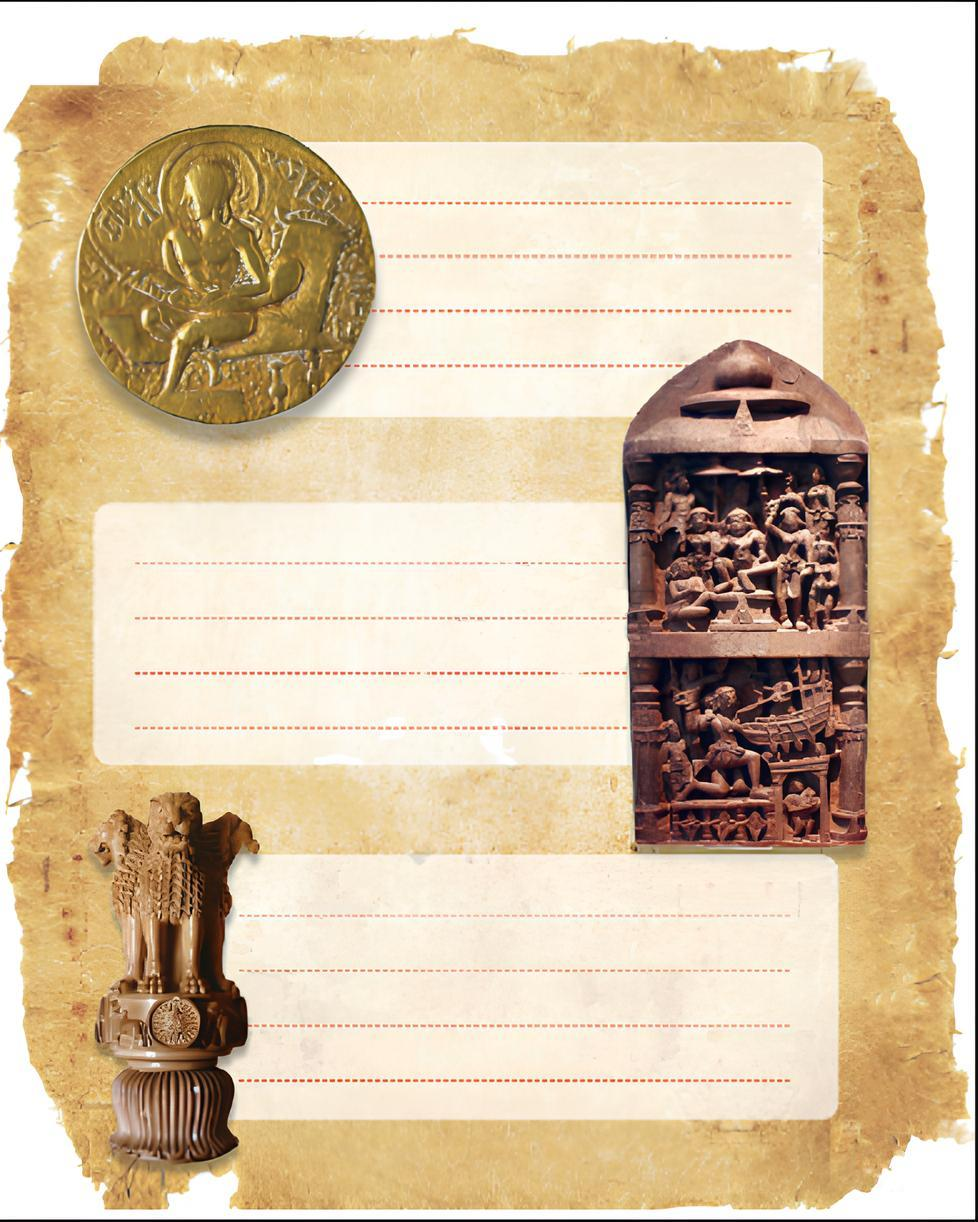
Ans:
Gold Coin (Top Left):
This appears to be an ancient coin featuring a figure, likely a king or ruler, in a seated posture. It could belong to an Indian dynasty, such as the Gupta dynasty, where kings were depicted on coins. The presence of such coins helps historians trace the economy, rulers, and the extent of trade during a certain period.
Stone Sculpture (Top Right):
This is a relief sculpture possibly representing a historical or religious scene. Such artefacts are typically found in temples or monuments and provide insight into the cultural and religious practices of the time. The intricacies in the carving suggest the artistic style and the importance of the scene depicted.
Ashoka Pillar (Bottom Left):
The third image is of the Ashoka Pillar, specifically the Lion Capital of Ashoka, which is now India's national emblem. This structure signifies the Mauryan Empire under Emperor Ashoka and symbolises power, sovereignty, and Buddhism, as Ashoka promoted Buddhist values after converting to Buddhism.
LET’S EXPLORE
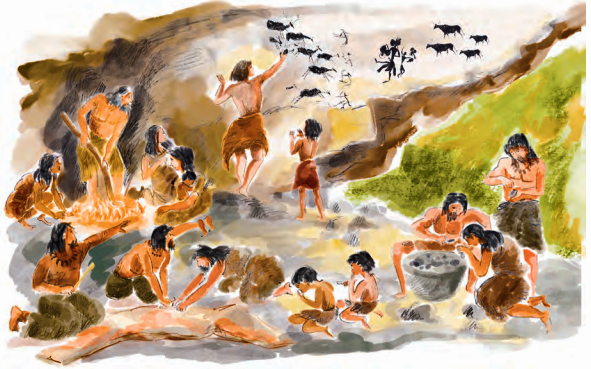
In the above picture, look at some activities of early humans in a rock shelter. Which ones can you recognise? Give a brief description of each.
Ans: In the picture showing early human activities in a rock shelter, we can recognize several key tasks from prehistoric life. Here's a brief description of each:
Hunting Scene (Top Center):
In the upper part of the image, a person is seen holding a weapon, possibly a spear, pointing towards a group of animals drawn on the wall. This represents early humans hunting wild animals, an essential activity for food and survival.
Fire-Making (Left Side):
A group of early humans is gathered around a fire. This indicates the discovery and use of fire for cooking, warmth, and protection. The fire was a crucial development in human evolution.
Tool Making or Crafting (Center and Bottom Left):
Some figures are engaged in crafting tools, such as stone tools or weapons. This reflects early humans’ ability to shape tools from stone, bones, and wood to improve their efficiency in hunting, building, or other survival tasks.
Food Preparation (Bottom Right):
Another group is seen preparing or grinding food, possibly using stones. This suggests early methods of processing food, such as grinding grains or crushing nuts, an important step in the development of agriculture.
Family or Group Interactions (Top Right and Bottom):
Several figures are depicted sitting and interacting with one another, which shows the communal aspect of early human life. This could represent social interactions or shared responsibilities within the group.
These activities demonstrate early humans' ability to adapt to their environment through hunting, tool-making, and social organisation.
LET’S EXPLORE
Observe the scene on the next page. It depicts an agricultural community from a few millenniums ago. List the main activities you can identify.
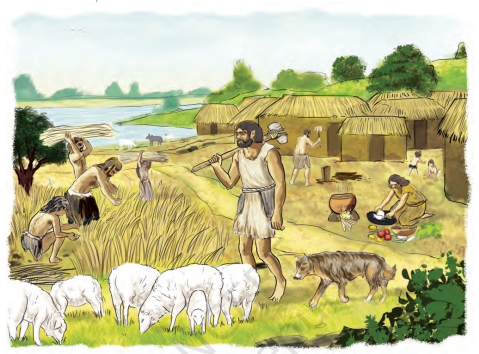
In the scene depicting an agricultural community from a few millenniums ago, the following main activities can be identified:
Harvesting Crops:
On the left side of the image, individuals are cutting and gathering crops, likely wheat or barley, indicating the practice of agriculture and crop cultivation.
Shepherding:
In the foreground, a man is tending to a flock of sheep. This suggests the domestication of animals for purposes such as wool, milk, or meat.
Carrying Resources:
Another person is seen carrying bundles of harvested crops, indicating the transportation of agricultural produce from the field to the community or storage areas.
Food Preparation:
In the centre-right, a woman is preparing food near a cooking pot, suggesting that food preparation and cooking are important aspects of daily life in the community.
Building and Maintenance:
In the background, a man is engaged in constructing or maintaining the thatched-roof houses, signifying the importance of shelter and community building.
Animal Domestication:
The presence of a dog along with the sheep suggests the domestication of animals for herding or companionship.
These activities show a settled, agricultural way of life with farming, animal husbandry, and community living as central elements.
Questions, activities, and projects
1. As a project, write the history of your family (or village if you live in one), using sources of history at your disposal. Ask your teacher to guide you.
Ans: Do it Yourself
2. Can we compare historians to detectives? Give reasons for your answers.
Ans: Yes, historians can be compared to detectives. Both historians and detectives gather clues and evidence to solve mysteries. Historians use sources such as documents, artefacts, and oral histories to uncover facts about the past, much like detectives piece together evidence to solve a case. Both work carefully to understand what happened by interpreting the available information.
3. A few exercises with dates:
Place these dates chronologically on the timeline: 323 CE, 323 BCE, 100 CE, 100 BCE, 1900 BCE, 1090 CE, 2024 CE.
Ans:
1900 BCE
323 BCE
100 BCE
100 CE
323 CE
1090 CE
2024 CE
If King Chandragupta was born in 320 CE, which century did he belong to? And how many years was that after the Buddha’s birth?
Ans:
King Chandragupta was born in the 4th century CE (320 CE).
Buddha was born around 563 BCE, so the difference between Buddha’s birth and Chandragupta’s birth is approximately 883 years (563 BCE + 320 CE).
Rani of Jhansi was born in 1828. Which century did she belong to? How many years was that before India’s Independence?
Ans:
Rani of Jhansi was born in the 19th century (1828).
India gained independence in 1947, so Rani of Jhansi’s birth was 119 years before India’s independence (1947 - 1828 = 119).
Turn ‘12,000 years ago’ into a date.
Ans: 12,000 years ago from the present (2024 CE) would be around 10,000 BCE (2024 CE - 12,000 years = 10,000 BCE).
4. Plan a visit to a nearby museum: the visit should be prepared with some prior research on the kind of exhibits the museum holds. Keep notes during the visit. Write a brief report afterward, highlighting what was unexpected/interesting/fun about the visit and the exhibits.
Ans:
Date of Visit: 12th September 2024
Museum Name: National History Museum
Exhibits Viewed:
During my visit, I explored a variety of exhibits, including artefacts from ancient India, sculptures, and historical tools. The most fascinating section was dedicated to the Indus Valley Civilization, where I saw seals, pottery, and tools used by early settlers. Another highlight was the collection of mediaeval Indian coins, which helped me understand the economic systems of ancient times.
Unexpected Findings:
One unexpected exhibit was a collection of early human fossils, which showed the development of humans over thousands of years. I didn’t expect to see actual fossil remains of animals like mammoths, which added a new dimension to the experience.
Fun Aspects:
The interactive displays were quite enjoyable. One section allowed visitors to digitally recreate ancient pottery, which was both fun and educational. There were also 3D models of ancient structures that provided a closer look at how ancient cities were built.
This visit was both informative and enjoyable, giving me a deeper understanding of ancient cultures and their ways of life.
5. Invite to your school an archaeologist or a historian and ask them to speak on the history of your region and why it’s important to know it.
Ans:
Subject: Invitation to Speak on the History of Our Region
Dear XYZ,
I hope this message finds you well. On behalf of [School Name], I would like to extend a formal invitation for you to visit our school and speak to our students about the rich history of our region. As part of our ongoing efforts to enhance student's understanding of local history and its significance, we believe your insights would be invaluable.
We would be honoured if you could share your knowledge and expertise with our students, emphasising the importance of learning about regional history and how it shapes our present and future. The event would be an excellent opportunity for students to engage with a professional in the field and develop a deeper appreciation for history.
The proposed date for the event is (insert date), but we are flexible and happy to adjust based on your availability. Please let us know if this is possible and any logistical arrangements we can make to facilitate your visit.
Thank you for considering our invitation. We look forward to the opportunity to learn from your experience and expertise.
Warm regards,
ABC
MNC School
Xxxxxxxx
Benefits of NCERT Solutions for Class 6 Social Science Chapter 4 Timeline and Sources of History
NCERT Solutions for Class 6 Social Science Chapter 4 Timeline and Sources of History help students grasp key historical concepts, such as timelines and various sources of history, in a simple and easy-to-understand format.
By using these solutions, students can save time during revision by having clear and concise explanations, allowing them to focus on the most important aspects of the chapter.
NCERT Solutions for Class 6 Social Science Chapter 4 provides accurate and detailed answers to all questions in the chapter, ensuring that students are well-prepared for exams.
The chapter encourages students to think critically about how history is recorded and understood, improving their analytical skills.
With well-organised solutions, students can practise and gain confidence in answering questions related to history and timelines effectively.
Important Study Material Links for Social Science Chapter 4 Class 6
Conclusion
The NCERT Solutions for Class 6 Social Science Chapter 4: Timeline and Sources of History provide students with clear explanations of important historical concepts. These solutions make it easier to understand how events are placed on a timeline and how different sources of history help us learn about the past. With well-structured answers, students can confidently prepare for their exams and improve their understanding of history. These solutions not only save time but also strengthen critical thinking and help students develop a deeper interest in the subject.
Chapter-wise NCERT Solutions Class 6 Social Science
Related Important Links for Class 6 Social Science
Along with this, students can also download additional study materials provided by Vedantu for Social Science Class 6-

FAQs on NCERT Solutions For Class 6 Social Science Chapter 4 Timeline And Sources Of History - 2026-27 Free PDF Download (Sign-in Required)
1. What is the timeline in history for class 6?
A timeline in history is a chronological arrangement of events that helps students understand the sequence and relationship between different historical periods. It organizes events from past to present, showing dates, centuries, and the order in which important developments occurred in human civilization.
2. Which are the main sources of history that students learn about?
Historical sources are classified into three main categories that help us understand the past.
Primary sources: These include archaeological remains like tools, coins, inscriptions, and monuments that provide direct evidence from the time period being studied.
Literary sources: Written records such as religious texts, court chronicles, travel accounts, and official documents that contain information about past events and societies.
Oral traditions: Stories, songs, and customs passed down through generations that preserve historical memory and cultural practices.
These three types of sources work together to give historians a complete picture of how people lived in different time periods.
3. How do NCERT Solutions help students with timeline and sources of history questions?
NCERT Solutions provide step-by-step explanations for all textbook questions, making complex historical concepts easier to understand. The solutions include detailed answers for both in-text and exercise questions, helping students grasp the importance of chronology and different types of historical evidence through clear examples.
4. What is the summary of chapter timeline and sources of history?
This chapter introduces students to two fundamental tools historians use - timelines for organizing events chronologically and various sources for gathering historical information.
Understanding these concepts helps students think like historians and analyze how we know about the past.
5. Can students access timeline and sources of history class 6 solutions as a Free PDF?
Yes, students can download Free PDF versions of SST solutions that include comprehensive answers to all chapter questions from Vedantu. These PDFs are formatted for easy offline study and contain step-by-step explanations that match the latest NCERT textbook requirements.
6. Why do historians use BCE and CE in timelines?
BCE (Before Common Era) and CE (Common Era) are modern terms used to mark years in historical timelines without religious references. These terms make historical dating more inclusive and universally acceptable across different cultures and religions.
Understanding the system:
- CE counts years forward from year 1 (same as AD system)
- BCE counts years backward from year 1 (same as BC system)
- Higher BCE numbers represent earlier time periods
- Timeline moves from higher BCE numbers to lower BCE, then to CE
7. What types of questions are covered in timeline and sources of history question answer sections?
The question-answer sections cover concept-based queries about chronological arrangements, identification of different source types, and practical applications of historical methods. Students practice creating timelines, analyzing archaeological findings, and distinguishing between primary and secondary sources through varied exercise formats.
8. How do archaeological sources help in understanding ancient history?
Archaeological sources are physical remains discovered through excavation that provide direct evidence about how people lived in ancient times. These sources fill gaps where written records don't exist and offer unbiased information about daily life, technology, and culture.
9. What additional practice materials are available for timeline and sources of history class 6 worksheet activities?
Vedantu provides extra questions, fill-in-the-blanks exercises, and timeline creation activities that complement NCERT textbook content. These worksheet materials help students practice identifying historical sources and arranging events chronologically through interactive exercises and assessment questions.
10. How do students create accurate historical timelines using proper chronological methods?
Creating historical timelines requires organizing events in chronological sequence using proper dating systems and appropriate time scales. Accurate timelines help students visualize historical progression and understand cause-and-effect relationships between events.
Steps for timeline creation:
- List all events with their specific dates or approximate periods
- Arrange events from earliest to latest using BCE/CE system
- Choose appropriate time scale (years, decades, or centuries)
- Mark events clearly with brief descriptions
- Include important cultural, political, and social developments
- Verify that earlier events appear before later ones and dates follow logical sequence.
