








What Is the Base of a Shape Definition Formula and Examples
Although the term “base” is used in different Mathematical contests, here, we will understand the meaning of “base” in terms of Geometry. The base of an object is generally observed as a side or face upon which the object generally rests. It is best described as the “bottom” of the shape. Remember, the base of a shape is not only limited to its bottom sides or faces but is often paired with a height that is perpendicular to the base. This is applicable in both 2-D and 3-D figures.
Read the article to understand the base of a shape in a better way.
Base of a Shape Definition
The base of a shape is defined as the surface, a solid object stands on or rests upon. Also, the base is considered the bottom line of a shape such as a triangle.
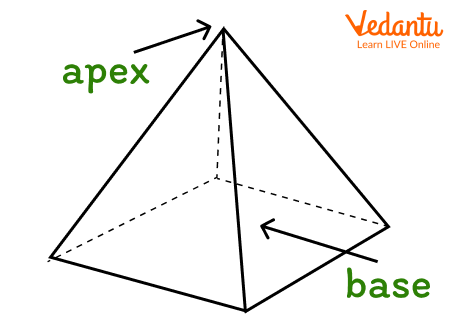
But, the top is also considered as a base when it is parallel to the bottom.
Base of Two-Dimensional Object
Let’s observe where the base is found in different 2-d shapes.
The blue line in the following 2-D shapes represents the “Base” of the respective shapes.
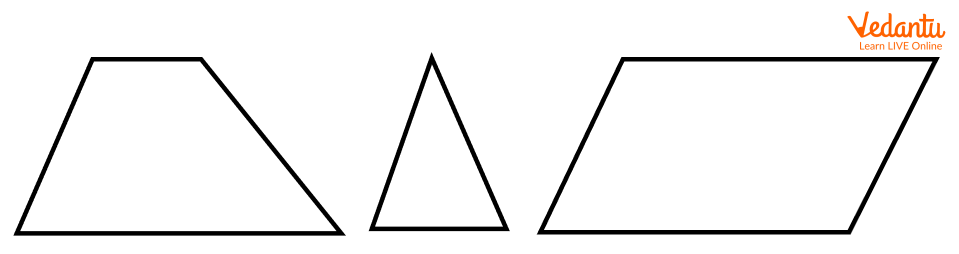
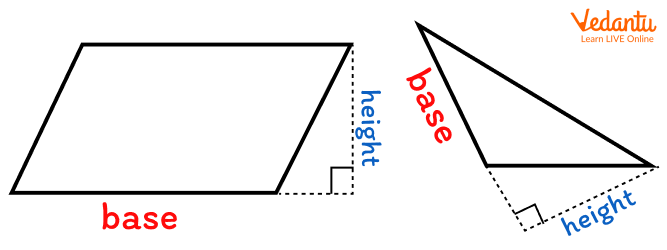
The sides of 2-d shapes are also considered as base if the base and its corresponding height are perpendicular to each other. Look at the image below to understand precisely.
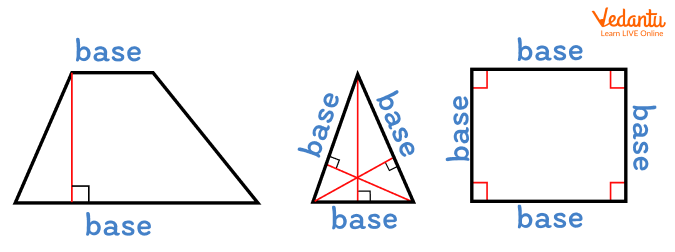
Sometimes, the base of the shape needs to be extended to form its associated height.
Base of Three-Dimensional Object
The grey line in the following 2-D shapes represents the “Base” of the respective shapes.
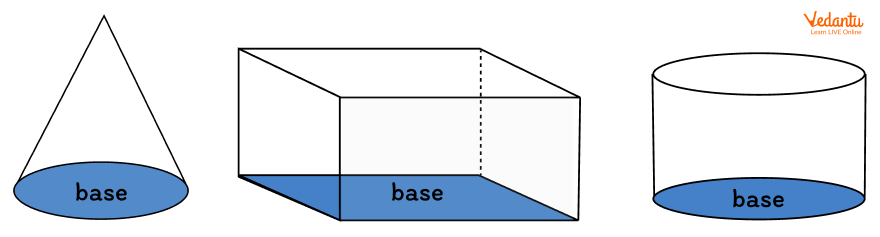
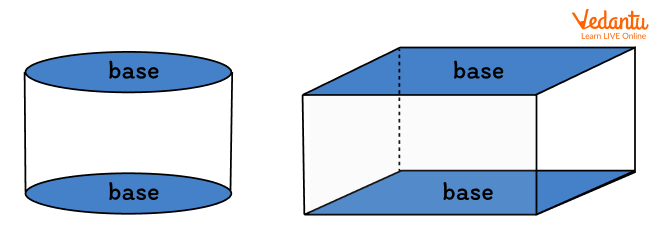
Similar to 2-D shapes, other sides or faces are also considered as the base.
Base of a Shape Examples
A triangle is a polygon with three sides. Any side of a triangle can be considered as its base while calculating its area. Once we choose the base of a triangle, there is only one line segment that represents its corresponding height.
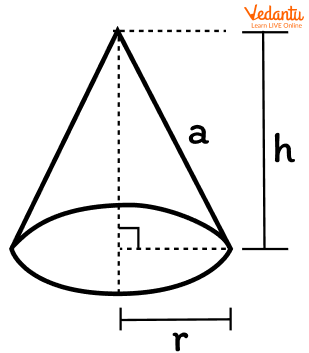
The base of a cone is the plane surface of a solid shape; the other face or side is a curved surface.
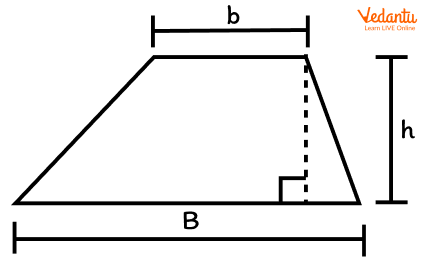
A trapezoid has two bases, one small base (b) at the top and one large base (B) at the bottom.
Conclusion
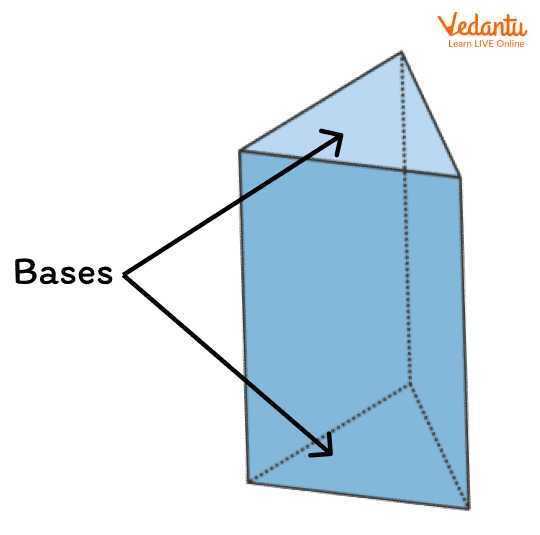
In short, the base is the surface upon which a solid object rests. A solid object may have one or more than one bases. For example, the prism has 2 bases. One base is at its top and the other at its bottom. Both are parallel to each other. Understanding the concept of the base is very important for kids as it is one of the fundamental concepts of Geometry. This will help to understand the complex geometrical concepts easily in higher classes.
FAQs on Understanding the Base of a Shape in Geometry
1. What is the base of a shape in geometry?
The base of a shape is the side or surface that is used as the reference for measuring height and calculating area or volume. In 2D shapes like triangles and parallelograms, the base is usually one side. In 3D shapes like prisms and pyramids, the base is the flat face on which the solid appears to rest. The base is important because many formulas, such as area and volume, depend directly on the base and its corresponding height.
2. How do you identify the base of a triangle?
The base of a triangle can be any one of its three sides, as long as you measure the perpendicular height from the opposite vertex to that side. To identify it:
- Choose any side as the base.
- Draw or imagine a perpendicular line from the opposite vertex to that side.
- That perpendicular line is the height corresponding to the chosen base.
3. What is the formula for area using the base of a triangle?
The formula for the area of a triangle using its base is Area = 1/2 × base × height. Here:
- Base (b) is any chosen side.
- Height (h) is the perpendicular distance from the opposite vertex to the base.
4. Can any side of a triangle be the base?
Yes, any side of a triangle can be chosen as the base, provided you use the correct perpendicular height for that side. A triangle has three sides, so it also has three possible base–height pairs. The area remains the same regardless of which side is selected as the base, as long as the corresponding height is used correctly.
5. What is the base of a rectangle?
The base of a rectangle is usually the bottom horizontal side, but mathematically it can be either of the two parallel longer or shorter sides. In the area formula Area = length × width, one side is treated as the base and the other as the height. For example, if a rectangle has sides 10 cm and 6 cm, you may take 10 cm as the base and 6 cm as the height.
6. What is the base of a 3D shape like a prism or pyramid?
The base of a 3D shape is the flat face used to calculate its volume. In a prism, there are two identical parallel bases. In a pyramid, there is one base and triangular faces meeting at a vertex. The volume formulas use the base area:
- Prism: Volume = base area × height
- Pyramid: Volume = 1/3 × base area × height
7. What is the difference between base and height?
The base is the chosen side or surface of a shape, while the height is the perpendicular distance from the base to the opposite vertex or top. Key difference:
- Base: a side or face used for reference.
- Height: always measured at a right angle (90°) to the base.
8. How do you find the base if the area and height are given?
You can find the base by rearranging the area formula. For a triangle:
- Area = 1/2 × base × height
- Base = (2 × Area) ÷ height
9. Does the base always have to be at the bottom of a shape?
No, the base does not always have to be at the bottom; it is simply the side or face chosen for calculation. In diagrams, the bottom side is often labeled as the base for convenience, but mathematically any suitable side can serve as the base if the correct perpendicular height is used.
10. Why is the base important in area and volume formulas?
The base is important because most area and volume formulas are built around the base and its corresponding height. For example:
- Triangle: 1/2 × base × height
- Parallelogram: base × height
- Prism: base area × height
