









Prime Factorization and Pair Factors of 175 with Examples
A factor is a number that completely divides the original number. Real numbers that can evenly divide the original number are factors of $175$. There is no residue if $"x"$ is the factor of $175$, since $"x"$ divides $175$ into equal parts. For instance, $24$ divided by $4$ is $6$, then 4 is the component of $24$. Consequently, $4$ divides $24$ into six equal parts, leaving $0$ as the remainder. Since $175$ can only be divided by $1, 5, 7, 25, 35 and 175$. So these are factors of 175.
Let's use straightforward methods in this article to determine the factors, pair factors, and prime factors of $175$.
What are the Factors of $175$?
The natural numbers that can divide the number $175$ evenly are factors of $175$. These factors divide the original number into equal numbers of parts. For example, $175$ is divisible by $5$. So, $175$ divided by $5$ is equal to $35$. Hence, $5$ divides the number $175$ into $35$ equal parts.
We can determine the other factors of $175$ with the help of the division method. $175$ has more than two factors. Thus, it is a composite number.
How to Find Factors of $175$?
The natural numbers that can divide the number $175$ evenly are factors of $175$. So the way you find and list all of the factors of $175$ is to go through every number up to and including $175$ and check which numbers result in an even quotient.
In the division method, the factors of $175$ are found by dividing the number $175$ by different integer numbers. If the integer divides $175$ exactly without leaving a remainder, then the integer is a factor of $175$. Let's start dividing $175$ by $1$ and proceed with the different integers.
$175 \div 1 = 175$
$175 \div 2 = 87.5$ So, 2 is not a factor of 175.
$175 \div 5 = 35$
$175 \div 7 = 25$
$175 \div 25 = 7$
$175 \div 35 = 5$
$175 \div 175 = 1$
Therefore, the factors of $175$ are 1, 5, 7, 25, 35 and 175.
Prime Factorisation of $175$
Prime factorization is the process of finding the prime terms or prime factors which, when multiplied, give the original number.
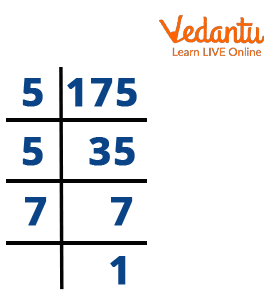
Prime Factorization of 175
Take a pair factor of $175$, say $\left ( 1, 175 \right )$
As the number $1$ is neither prime nor composite, it cannot be split further. Take the other factor, $175$, which is a composite number, and it can be factored further into its prime factors.
Thus, $175$ is written as the product of $7$ and $25$. Here, $7$ is a prime number, $25$ is a composite number, and the number $25$ can be written as the product of $5 and $5.
Write the number $175$ as the product of its prime factors.
So, $175$ is written as $5 \times 5 \times 7$.
Therefore, the prime factorization of $175$ is $5 \times 5 \times 7$ or $5^2 \times 7$, where $5$ and $7$ are prime numbers.
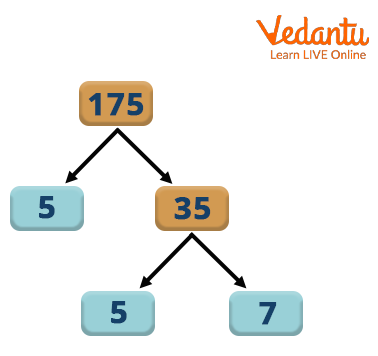
Factor Tree
Pair Factors of $175$
A factor pair is a pair of numbers that, when multiplied, will result in an original number(or the same product).
To calculate the factor of a number, factors are frequently presented as pairs of numbers. They are referred to as factor pairs. For example- factor pairs of $12$ include, $\left ( 1, 12 \right )$ and $\left ( 3, 4 \right )$.
The pair factors of $175$ are expressed in positive and negative forms. Since the number $175$ is composite, it has more than one-factor pair. Thus, the positive and negative pair factors of $175$ are given below:
Positive Pair Factor of $175$:
$1 \times 175 = 175$
$5 \times 35 = 175$
$7 \times 25 = 175$
Therefore, the positive pair factors of $175$ are $\left ( 1, 175 \right )$, $\left ( 5, 35 \right )$ and $\left ( 7, 25 \right )$.
Negative Pair Factor of $175$:
$-1 \times -175 = 175$
$-5 \times -35 = 175$
$-7 \times -25 = 175$
Therefore, the negative pair factors of $175$ are $\left ( -1, -175 \right )$, $\left ( -5, -35 \right )$ and $\left ( -7, -25 \right )$
Prime Factors of $175$
First, note that prime numbers are all positive integers that can only be evenly divided by $1$ and itself. Prime Factors of $175$ are all the prime numbers that, when multiplied together, equal $175$.
All the prime numbers used to divide in the Prime Factor Tree are the Prime Factors of $175$. Here are the maths to illustrate:
$175 \div 5 = 35$
$35 \div 5 = 7$
$7 \div 7 = 1$
Again, all the prime numbers you used to divide above are the Prime Factors of $175$. Thus, the Prime Factors of $175$ are $5, 7$.
Solved Examples
Example 1: What are the possible factors of $175$?
Solution: The natural numbers that can divide a number evenly are factors of $175$. As a result, the factors of the $175$ are $1, 5, 7, 25, 35 and 175$. If we divide $1755$ by any negative of these integers, then the resulting number will always be a factor of 175. Generally, we consider only positive numbers as factors.
Example 2: Can you assist Aman with adding up all the factors of $175$?
Solution: First, we must take out the factors of $175$.
$175 = 1, 5, 7, 25, 35, 175$
Here we can see the $1755$ are $1, 5, 7, 25, 35 and 175$.
We can conclude here that If you add up all the components of $175$,
you get $1 + 5 + 7 + 25 + 35 + 175 = 248$
Example 3: Is $25$ a factor of $175$?
Solution: Yes, $25$ is a factor of $175$. If $175$ is divisible by $25$, it leaves a quotient of $7$ and remainders $0$. Hence, $25$ is a factor of $175$.
Conclusion
The number $175$ is odd and composite in mathematics. The only numbers with more than two elements are composite. Each factor is either less than or equal to the original number. A given integer has a finite number of factors. Factors of $175$ are numbers that leave no residue when divided by $1, 5, 7, 25, 35 and 175$.


FAQs on What Are the Factors of 175
1. What are the factors of 175?
The factors of 175 are 1, 5, 7, 25, 35, and 175. These are the positive integers that divide 175 exactly without leaving a remainder.
- 175 ÷ 1 = 175
- 175 ÷ 5 = 35
- 175 ÷ 7 = 25
- 175 ÷ 25 = 7
- 175 ÷ 35 = 5
- 175 ÷ 175 = 1
2. How do you find the factors of 175?
To find the factors of 175, divide 175 by whole numbers and list those that give no remainder.
- Start from 1 and go up to √175 (about 13.2).
- Check divisibility by 1, 5, and 7.
- List each divisor and its pair (e.g., 5 and 35).
3. What is the prime factorization of 175?
The prime factorization of 175 is 5 × 5 × 7 or 5² × 7. Breaking it down:
- 175 ÷ 5 = 35
- 35 ÷ 5 = 7
- 7 ÷ 7 = 1
4. Is 175 a prime or composite number?
The number 175 is a composite number because it has more than two factors. A prime number has exactly two factors (1 and itself), but 175 has six factors: 1, 5, 7, 25, 35, and 175.
5. What are the factor pairs of 175?
The factor pairs of 175 are (1, 175), (5, 35), and (7, 25). These pairs multiply together to give 175.
- 1 × 175 = 175
- 5 × 35 = 175
- 7 × 25 = 175
6. How many factors does 175 have?
The number 175 has 6 positive factors. Using its prime factorization 5² × 7, apply the formula for total factors:
- Add 1 to each exponent: (2 + 1)(1 + 1)
- Multiply: 3 × 2 = 6
7. What are the common factors of 175 and 35?
The common factors of 175 and 35 are 1, 5, 7, and 35.
- Factors of 175: 1, 5, 7, 25, 35, 175
- Factors of 35: 1, 5, 7, 35
8. What is the greatest common factor (GCF) of 175 and 25?
The greatest common factor of 175 and 25 is 25.
- Prime factorization of 175 = 5² × 7
- Prime factorization of 25 = 5²
9. Is 175 a multiple of 5 and 7?
Yes, 175 is a multiple of both 5 and 7.
- 175 ÷ 5 = 35 (whole number)
- 175 ÷ 7 = 25 (whole number)
10. What is the sum of all factors of 175?
The sum of all factors of 175 is 248. Add all its positive factors:
- 1 + 5 + 7 + 25 + 35 + 175 = 248
