









Angle Measurement Definition Units Formulas and Solved Examples
Introduction to Angle Measurement
Before understanding the angle measurement methods kids must understand what an angle is. The angle is defined as the geometrical shape that is the resultant of the joining of two lines at their ends. Acute angle, obtuse angle, right angle, straight angle, reflex angle and full rotation angle are the angles that are taught to kids to help them better understand the concepts of geometry and as their grades progress the understanding of angles play a crucial role in the understanding of trigonometry. In this article, we are focused on providing the students with a short description of the common angles and the methods of angle measurement. Let us start our discussion by looking into how angles are measured?
How is Angle Measurement Performed?
As we know angles are the geometrical shape that is formed by adjoining rays in an end to end fashion, this leads to the formation of inclination. The angle measurement is done in degrees. Now it is important for kids to note that this degree is the unit of measurement of angle. Kids must not confuse it with the measurement of the temperature. As the temperature is also measured in degrees Celsius and degrees Fahrenheit. The angle measurement is done with the help of a geometrical tool named a protractor.
Protractor
As defined earlier protractor is defined as the tool used to measure the angles. The protractor is a semi-circle in shape. The tool is divided into equal parts which represent angles from 0 degrees to 180 degrees. It is important to note that a protractor has two readings, the inner and outer measurements are in opposite directions. The image mentioned below helps in a better understanding of the measurements of the protractor.
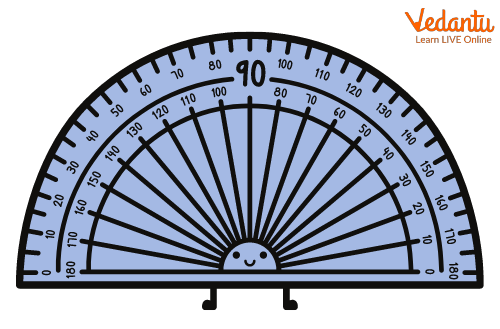
Image illustrating the protractor measurement units
Measuring Angle Using a Protractor
For measuring an angle using a protractor students must place the protractor on the vertex of the angle. The base of the proctor must be aligned with the base of the angle. The angle is then measured by counting from 0 up to the point where the ray intersects. It can be better understood by the diagram mentioned below.
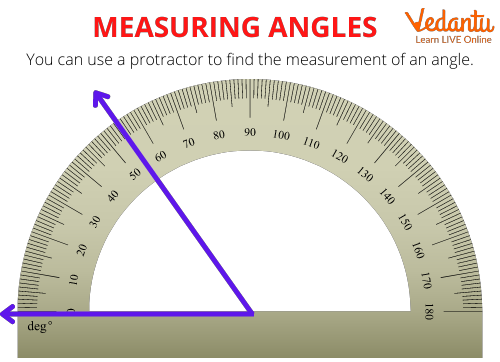
Measuring angle using the protractor
The image illustrates that the angle is 55 degrees.
Note- One of the most important points while performing angle measurement is to start the counting from zero degrees of the protractor scale. As in the example illustrated above, if the angle is measured by counting from 180 degrees, the angle measurement would have been 125 degrees, which is wrong.
Types of Angles
Since we have learnt how to measure angles, let us look into the six types of angles.
Acute Angle
The angles that lie between 0 to 90 degrees are categorized as acute angles.
Obtuse Angle
The angle that lies between 90 to 180 degrees is said to be the obtuse angle, they are in a sense opposite to the acute angles.
Right Angle
The right angle is defined as 90 degrees. 91 degrees is considered an obtuse angle whereas 89 degrees is considered to be an acute angle.
Straight Angle
The angle that is 180 degrees is known as the straight angle.
Reflex Angle
An angle that is between 180 to 360 degrees is termed a reflex angle. It is greater than 180 degrees but is lesser than 360 degrees.
Full Rotation Angle
It is the angle whose measurement is 360 degrees, they are formed by the complete rotation of the ray. The image illustrated below represents all the angles discussed above.
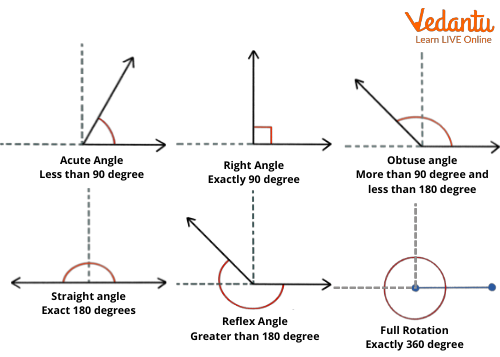
Image illustrating the different angles
In conclusion of the article, we have learnt about the angle measurement method using a protractor. We have also learnt about the various angles and their definitions. We hope that the study material provided will help students excel in geometry classes.
FAQs on Understanding Angle Measurement in Geometry
1. What is angle measurement in maths?
Angle measurement is the process of determining the size of an angle in degrees (°) or radians. An angle measures the amount of rotation between two rays sharing a common endpoint called the vertex. In geometry, angles are commonly measured using degrees, where a full rotation equals 360°, or radians, where a full rotation equals 2π radians.
2. What are the units used to measure angles?
The main units used to measure angles are degrees and radians.
- Degrees (°): A full circle is 360°.
- Radians: A full circle is 2π radians.
3. How do you measure an angle using a protractor?
To measure an angle using a protractor, align the center point with the vertex and read the scale where the second ray crosses.
- Place the protractor’s center at the angle’s vertex.
- Align one ray with the zero line.
- Read the degree marking where the other ray intersects.
4. What is the formula to convert degrees to radians?
To convert degrees to radians, use the formula Radians = Degrees × (π/180).
- Example: Convert 90° to radians.
- 90 × (π/180) = π/2 radians.
5. How do you convert radians to degrees?
To convert radians to degrees, use the formula Degrees = Radians × (180/π).
- Example: Convert π/3 radians to degrees.
- (π/3) × (180/π) = 60°.
6. What are the different types of angles based on measurement?
Angles are classified by their measurement in degrees.
- Acute angle: Less than 90°
- Right angle: Exactly 90°
- Obtuse angle: Between 90° and 180°
- Straight angle: Exactly 180°
- Reflex angle: Between 180° and 360°
- Complete angle: Exactly 360°
7. Why is a full circle 360 degrees?
A full circle is 360 degrees because ancient mathematicians divided a circle into 360 equal parts for convenience in calculations. The number 360 has many factors, making it practical for dividing into equal sections. Thus, one complete rotation equals 360°.
8. What is the relationship between degrees and radians?
The relationship between degrees and radians is based on the equivalence 180° = π radians. From this, we derive:
- 1° = π/180 radians
- 1 radian = 180/π degrees
9. How do you find the measure of complementary and supplementary angles?
Complementary angles sum to 90° and supplementary angles sum to 180°.
- If one complementary angle is 30°, the other is 90° − 30° = 60°.
- If one supplementary angle is 110°, the other is 180° − 110° = 70°.
10. What is an example of angle measurement in real life?
Angle measurement is used in real life to measure turns, slopes, and directions.
- Engineers measure roof slopes using angles.
- Navigation systems use angles for direction and bearings.
- Car steering involves measuring rotation angles.
