









What Does Quarter Past 12 Mean on a Clock with Examples
The time in the clock can be read in am or pm, but it can also be read as a quarter to, quarter past and half past, referring to the different time points. The clock has readings written up to 12, and the numbers are 5 minutes apart. So, we can divide the time in a way that becomes easy to read. Let us understand more about this:
What is a Quarter?
The clock consists of 60 minutes in total which can be divided into two major parts of 30 minutes each and four minor parts consisting of 15 minutes each. The major part is called half past, and the minor part is called quarter to or quarter past. The half-past occurs when the minute hand is at 6. If the minute hand is present on 3, then it is quarter past, and if it is at 9 then it is quarter to.
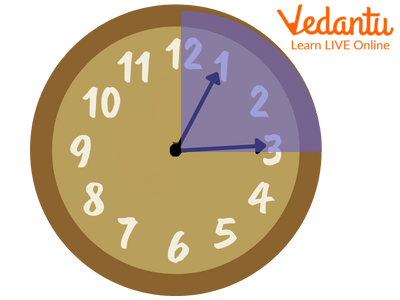
Quarter Past 1
Example to Read Time
If the hour hand is at 7 and the minute hand is at 12 then we would say it is 7 o’clock.
The minute hand will come at 3, then we would say it is quarter past 7.
If the minute hand is present at 6 then it would be half past to 7.
And when it would reach 9 the hour hand would be close to 8, then we would say it is quarter to 8.
How Many Quarters in a Month?
A quarter is one-fourth of the total, whether it would be time or days in a month. To calculate the quarter of a month you can divide 30 by one-fourth. This would give you 7 and half days, which means a quarter in a month consists of 7 and half days. If a month like February is considered then it will have only 7 days in a quarter. And a month that has 31 days in total would have nearly 8 as a quarter in a month.
How Many Quarters are in a Year?
A year has 12 months in total. To find out a quarter of a year you can divide 12 by 4 which will give you the result as 3. This means that a quarter in a year has 3 months in it.
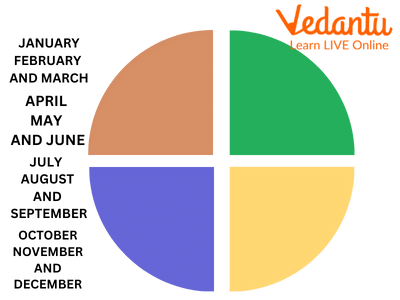
Year Divided Into Quarters
Points To Remember
The bigger or longer hand on the clock is the minute hand and the smaller or short hand is the hour hand.
The minute hand from 12 takes 15 minutes to make it to quarter past.
The minute hand from 12 takes 30 minutes to make it to half past.
The minute hand from 12 takes 45 minutes to make it to a quarter to.
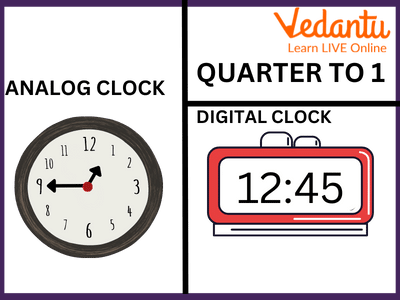
Time Shown In Digital And Analog Clock
Conclusion
An hour consists of 60 minutes which can be divided into 4 equal parts or 2 equal parts known as quarters and halves respectively. Similarly, days in a month and months in a year can also be divided into a quarter of a month and a quarter of a year.
Sample Questions
1. How many minutes are there in a quarter of an hour?
a. 10
B. 20
c. 15
d. 30
Ans: 15
Explanation: an hour consists of 60 minutes which we can divide by 4 to get a quarter of an hour. This will result in 15. So, there are 15 minutes in a quarter of an hour.
2. What does one mean when one says it's quarter past 3?
a. 2:45
b. 3:15
c. 3:30
d. 3:45
Ans: 3:15
Explanation: Quarter past to 3 means that 15 minutes have passed since 3 o’clock. So it can be said as 3:15 too.
3. What do you mean by quarter to 11?
a. It's going to be 30 minutes from 10 o’clock
b. It's 45 minutes past 10 o’clock
c. it's going to be 12 o’clock in 15 minutes.
d. None of the above
Ans: Its 45 minutes past 10 o’clock
Explanation: Quarter to 11 means that only 15 minutes are left for 11 o’clock or in other words we can say that 45 minutes have passed since 10 o’clock and now it would be 11 o’clock soon. It can also be written as 10:45.
FAQs on Quarter Past 12 Explained in Simple Words
1. What does quarter past 12 mean?
Quarter past 12 means 15 minutes after 12 o’clock, which is written as 12:15. In time vocabulary, a “quarter” represents one-fourth of an hour, and one hour has 60 minutes.
- 1 hour = 60 minutes
- One quarter of 60 = 15 minutes
- So, quarter past 12 = 12:15
2. What is quarter past 12 in digital time?
Quarter past 12 in digital time is written as 12:15. Digital clocks show time in numbers separated by a colon.
- The first number (12) shows the hour
- The second number (15) shows the minutes
- So, quarter past 12 = 12:15 (either AM or PM depending on context)
3. How do you show quarter past 12 on an analog clock?
To show quarter past 12 on an analog clock, place the minute hand on 3 and the hour hand slightly past 12. On a clock face:
- The minute hand pointing at 3 represents 15 minutes
- The hour hand moves slightly forward from 12
- This position represents 12:15
4. Why is quarter past 12 equal to 15 minutes?
Quarter past 12 equals 15 minutes because a quarter of an hour is 15 minutes. Since 1 hour = 60 minutes:
- Quarter means one-fourth
- 60 ÷ 4 = 15
- So, a quarter past any hour means 15 minutes after that hour
5. What is the difference between 12 o’clock and quarter past 12?
The difference between 12 o’clock and quarter past 12 is 15 minutes.
- 12 o’clock = 12:00
- Quarter past 12 = 12:15
- 12:15 − 12:00 = 15 minutes
6. How do you calculate quarter past any time?
To calculate quarter past any time, add 15 minutes to the given hour. Follow these steps:
- Start with the hour (for example, 5:00)
- Add 15 minutes
- 5:00 + 15 minutes = 5:15
7. What is quarter past 12 in 24-hour format?
Quarter past 12 in 24-hour format is 00:15 (midnight) or 12:15 (afternoon), depending on whether it is AM or PM.
- 12:15 AM = 00:15
- 12:15 PM = 12:15
8. What fraction of an hour is quarter past 12?
Quarter past 12 represents 1/4 of an hour. Since one hour has 60 minutes:
- 15 minutes ÷ 60 minutes = 1/4
- This can also be written as 0.25 hours
9. Can you give a real-life example of quarter past 12?
A real-life example of quarter past 12 is when a lunch break starts at 12:15 PM. For example:
- If school ends at 12:00 PM
- Students leave 15 minutes later
- They leave at 12:15 PM (quarter past 12)
10. What are common mistakes when reading quarter past 12?
A common mistake when reading quarter past 12 is confusing it with 12:45, which is quarter to 1. Remember:
- Quarter past = 15 minutes after the hour (12:15)
- Quarter to = 15 minutes before the next hour (12:45)
- Minute hand on 3 = quarter past
