




Why is it meant by frequency?
Answer
 Verified
254.4k+ views
Hint: Here in order to understand about the term frequency. Anything that happens at a repeated time interval. Let’s see this in detail.
Complete step by step solution:
Frequency is defined as the number of oscillations or vibrations per second. The below equation relates between frequency and time period.
\[f = \dfrac{1}{T}\]
Where, f is frequency and T is the time period.
The unit of time period is second written as s, and the unit of frequency is hertz denoted by Hz.
Suppose say if the time period is 10seconds, then by using the formula \[f = \dfrac{1}{{10}}\]. Then the frequency is 0.1 hertz. As the number of cycles increases, frequency also increases. One hertz is defined as one cycle per second. Then the cycle is defined as one complete cycle of AC or DC.
Time period is the time taken to complete one oscillation or vibration of a wave. Basically, frequency is something which repeats over a small period of time. We have discussed frequency till this point. Now let’s look at the word natural frequency. It is the frequency at which an object vibrates naturally in the absence of driving force.
Note:There are some relative terms to the frequency that we are going to discuss now. In the wave form the parts of the wave are represented clearly.
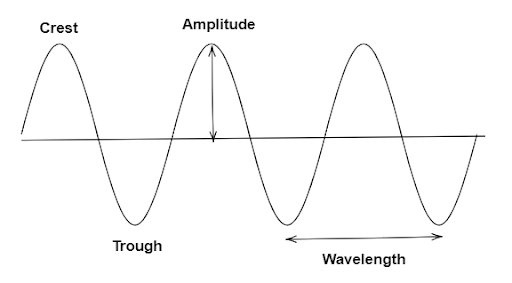
Parts of a wave are,
Wavelength- The distance between the two consecutive crests or troughs is known as wavelength of a wave and is denoted by \[\lambda \].
Amplitude- The maximum displacement of a particle from its mean position is called the amplitude of a wave and it is denoted by A.
Crest- The upper part of the wave in which there is a maximum displacement of the medium.
Trough- Lower part of the wave in which there is a minimum displacement of the medium.
Complete step by step solution:
Frequency is defined as the number of oscillations or vibrations per second. The below equation relates between frequency and time period.
\[f = \dfrac{1}{T}\]
Where, f is frequency and T is the time period.
The unit of time period is second written as s, and the unit of frequency is hertz denoted by Hz.
Suppose say if the time period is 10seconds, then by using the formula \[f = \dfrac{1}{{10}}\]. Then the frequency is 0.1 hertz. As the number of cycles increases, frequency also increases. One hertz is defined as one cycle per second. Then the cycle is defined as one complete cycle of AC or DC.
Time period is the time taken to complete one oscillation or vibration of a wave. Basically, frequency is something which repeats over a small period of time. We have discussed frequency till this point. Now let’s look at the word natural frequency. It is the frequency at which an object vibrates naturally in the absence of driving force.
Note:There are some relative terms to the frequency that we are going to discuss now. In the wave form the parts of the wave are represented clearly.
Parts of a wave are,
Wavelength- The distance between the two consecutive crests or troughs is known as wavelength of a wave and is denoted by \[\lambda \].
Amplitude- The maximum displacement of a particle from its mean position is called the amplitude of a wave and it is denoted by A.
Crest- The upper part of the wave in which there is a maximum displacement of the medium.
Trough- Lower part of the wave in which there is a minimum displacement of the medium.
Recently Updated Pages
Mass vs Weight: Key Differences Explained for Students

Uniform Acceleration Explained: Formula, Examples & Graphs
JEE Main 2022 (June 25th Shift 2) Chemistry Question Paper with Answer Key
Average Atomic Mass - Important Concepts and Tips for JEE
JEE Main 2023 (April 15th Shift 1) Physics Question Paper with Answer Key
JEE Main 2022 (June 27th Shift 2) Chemistry Question Paper with Answer Key
Trending doubts
JEE Main 2026: Exam Dates, Session 2 Updates, City Slip, Admit Card & Latest News
JEE Main Marking Scheme 2026- Paper-Wise Marks Distribution and Negative Marking Details
JEE Main 2026 Application Login: Direct Link, Registration, Form Fill, and Steps
Hybridisation in Chemistry – Concept, Types & Applications
Understanding the Electric Field of a Uniformly Charged Ring
Derivation of Equation of Trajectory Explained for Students
Other Pages
JEE Advanced 2026 - Exam Date (Released), Syllabus, Registration, Eligibility, Preparation, and More
JEE Advanced Marks vs Ranks 2025: Understanding Category-wise Qualifying Marks and Previous Year Cut-offs
CBSE Notes Class 11 Physics Chapter 1 - Units And Measurements - 2025-26
NCERT Solutions For Class 11 Physics Chapter 1 Units And Measurements - 2025-26
Important Questions For Class 11 Physics Chapter 1 Units and Measurement - 2025-26
CBSE Notes Class 11 Physics Chapter 4 - Laws of Motion - 2025-26