




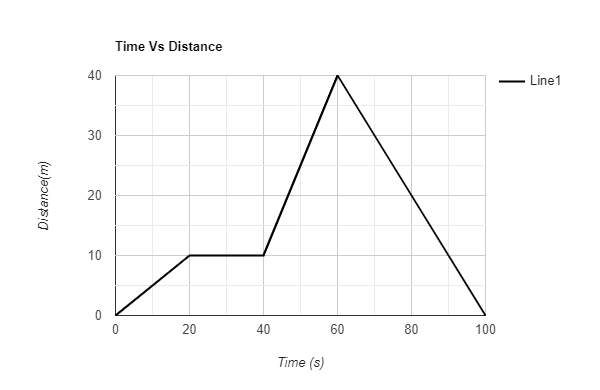
Which part of the distance-time graph represents increasing speed?
A) \[0 - 20\]
B) \[40 - 60\]
C) \[60 - 80\]
D) \[80 - 100\]
Answer
 Verified
264.6k+ views
Hint: Velocity/ Speed increase with the increase in the distance covered by the time.In a line graph representing the time and distance, the distance may increase or decrease as per the time, but the vertical slanting line shows an increase in speed.
Complete step by step solution: We know velocity defines the distance travelled with time. The speed is defined as the time rate of change of the distance. If there is an increase in speed the distance travelled in the time interval will also be increased. And if the speed decreased, the distance covered in the time interval will also be decreased.
Now, let’s discuss the Time vs. Distance line graph given here.
While considering the first time interval (\[0 - 20\]), there is a vertical slanting line which indicates increasing speed.
While considering the second time interval ($20 - 40$) the distance covered is found to be constant and thus there is neither a rise nor a decrease in the speed occurred.
While considering the third time interval (\[40 - 60\]) there shows a vertical slanting line which indicates increasing speed with a greater slope indicates more speed.
While considering the fourth Time interval (\[60 - 80\]), the distance covered is decreasing and the slope indicates the decreased speed.
While considering the last Time interval (\[80 - 100\]), the distance covered is decreasing and the slope indicating the decreased speed is the same as the fourth time interval.
By analysing all these cases the increased speed is represented by the time interval \[40 - 60\] in the Time vs. Distance line graph.
Final answer is: Option (B).
Note: If there is a change in the velocity, there will be a difference in the distance travelled in a time interval, Thus in a time- Distance line graph, There will be difference in the slope of the line.
Speed is calculated by \[s = \dfrac{d}{t}\]
Where, \[s - speed\]
\[d - distance\]
\[t - time\]
Complete step by step solution: We know velocity defines the distance travelled with time. The speed is defined as the time rate of change of the distance. If there is an increase in speed the distance travelled in the time interval will also be increased. And if the speed decreased, the distance covered in the time interval will also be decreased.
Now, let’s discuss the Time vs. Distance line graph given here.
While considering the first time interval (\[0 - 20\]), there is a vertical slanting line which indicates increasing speed.
While considering the second time interval ($20 - 40$) the distance covered is found to be constant and thus there is neither a rise nor a decrease in the speed occurred.
While considering the third time interval (\[40 - 60\]) there shows a vertical slanting line which indicates increasing speed with a greater slope indicates more speed.
While considering the fourth Time interval (\[60 - 80\]), the distance covered is decreasing and the slope indicates the decreased speed.
While considering the last Time interval (\[80 - 100\]), the distance covered is decreasing and the slope indicating the decreased speed is the same as the fourth time interval.
By analysing all these cases the increased speed is represented by the time interval \[40 - 60\] in the Time vs. Distance line graph.
Final answer is: Option (B).
Note: If there is a change in the velocity, there will be a difference in the distance travelled in a time interval, Thus in a time- Distance line graph, There will be difference in the slope of the line.
Speed is calculated by \[s = \dfrac{d}{t}\]
Where, \[s - speed\]
\[d - distance\]
\[t - time\]
Recently Updated Pages
JEE Main Mock Test 2025-26: Principles Related To Practical

JEE Main 2025-26 Experimental Skills Mock Test – Free Practice
JEE Main 2025-26 Electronic Devices Mock Test: Free Practice Online
JEE Main 2025-26 Mock Tests: Free Practice Papers & Solutions
JEE Main 2025-26: Magnetic Effects of Current & Magnetism Mock Test
JEE Main Statistics and Probability Mock Test 2025-26
Trending doubts
JEE Main 2026: Exam Dates, Session 2 Updates, City Slip, Admit Card & Latest News
JEE Main Participating Colleges 2026 - A Complete List of Top Colleges
Hybridisation in Chemistry – Concept, Types & Applications
Understanding the Electric Field of a Uniformly Charged Ring
Derivation of Equation of Trajectory Explained for Students
How to Convert a Galvanometer into an Ammeter or Voltmeter
Other Pages
JEE Advanced 2026 Notification Out with Exam Date, Registration (Extended), Syllabus and More
JEE Advanced Percentile vs Marks 2026: JEE Main Cutoff, AIR & IIT Admission Guide
CBSE Notes Class 11 Physics Chapter 1 - Units And Measurements - 2025-26
NCERT Solutions For Class 11 Physics Chapter 1 Units And Measurements - 2025-26
Important Questions For Class 11 Physics Chapter 1 Units and Measurement - 2025-26
JEE Advanced Weightage Chapter Wise 2026 for Physics, Chemistry, and Mathematics