




Which orbital has the highest$\dfrac{n}{k}\gg 1$value?
[A] 7s
[B] 5p
[C] 3d
[D] 4d
Answer
 Verified
292.8k+ views
Hint: We can solve this question by using the Sommerfeld’s atomic model concept according to which each ‘n’ will have several values of k. We can calculate the $\dfrac{n}{k}$value for each option where ‘n’ will be the energy level and ‘k’ will be the specific s, p, d or f subshell. The highest value of $\dfrac{n}{k}$ will give us the correct answer.
Complete Step by Step Solution:
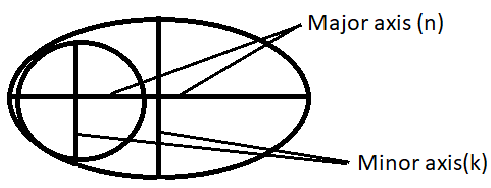
According to Sommerfeld’s atomic model, the orbitals are elliptical and corresponding to each principal quantum number (n) several orbits of varying ellipticity were possible. An ellipse has two axes major and minor and the relation between them was given as-
$\dfrac{n}{k}=\dfrac{major\text{ }axis}{minor\text{ }axis}$
Here, ‘n’ is the principal quantum number. It is the energy level to which the electron belongs and
‘k’ is the azimuthal quantum number which was later changed to ‘l’ for certain mathematical advantages.
Now we will discuss each option to find the orbital with the highest value for$\dfrac{n}{k}\gg 1$,
For s-orbital, $\dfrac{n}{k}=1$as it has a circular orbit therefore, option [A] is incorrect
In option [B], we have 5p orbital,
Here, n will be 5 and corresponding values of k will be-
K = 5 (for s-orbital), 4 (for p-orbital), 3 (for d-orbital), 2(for f-orbital) and 1 (for g-orbital)
Therefore,$\dfrac{n}{k}$for 5p-orbital will be $\dfrac{5}{4}$.
In option [C], we have a 3d orbital.
Here, n will be 3 so we can write the corresponding values of k as-
K = 3 (for s-orbital), 2 (for p-orbital), 1 (for d-orbital)
Therefore,$\dfrac{n}{k}$for 3d-orbital will be $\dfrac{3}{1}$.
In option [D] we have a 4d orbital.
Here, n will be 4 so the corresponding values of k will be –
K= 4 (for s-orbital), 3 (for p-orbital), 2(for d-orbital) and 1 (for f-orbital)
Therefore,$\dfrac{n}{k}$for 4d-orbital will be $\dfrac{4}{2}$.
As we can see from the above calculations that the value of $\dfrac{n}{k}$is highest for a 3d orbital which is 3.
Therefore, the correct answer is option [C] 3d
Note: From the above discussion, we can say that for any given value of ‘n’, k is an integer which is always greater than zero. If the major axis becomes equal to the minor axis, the orbits become circular According to this, we can write that-
If $\dfrac{n}{k}=1$, the orbit is circular and if $\dfrac{n}{k}>1$, the orbit is elliptical.
Complete Step by Step Solution:
According to Sommerfeld’s atomic model, the orbitals are elliptical and corresponding to each principal quantum number (n) several orbits of varying ellipticity were possible. An ellipse has two axes major and minor and the relation between them was given as-
$\dfrac{n}{k}=\dfrac{major\text{ }axis}{minor\text{ }axis}$
Here, ‘n’ is the principal quantum number. It is the energy level to which the electron belongs and
‘k’ is the azimuthal quantum number which was later changed to ‘l’ for certain mathematical advantages.
Now we will discuss each option to find the orbital with the highest value for$\dfrac{n}{k}\gg 1$,
For s-orbital, $\dfrac{n}{k}=1$as it has a circular orbit therefore, option [A] is incorrect
In option [B], we have 5p orbital,
Here, n will be 5 and corresponding values of k will be-
K = 5 (for s-orbital), 4 (for p-orbital), 3 (for d-orbital), 2(for f-orbital) and 1 (for g-orbital)
Therefore,$\dfrac{n}{k}$for 5p-orbital will be $\dfrac{5}{4}$.
In option [C], we have a 3d orbital.
Here, n will be 3 so we can write the corresponding values of k as-
K = 3 (for s-orbital), 2 (for p-orbital), 1 (for d-orbital)
Therefore,$\dfrac{n}{k}$for 3d-orbital will be $\dfrac{3}{1}$.
In option [D] we have a 4d orbital.
Here, n will be 4 so the corresponding values of k will be –
K= 4 (for s-orbital), 3 (for p-orbital), 2(for d-orbital) and 1 (for f-orbital)
Therefore,$\dfrac{n}{k}$for 4d-orbital will be $\dfrac{4}{2}$.
As we can see from the above calculations that the value of $\dfrac{n}{k}$is highest for a 3d orbital which is 3.
Therefore, the correct answer is option [C] 3d
Note: From the above discussion, we can say that for any given value of ‘n’, k is an integer which is always greater than zero. If the major axis becomes equal to the minor axis, the orbits become circular According to this, we can write that-
If $\dfrac{n}{k}=1$, the orbit is circular and if $\dfrac{n}{k}>1$, the orbit is elliptical.
Recently Updated Pages
JEE Main 2023 (February 1st Shift 2) Physics Question Paper with Answer Key

JEE Main 2023 (February 1st Shift 1) Maths Question Paper with Answer Key
JEE Main 2023 (February 1st Shift 2) Chemistry Question Paper with Answer Key
Hydrogen and Its Type Important Concepts and Tips for JEE Exam Preparation
JEE Main 2023 (February 1st Shift 2) Maths Question Paper with Answer Key
JEE Main 2023 (February 1st Shift 1) Physics Question Paper with Answer Key
Trending doubts
JEE Main 2026: Exam Dates, Session 2 Updates, City Slip, Admit Card & Latest News
Understanding the Electric Field of a Uniformly Charged Ring
Understanding Atomic Structure for Beginners
Electron Gain Enthalpy and Electron Affinity Explained
Derivation of Equation of Trajectory Explained for Students
Understanding the Different Types of Solutions in Chemistry
Other Pages
JEE Advanced Percentile vs Marks 2026: JEE Main Cutoff, AIR & IIT Admission Guide
JEE Advanced 2026 Notification Out with Exam Date, Registration (Extended), Syllabus and More
NCERT Solutions For Class 11 Chemistry In Hindi Chapter 1 Some Basic Concepts Of Chemistry - 2026-27 Free PDF Download (Sign-in Required)
How to Convert a Galvanometer into an Ammeter or Voltmeter
JEE Advanced Weightage Chapter Wise 2026 for Physics, Chemistry, and Mathematics
What Are Current and Potential Difference in Electricity?
JEE Advanced Percentile vs Marks 2026: JEE Main Cutoff, AIR & IIT Admission Guide
JEE Advanced 2026 Notification Out with Exam Date, Registration (Extended), Syllabus and More
NCERT Solutions For Class 11 Chemistry In Hindi Chapter 1 Some Basic Concepts Of Chemistry - 2026-27 Free PDF Download (Sign-in Required)