




Which one is correct about the given P-V plot for 2 mole of an ideal gas?
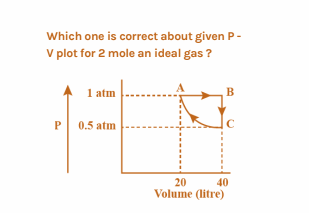
A. ${W_{AB}} = - 20L - atm$
B. $\Delta u$ for cycle = 0
C. $\Delta {S_{cycle}}$ = 0
D. ${W_{CA}} = 13.86 Latm$
Answer
 Verified
264.9k+ views
Hint: For an ideal gas, from the ideal gas law, P-V remains constant through an isothermal process. For an isothermal, reversible process, the work done by the gas is equal to the area under the relevant pressure-volume isotherm.
Formula used:
${W_{AB}} = - {P_{ext}}({V_2} - {V_1})$
$\Delta S + nR\ln (\dfrac{{{v_2}}}{{{v_1}}}) + n{C_V}\ln (\dfrac{{{T_2}}}{{{T_1}}})$
Complete step by step answer:
Now,
According to formula A,
${W_{AB}} = - {P_{ext}}({V_2} - {V_1})$
$ = - 1(40 - 20)$
$ = - 20L $atm
$\Delta u$ For cycle =0 (as initial and final temperatures are same)
$\Delta S = 0$ As initial and final states are same (according to formula B )
Now, the work done in AC=Work done in ABCA-Work done in AB
$ = \dfrac{{\pi \times 0.5 \times 20}}{4} - 20$
$ = - 12.15L atm$
Hence, we can see that option A, B, C are correct.
Note:
There is no “real” gas that is truly an ideal gas. An ideal gas is a theoretical concept which has single points moving randomly with perfectly elastic collisions. All molecules have a volume and intermolecular forces of attraction. So a real molar volume is different from an ideal molar volume.
Formula used:
${W_{AB}} = - {P_{ext}}({V_2} - {V_1})$
$\Delta S + nR\ln (\dfrac{{{v_2}}}{{{v_1}}}) + n{C_V}\ln (\dfrac{{{T_2}}}{{{T_1}}})$
Complete step by step answer:
Now,
According to formula A,
${W_{AB}} = - {P_{ext}}({V_2} - {V_1})$
$ = - 1(40 - 20)$
$ = - 20L $atm
$\Delta u$ For cycle =0 (as initial and final temperatures are same)
$\Delta S = 0$ As initial and final states are same (according to formula B )
Now, the work done in AC=Work done in ABCA-Work done in AB
$ = \dfrac{{\pi \times 0.5 \times 20}}{4} - 20$
$ = - 12.15L atm$
Hence, we can see that option A, B, C are correct.
Note:
There is no “real” gas that is truly an ideal gas. An ideal gas is a theoretical concept which has single points moving randomly with perfectly elastic collisions. All molecules have a volume and intermolecular forces of attraction. So a real molar volume is different from an ideal molar volume.
Recently Updated Pages
JEE Main Mock Test 2025-26: Principles Related To Practical

JEE Main 2025-26 Experimental Skills Mock Test – Free Practice
JEE Main 2025-26 Electronic Devices Mock Test: Free Practice Online
JEE Main 2025-26 Mock Tests: Free Practice Papers & Solutions
JEE Main 2025-26: Magnetic Effects of Current & Magnetism Mock Test
JEE Main Statistics and Probability Mock Test 2025-26
Trending doubts
JEE Main Marking Scheme 2026- Paper-Wise Marks Distribution and Negative Marking Details
Understanding Atomic Structure for Beginners
Degree of Dissociation: Meaning, Formula, Calculation & Uses
Understanding the Electric Field Due to Infinite Linear Charge and Cylinders
Understanding the Angle of Deviation in a Prism
Understanding Instantaneous Velocity
Other Pages