




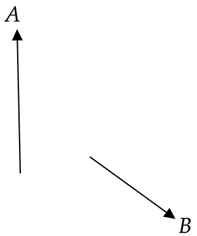
Which of the following vectors best represents the vector \[\overrightarrow{A}+\overrightarrow{B}\] ?
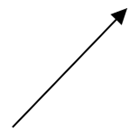
A)
B)
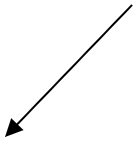
C)
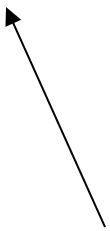
D)
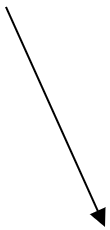
Answer
 Verified
261k+ views
Hint: We all know what vectors are? But let’s brush up our knowledge. Vectors are physical quantities having magnitude as well as a particular direction. Vectors are represented through arrows, as given in the question. The length of the arrow is an indication of the vector’s magnitude and the arrowhead points in the direction of the vector.
Complete step by step solution:
In the given question, we are directed to find the resultant of the addition of the two vectors \[\overrightarrow{A}\] and \[\overrightarrow{B}\] whose diagrammatic representation has been provided to us.
A common method of finding the sum of vectors is to join the head of one of the given vectors to the tail of the other vector. Now, the resultant vector will have its tail at the tail of the first vector and its head at the head of the second vector. The given vectors and the resultant vector will form a triangle and hence this method of vector addition goes by the name of the triangle law for vector addition. For the given question, the triangle law of vector addition can be shown as follows:
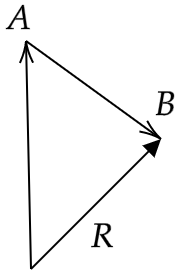
You will see that the tail of the vector \[\overrightarrow{B}\] is joined with the head of the vector \[\overrightarrow{A}\] and then the resultant vector \[\overrightarrow{R}\] has its tail at the tail of the vector \[\overrightarrow{A}\] and its head at the head of vector \[\overrightarrow{B}\]
Only considering the resultant we can represent it as follows
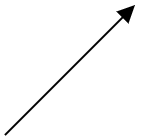
Hence we can say that option (A) is the correct answer and represents the vector \[\overrightarrow{A}+\overrightarrow{B}\].
Note: Students should be careful that while putting the tail of a vector with the head of the other vector, they should not change the magnitude and direction of the original vectors as doing so would furnish them incorrect answers. The triangle law of vector addition has another alternative known as the parallelogram law of vector addition, where the resultant is given as the diagonal of the parallelogram formed by the original vectors.
Complete step by step solution:
In the given question, we are directed to find the resultant of the addition of the two vectors \[\overrightarrow{A}\] and \[\overrightarrow{B}\] whose diagrammatic representation has been provided to us.
A common method of finding the sum of vectors is to join the head of one of the given vectors to the tail of the other vector. Now, the resultant vector will have its tail at the tail of the first vector and its head at the head of the second vector. The given vectors and the resultant vector will form a triangle and hence this method of vector addition goes by the name of the triangle law for vector addition. For the given question, the triangle law of vector addition can be shown as follows:
You will see that the tail of the vector \[\overrightarrow{B}\] is joined with the head of the vector \[\overrightarrow{A}\] and then the resultant vector \[\overrightarrow{R}\] has its tail at the tail of the vector \[\overrightarrow{A}\] and its head at the head of vector \[\overrightarrow{B}\]
Only considering the resultant we can represent it as follows
Hence we can say that option (A) is the correct answer and represents the vector \[\overrightarrow{A}+\overrightarrow{B}\].
Note: Students should be careful that while putting the tail of a vector with the head of the other vector, they should not change the magnitude and direction of the original vectors as doing so would furnish them incorrect answers. The triangle law of vector addition has another alternative known as the parallelogram law of vector addition, where the resultant is given as the diagonal of the parallelogram formed by the original vectors.
Recently Updated Pages
Circuit Switching vs Packet Switching: Key Differences Explained

Dimensions of Pressure in Physics: Formula, Derivation & SI Unit
JEE Extractive Metallurgy Important Concepts and Tips for Exam Preparation
JEE Atomic Structure and Chemical Bonding important Concepts and Tips
JEE Amino Acids and Peptides Important Concepts and Tips for Exam Preparation
Electricity and Magnetism Explained: Key Concepts & Applications
Trending doubts
JEE Main 2026: Exam Dates, Session 2 Updates, City Slip, Admit Card & Latest News
JEE Main Participating Colleges 2026 - A Complete List of Top Colleges
Hybridisation in Chemistry – Concept, Types & Applications
Understanding the Electric Field of a Uniformly Charged Ring
Derivation of Equation of Trajectory Explained for Students
Understanding Atomic Structure for Beginners
Other Pages
JEE Advanced 2026 Notification Out with Exam Date, Registration (Extended), Syllabus and More
JEE Advanced Marks vs Ranks 2025: Understanding Category-wise Qualifying Marks and Previous Year Cut-offs
CBSE Notes Class 11 Physics Chapter 1 - Units And Measurements - 2025-26
NCERT Solutions For Class 11 Physics Chapter 1 Units And Measurements - 2025-26
Important Questions For Class 11 Physics Chapter 1 Units and Measurement - 2025-26
JEE Advanced Weightage Chapter Wise 2026 for Physics, Chemistry, and Mathematics