




Which of the following shows \[ds{{p}^{2}}\] hybridisation and a square planar geometry?
A. $S{{F}_{6}}$
B. $Br{{F}_{5}}$
C. $PC{{l}_{5}}$
D. ${{\left[ Ni{{\left( CN \right)}_{4}} \right]}^{2-}}$
Answer
 Verified
271.5k+ views
Hint: We have to find out the hybridisation, which means when different atomic orbitals are combined having different energies to give the equivalent orbitals. Here we will see the combination of one d orbital, one s orbital and two p orbitals to give the \[ds{{p}^{2}}\] hybridisation and square planar geometry.
Step by step solution:
- We will find the electronic configuration of Ni in the compound ${{\left[ Ni{{\left( CN \right)}_{4}} \right]}^{2-}}$,
- The electronic configuration of Ni is-$1{{s}^{2}}2{{s}^{2}}2{{p}^{6}}3{{s}^{2}}3{{p}^{6}}4{{s}^{2}}3{{d}^{8}}$
- And the electronic configuration of \[N{{i}^{2+}}\]will be-\[1{{s}^{2}}2{{s}^{2}}2{{p}^{6}}3{{s}^{2}}3{{p}^{6}}4{{s}^{0}}3{{d}^{8}}\]
- We can represent the valence bond representation as:
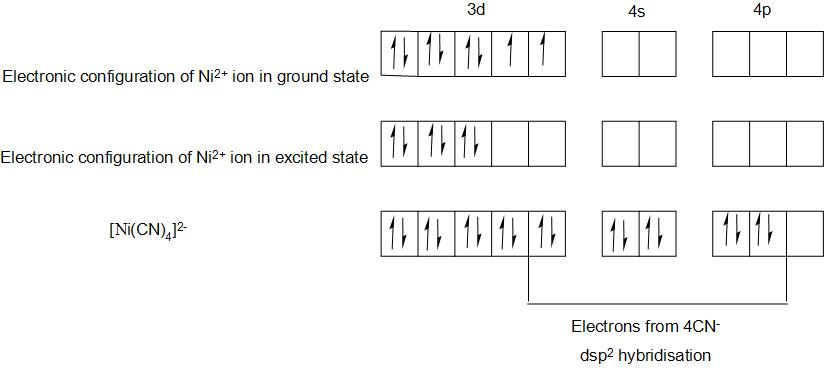
- Here we have filled the 8 electrons of \[N{{i}^{2+}}\] in 3d orbitals, the two unpaired electrons in the ground state of ion, will pair up in the excited state , due to the pairing energy supplied by the formation of strong bonds in the complex.
- This makes one of the 3d orbitals empty. By this we can see above that there are no unpaired electrons and hence the compound will be diamagnetic.
- Here we can see that 4 $C{{N}^{-}}$ ions will form a strong bond in the complex.
- And here the central metal ion undergoes \[ds{{p}^{2}}\] hybridisation and the complex ion takes square planar geometry.
- Therefore, we can conclude that the correct option is(d) that is ${{\left[ Ni{{\left( CN \right)}_{4}} \right]}^{2-}}$ shows \[ds{{p}^{2}}\] hybridisation and a square planar geometry.
- As we have seen from the above valence bond representation that there are no unpaired electrons present and hence it is diamagnetic, we can also say that it has zero magnetic moment.
Note:
- In presence of any strong field ligand like $C{{N}^{-}}$ , all the electrons are paired up, and in the presence of weak field ligands electrons are not paired up.
- We can calculate the magnetic moment, hybridisation, geometry, and magnetic nature from the valence bond representation.
Step by step solution:
- We will find the electronic configuration of Ni in the compound ${{\left[ Ni{{\left( CN \right)}_{4}} \right]}^{2-}}$,
- The electronic configuration of Ni is-$1{{s}^{2}}2{{s}^{2}}2{{p}^{6}}3{{s}^{2}}3{{p}^{6}}4{{s}^{2}}3{{d}^{8}}$
- And the electronic configuration of \[N{{i}^{2+}}\]will be-\[1{{s}^{2}}2{{s}^{2}}2{{p}^{6}}3{{s}^{2}}3{{p}^{6}}4{{s}^{0}}3{{d}^{8}}\]
- We can represent the valence bond representation as:
- Here we have filled the 8 electrons of \[N{{i}^{2+}}\] in 3d orbitals, the two unpaired electrons in the ground state of ion, will pair up in the excited state , due to the pairing energy supplied by the formation of strong bonds in the complex.
- This makes one of the 3d orbitals empty. By this we can see above that there are no unpaired electrons and hence the compound will be diamagnetic.
- Here we can see that 4 $C{{N}^{-}}$ ions will form a strong bond in the complex.
- And here the central metal ion undergoes \[ds{{p}^{2}}\] hybridisation and the complex ion takes square planar geometry.
- Therefore, we can conclude that the correct option is(d) that is ${{\left[ Ni{{\left( CN \right)}_{4}} \right]}^{2-}}$ shows \[ds{{p}^{2}}\] hybridisation and a square planar geometry.
- As we have seen from the above valence bond representation that there are no unpaired electrons present and hence it is diamagnetic, we can also say that it has zero magnetic moment.
Note:
- In presence of any strong field ligand like $C{{N}^{-}}$ , all the electrons are paired up, and in the presence of weak field ligands electrons are not paired up.
- We can calculate the magnetic moment, hybridisation, geometry, and magnetic nature from the valence bond representation.
Recently Updated Pages
JoSAA Counselling 2026: JoSAA 2026 Mock Seat Allotment LIVE: Round 2 Result Released, Registration, Choice Filling and Ranks

Disproportionation Reaction: Definition, Example & JEE Guide
Hess Law of Constant Heat Summation: Definition, Formula & Applications
JEE General Topics in Chemistry Important Concepts and Tips
JEE Extractive Metallurgy Important Concepts and Tips for Exam Preparation
JEE Atomic Structure and Chemical Bonding important Concepts and Tips
Trending doubts
JEE Main 2026: Exam Dates, Session 2 Updates, City Slip, Admit Card & Latest News
JEE Main Participating Colleges 2026 - A Complete List of Top Colleges
Understanding the Electric Field of a Uniformly Charged Ring
Understanding Atomic Structure for Beginners
Derivation of Equation of Trajectory Explained for Students
Understanding the Different Types of Solutions in Chemistry
Other Pages
JEE Advanced 2026 Notification Out with Exam Date, Registration (Extended), Syllabus and More
JEE Advanced Percentile vs Marks 2026: JEE Main Cutoff, AIR & IIT Admission Guide
JEE Advanced Weightage Chapter Wise 2026 for Physics, Chemistry, and Mathematics
JEE Main Marking Scheme 2026- Paper-Wise Marks Distribution and Negative Marking Details
NCERT Solutions For Class 11 Chemistry In Hindi Chapter 1 Some Basic Concepts Of Chemistry - 2025-26
How to Convert a Galvanometer into an Ammeter or Voltmeter