




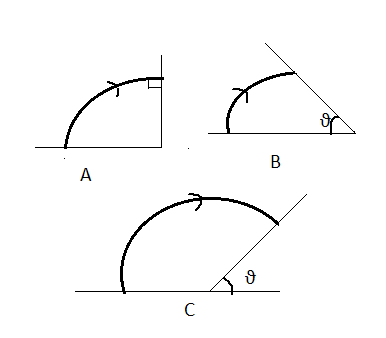
Which of the following relations about the maximum height H of the three balls from the ground during their motion in air is correct?
A) \[{H_A} = {H_C} > {H_B}\]
B) \[{H_A} > {H_B} = {H_C}\]
C) \[{H_A} > {H_c} > {H_B}\]
D) \[{H_A} = {H_B} = {H_C}\]
Answer
 Verified
233.1k+ views
Hint: Maximum height depends on the angle of projection, initial velocity and acceleration due to gravity. From the pictorial representation, three cases are depicted: one where the object has just reached the maximum height, second where the object has yet not reached the maximum height and third where the object has passed its maximum height.
Complete step by step solution:
Maximum height can be calculated only if the angle of projection, initial velocity of projection and the acceleration due to gravity is known. In the above representation these three quantities are not given therefore we will assume that their angle of projection and initial velocity is the same.
We know that maximum height is reached when the object is at the center of its projectile motion, that is it has completed half of its motion. From the above diagram we can clearly see that object A has just reached its maximum height. Object C has crossed its maximum height. And object B is yet to attain its maximum height.
Since Object A and C has already attained their maximum height and B is yet to reach its maximum height, we can conclude that maximum height for A and C will be equal and that for B it will be less than that of A and C.
Hence Option (A) is the correct option.
Note: Since the velocities and angle of projection was not given hence we assumed them to be the same. Also if B would have reached its maximum height then the maximum height of all three objects would have been the same. Maximum height is obtained when an object is projected at an angle perpendicular to the ground.
Complete step by step solution:
Maximum height can be calculated only if the angle of projection, initial velocity of projection and the acceleration due to gravity is known. In the above representation these three quantities are not given therefore we will assume that their angle of projection and initial velocity is the same.
We know that maximum height is reached when the object is at the center of its projectile motion, that is it has completed half of its motion. From the above diagram we can clearly see that object A has just reached its maximum height. Object C has crossed its maximum height. And object B is yet to attain its maximum height.
Since Object A and C has already attained their maximum height and B is yet to reach its maximum height, we can conclude that maximum height for A and C will be equal and that for B it will be less than that of A and C.
Hence Option (A) is the correct option.
Note: Since the velocities and angle of projection was not given hence we assumed them to be the same. Also if B would have reached its maximum height then the maximum height of all three objects would have been the same. Maximum height is obtained when an object is projected at an angle perpendicular to the ground.
Recently Updated Pages
JEE Main 2023 April 6 Shift 1 Question Paper with Answer Key

JEE Main 2023 April 6 Shift 2 Question Paper with Answer Key
JEE Main 2023 (January 31 Evening Shift) Question Paper with Solutions [PDF]
JEE Main 2023 January 30 Shift 2 Question Paper with Answer Key
JEE Main 2023 January 25 Shift 1 Question Paper with Answer Key
JEE Main 2023 January 24 Shift 2 Question Paper with Answer Key
Trending doubts
JEE Main 2026: Session 2 Registration Open, City Intimation Slip, Exam Dates, Syllabus & Eligibility
JEE Main 2026 Application Login: Direct Link, Registration, Form Fill, and Steps
Understanding the Angle of Deviation in a Prism
Hybridisation in Chemistry – Concept, Types & Applications
How to Convert a Galvanometer into an Ammeter or Voltmeter
Understanding Uniform Acceleration in Physics
Other Pages
JEE Advanced Marks vs Ranks 2025: Understanding Category-wise Qualifying Marks and Previous Year Cut-offs
Laws of Motion Class 11 Physics Chapter 4 CBSE Notes - 2025-26
Waves Class 11 Physics Chapter 14 CBSE Notes - 2025-26
Mechanical Properties of Fluids Class 11 Physics Chapter 9 CBSE Notes - 2025-26
Thermodynamics Class 11 Physics Chapter 11 CBSE Notes - 2025-26
Units And Measurements Class 11 Physics Chapter 1 CBSE Notes - 2025-26