




Which of the following is not true about angle of contact?
A) The value of angle of contact for pure water and glass is zero.
B) Angle of contact increases with increase in temperature of liquid.
C) If the angle of contact of a liquid and a solid surface is less than ${90^ \circ }$, then the liquid spreads on the surface of solid.
D) Angle of contact doesn’t depend upon the inclination of the solid surface to the liquid surface.
Answer
 Verified
303k+ views
Hint: The angle of contact is actually the angle between the meniscus and the containing walls of a column of liquid measured from the vertical wall below the surface of the liquid to the position of the tangent to the meniscus at its point of contact with the wall. Angle of contact depends on the nature of liquid and solid, medium in which angle of contact is being made and purity of liquids and solids.
Complete solution:
The problem is asking for the correct statements regarding the angle of contact. So we will consider each statement and then find which of the options is correct.
Let us consider the option A.
For pure water and pure glass, the angle of contact is$0^\circ $. For ordinary water and glass, it lies between \[8^\circ \] and\[18^\circ \]. Hence this statement is true.
Consider option B.
With the increase in temperature, the surface tension of liquid decreases. Due to this the liquid surface on the solid surface becomes more flat so the angle of contact of a liquid increases with the increase in temperature. So the statement in option B is true.
Consider option C.
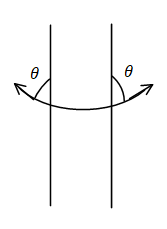
If the angle of contact of a liquid and a solid surface is less than ${90^ \circ }$, then the liquid spreads on the surface of solid, this statement is also true because for contact angle less than ${90^ \circ }$ the difference in the surface tensions of air-solid interface and liquid-solid interface is less than the air-liquid interface.
The diagram for the angle of contact for less than ${90^ \circ }$.
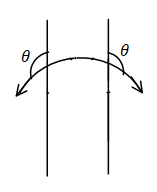
The diagram for the angle of contact more than ${90^ \circ }$.
Consider option D.
Angle of contact doesn’t depend upon the inclination of the solid surface to the liquid surface. Angle of contact actually depends on the inclination of the solid surface so this statement for option D is not true.
The correct answer for this problem is option D.
Note: Keep in mind that the shape of meniscus is decided by the angle of contact which depends on the surface tension. Glass and water always make a concave surface & glass and mercury always makes a convex surface.
Complete solution:
The problem is asking for the correct statements regarding the angle of contact. So we will consider each statement and then find which of the options is correct.
Let us consider the option A.
For pure water and pure glass, the angle of contact is$0^\circ $. For ordinary water and glass, it lies between \[8^\circ \] and\[18^\circ \]. Hence this statement is true.
Consider option B.
With the increase in temperature, the surface tension of liquid decreases. Due to this the liquid surface on the solid surface becomes more flat so the angle of contact of a liquid increases with the increase in temperature. So the statement in option B is true.
Consider option C.
If the angle of contact of a liquid and a solid surface is less than ${90^ \circ }$, then the liquid spreads on the surface of solid, this statement is also true because for contact angle less than ${90^ \circ }$ the difference in the surface tensions of air-solid interface and liquid-solid interface is less than the air-liquid interface.
The diagram for the angle of contact for less than ${90^ \circ }$.
The diagram for the angle of contact more than ${90^ \circ }$.
Consider option D.
Angle of contact doesn’t depend upon the inclination of the solid surface to the liquid surface. Angle of contact actually depends on the inclination of the solid surface so this statement for option D is not true.
The correct answer for this problem is option D.
Note: Keep in mind that the shape of meniscus is decided by the angle of contact which depends on the surface tension. Glass and water always make a concave surface & glass and mercury always makes a convex surface.
Recently Updated Pages
Four persons A B C and D initially at the corners of class 11 physics JEE_Main

What is the difference between Conduction and conv class 11 physics JEE_Main
Moment of inertia of solid sphere about its diameter class 11 physics JEE_Main
If a piece of ice floating on the surface of water class 11 physics JEE_Main
At what temperature speed of sound in air will be doubled class 11 physics JEE_Main
A closed organ pipe and an open organ pipe are tuned class 11 physics JEE_Main
Trending doubts
JEE Main 2026: Exam Dates, Session 2 Updates, City Slip, Admit Card & Latest News
Understanding the Electric Field of a Uniformly Charged Ring
Derivation of Equation of Trajectory Explained for Students
Understanding Atomic Structure for Beginners
How to Convert a Galvanometer into an Ammeter or Voltmeter
Electron Gain Enthalpy and Electron Affinity Explained
Other Pages
CBSE Notes Class 11 Physics Chapter 1 - Units And Measurements - 2026-27 PDF Download (Login Required)
NCERT Solutions For Class 11 Physics Chapter 1 Units And Measurements - 2026-27 Free PDF Download (Login Required)
NCERT Solutions For Class 11 Physics Chapter 2 Motion In A Straight Line - 2026-27 Free PDF Download (Login Required)
Important Questions For Class 11 Physics Chapter 1 Units and Measurement - 2026-27 Free PDF Download (Sign-in Required)
CBSE Notes Class 11 Physics Chapter 2 - Motion in a Straight Line - 2026-27 PDF Download (Login Required)
NCERT Solutions For Class 11 Physics Chapter 3 Motion In A Plane - 2026-27 Free PDF Download (Sign-in Required)
CBSE Notes Class 11 Physics Chapter 1 - Units And Measurements - 2026-27 PDF Download (Login Required)
NCERT Solutions For Class 11 Physics Chapter 1 Units And Measurements - 2026-27 Free PDF Download (Login Required)
NCERT Solutions For Class 11 Physics Chapter 2 Motion In A Straight Line - 2026-27 Free PDF Download (Login Required)