




Which of the following is not possible for a body in uniform motion?
(The shown graph is Displacement vs Time)
A. 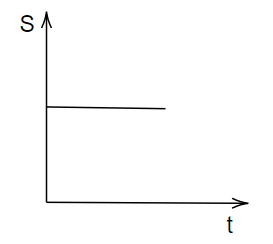
B. 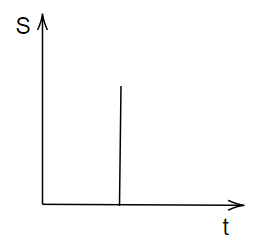
C. Both A and B
D. None of these
Answer
 Verified
283.8k+ views
Hint: The motion in which the object travels in a straight line with uniform speed, is known as uniform motion. This means the velocity of the body remains constant as it covers equal distances in equal intervals of time.
Complete step by step solution:
As we are going to find which one of the following is not possible for uniform motion. In a uniform motion, a body covers equal distances in an equal interval of time. If we consider the graph, by seeing this graph we can say that the body is at rest, that is, there is no motion of the body.
Similarly, if we consider the second graph, here the time taken to move a body is zero or constant, which is not physically possible, that is the body can't have displacement in no time. Therefore, both graphs A and B do not show the uniform motion.
Hence, option C is the correct answer.
Note:There are two types of motion one is uniform motion as we discussed above and the other one is non-uniform motion. A type of motion in which the object travels with a varied speed is called non-uniform motion. This means the object does not cover equal distances in equal time intervals. A car going along a straight level road at a constant speed. A train that is moving along straight tracks at a steady speed etc is an example of uniform motion. Usually, most of the motion around us is non-uniform, that is, an airplane moving through the clouds and then landing, a man running in a 100m race, etc.
Complete step by step solution:
As we are going to find which one of the following is not possible for uniform motion. In a uniform motion, a body covers equal distances in an equal interval of time. If we consider the graph, by seeing this graph we can say that the body is at rest, that is, there is no motion of the body.
Similarly, if we consider the second graph, here the time taken to move a body is zero or constant, which is not physically possible, that is the body can't have displacement in no time. Therefore, both graphs A and B do not show the uniform motion.
Hence, option C is the correct answer.
Note:There are two types of motion one is uniform motion as we discussed above and the other one is non-uniform motion. A type of motion in which the object travels with a varied speed is called non-uniform motion. This means the object does not cover equal distances in equal time intervals. A car going along a straight level road at a constant speed. A train that is moving along straight tracks at a steady speed etc is an example of uniform motion. Usually, most of the motion around us is non-uniform, that is, an airplane moving through the clouds and then landing, a man running in a 100m race, etc.
Recently Updated Pages
How to Calculate Moment of Inertia: Step-by-Step Guide & Formulas

Dimensions of Charge: Dimensional Formula, Derivation, SI Units & Examples
JEE Main 2025-26 Mock Test: Binomial Theorem & Quick Practice
Properties of Solids and Liquids Mock Test 2025
JEE Main Mock Test 2025-26: Principles Related To Practical
JEE Main Mock Test 2025-26: Dual Nature of Matter & Radiation
Trending doubts
JEE Main 2026: Exam Dates, Session 2 Updates, City Slip, Admit Card & Latest News
Understanding the Electric Field of a Uniformly Charged Ring
Understanding Atomic Structure for Beginners
Derivation of Equation of Trajectory Explained for Students
Electron Gain Enthalpy and Electron Affinity Explained
How to Convert a Galvanometer into an Ammeter or Voltmeter
Other Pages
JEE Advanced Percentile vs Marks 2026: JEE Main Cutoff, AIR & IIT Admission Guide
CBSE Notes Class 11 Physics Chapter 1 - Units And Measurements - 2026-27
NCERT Solutions For Class 11 Physics Chapter 1 Units And Measurements - 2026-27 Free PDF Download (Login Required)
NCERT Solutions For Class 11 Physics Chapter 2 Motion In A Straight Line - 2026-27 Free PDF Download (Login Required)
Important Questions For Class 11 Physics Chapter 1 Units and Measurement - 2026-27
CBSE Notes Class 11 Physics Chapter 2 - Motion in a Straight Line - 2026-27