




Which of the following gives a positive Libermann-nitroso test?
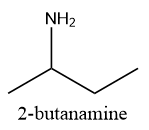
(A) 2-butanamine
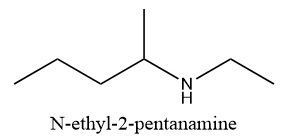
(B) N-ethyl-2-pentanamine
(C) N-methylpiperidine
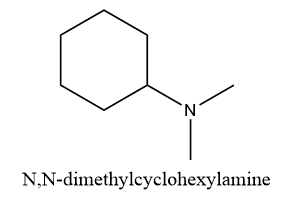
(D) N,N-dimethylcyclohexylamine
Answer
 Verified
249.9k+ views
Hint: The Libermann-nitroso test which is used for the test of secondary amines that may be aliphatic or aromatic. In the test, the secondary amines react with nitrous acid and formation of N-nitrosamines takes place which are water soluble yellow oils which convert into violet or greenish blue on further treatment with alkali.
Complete Step by Step Solution:
As we know that only secondary amines will give a positive result to the Libermann-nitroso test. So, among the given options we have to compare the structures of the given amines as follows:
Structure (A): 2-butanamine
Structure (B): N-ethyl-2-pentanamine
Structure (C): N-methylpiperidine

Structure (D): N,N-dimethylcyclohexylamine
Secondary amines are the amines in which the amino group i.e The nitrogen atom is bonded directly to the two carbon atoms of any hybridization but the carbon atoms must not be carbonyl group carbons.
So, among the given options, structure (A) is eliminated because the nitrogen atom of the amino group is bonded to a single carbon atom only. Structures (C) and (D) are eliminated as well because the nitrogen atom of the amino group in both the compounds are bonded to three carbon atoms i.e., the structure (C) and (D) are the tertiary amines.
In structure B, the nitrogen atom is bonded to two carbon atoms and one hydrogen atom and thus, is a secondary amine which shows positive Liberman-nitroso test. Hence, a positive Libermann-nitroso test will be given by N-ethyl-2-pentanamine.
Therefore, option (B) is the correct answer.
Note: It is important to note that the Libermann-nitroso test is also employed for the test of phenol as on reaction, it forms a deep green or blue colour solution which converts to red on dilution with water.
Complete Step by Step Solution:
As we know that only secondary amines will give a positive result to the Libermann-nitroso test. So, among the given options we have to compare the structures of the given amines as follows:
Structure (A): 2-butanamine
Structure (B): N-ethyl-2-pentanamine
Structure (C): N-methylpiperidine
Structure (D): N,N-dimethylcyclohexylamine
Secondary amines are the amines in which the amino group i.e The nitrogen atom is bonded directly to the two carbon atoms of any hybridization but the carbon atoms must not be carbonyl group carbons.
So, among the given options, structure (A) is eliminated because the nitrogen atom of the amino group is bonded to a single carbon atom only. Structures (C) and (D) are eliminated as well because the nitrogen atom of the amino group in both the compounds are bonded to three carbon atoms i.e., the structure (C) and (D) are the tertiary amines.
In structure B, the nitrogen atom is bonded to two carbon atoms and one hydrogen atom and thus, is a secondary amine which shows positive Liberman-nitroso test. Hence, a positive Libermann-nitroso test will be given by N-ethyl-2-pentanamine.
Therefore, option (B) is the correct answer.
Note: It is important to note that the Libermann-nitroso test is also employed for the test of phenol as on reaction, it forms a deep green or blue colour solution which converts to red on dilution with water.
Recently Updated Pages
JEE Isolation, Preparation and Properties of Non-metals Important Concepts and Tips for Exam Preparation

Isoelectronic Definition in Chemistry: Meaning, Examples & Trends
Ionisation Energy and Ionisation Potential Explained
Iodoform Reactions - Important Concepts and Tips for JEE
Introduction to Dimensions: Understanding the Basics
Instantaneous Velocity Explained: Formula, Examples & Graphs
Trending doubts
JEE Main 2026: Exam Dates, Session 2 Updates, City Slip, Admit Card & Latest News
Hybridisation in Chemistry – Concept, Types & Applications
JEE Main 2026 Application Login: Direct Link, Registration, Form Fill, and Steps
Understanding the Electric Field of a Uniformly Charged Ring
Derivation of Equation of Trajectory Explained for Students
JEE Main Marking Scheme 2026- Paper-Wise Marks Distribution and Negative Marking Details
Other Pages
CBSE Class 12 Chemistry Question Paper 2026 PDF Download (All Sets) with Answer Key
NCERT Solutions For Class 12 Chemistry Chapter 10 Biomolecules - 2025-26
JEE Advanced Marks vs Ranks 2025: Understanding Category-wise Qualifying Marks and Previous Year Cut-offs
NCERT Solutions For Class 12 Chemistry Chapter 2 Electrochemistry - 2025-26
NCERT Solutions For Class 12 Chemistry Chapter 1 Solutions - 2025-26
NCERT Solutions For Class 12 Chemistry Chapter 3 Chemical Kinetics - 2025-26