




Which of the following compounds is known as inorganic benzene?
A. ${{B}_{2}}{{H}_{6}}$
B. ${{C}_{5}}{{H}_{5}}B$
C. ${{C}_{3}}{{N}_{3}}{{H}_{3}}$
D. ${{B}_{3}}{{N}_{3}}{{H}_{6}}$
Answer
 Verified
308.7k+ views
Hint: Inorganic benzene is a cyclic compound, it is called as inorganic benzene because it is isoelectronic and also isostructural with benzene. It is actually a colourless liquid.
Step by step solution:
Borazine is called as the inorganic benzene, which is having chemical formula ${{B}_{3}}{{N}_{3}}{{H}_{6}}$. It is a cyclic compound , we can see the structure of borazine:
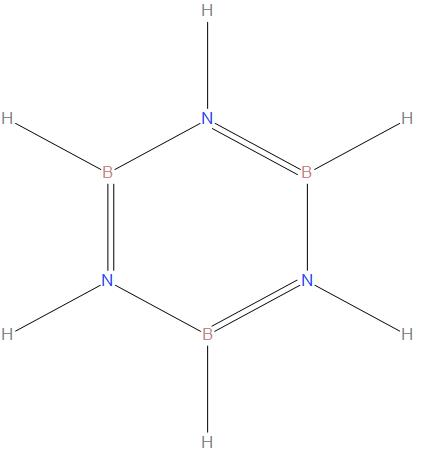
- The bond angle is found to be ${{117.1}^{\circ }}$ at the boron atoms and ${{122.9}^{\circ }}$ at the nitrogen, which will give the distinct symmetry to the molecule.
- There are several properties of borazine found like:
- It is isoelectronic and also isostructural with benzene, isoelectronic means those which have the same number of electrons around them and isostructural means those that are having the same hybridisation and shape as that of others.
-It is colourless and also has an aromatic smell.
- In borazine 12 sigma bonds and 3 pi bonds are found that are the same as in benzene.
- Now let’s see how borazine is being prepared: One of the main method of preparation of borazine is from diborane and ammonia, which are taken in a ratio of 1:2 at about temperature of ${{300}^{\circ }}C$. The reaction can be written as:
\[3{{B}_{2}}{{H}_{6}}+6N{{H}_{3}}\to 2{{B}_{3}}{{H}_{6}}{{N}_{3}}+12{{H}_{2}}\]
-The are several uses of borazine found like:
-It can be used as a precursor for growing boron nitride thin films on various surfaces.
- It is found that these are also used as a starting material for the various other ceramics like boron carbonitrides.
Hence, we can conclude that the correct option is (D) ,${{B}_{3}}{{N}_{3}}{{H}_{6}}$ is known as inorganic benzene.
Note:
We must remember that borazine is also called as borazole along with inorganic benzene, which is a polar compound, in which there are three BH units and three NH units are present alternate.
Step by step solution:
Borazine is called as the inorganic benzene, which is having chemical formula ${{B}_{3}}{{N}_{3}}{{H}_{6}}$. It is a cyclic compound , we can see the structure of borazine:
- The bond angle is found to be ${{117.1}^{\circ }}$ at the boron atoms and ${{122.9}^{\circ }}$ at the nitrogen, which will give the distinct symmetry to the molecule.
- There are several properties of borazine found like:
- It is isoelectronic and also isostructural with benzene, isoelectronic means those which have the same number of electrons around them and isostructural means those that are having the same hybridisation and shape as that of others.
-It is colourless and also has an aromatic smell.
- In borazine 12 sigma bonds and 3 pi bonds are found that are the same as in benzene.
- Now let’s see how borazine is being prepared: One of the main method of preparation of borazine is from diborane and ammonia, which are taken in a ratio of 1:2 at about temperature of ${{300}^{\circ }}C$. The reaction can be written as:
\[3{{B}_{2}}{{H}_{6}}+6N{{H}_{3}}\to 2{{B}_{3}}{{H}_{6}}{{N}_{3}}+12{{H}_{2}}\]
-The are several uses of borazine found like:
-It can be used as a precursor for growing boron nitride thin films on various surfaces.
- It is found that these are also used as a starting material for the various other ceramics like boron carbonitrides.
Hence, we can conclude that the correct option is (D) ,${{B}_{3}}{{N}_{3}}{{H}_{6}}$ is known as inorganic benzene.
Note:
We must remember that borazine is also called as borazole along with inorganic benzene, which is a polar compound, in which there are three BH units and three NH units are present alternate.
Recently Updated Pages
JEE Main 2023 (February 1st Shift 2) Physics Question Paper with Answer Key

JEE Main 2023 (February 1st Shift 1) Maths Question Paper with Answer Key
JEE Main 2023 (February 1st Shift 2) Chemistry Question Paper with Answer Key
Hydrogen and Its Type Important Concepts and Tips for JEE Exam Preparation
JEE Main 2023 (February 1st Shift 1) Physics Question Paper with Answer Key
Apparent Frequency Explained: Formula, Uses & Examples
Trending doubts
JEE Main 2026: Exam Dates, Session 2 Updates, City Slip, Admit Card & Latest News
Understanding the Electric Field of a Uniformly Charged Ring
Derivation of Equation of Trajectory Explained for Students
Understanding Atomic Structure for Beginners
Electron Gain Enthalpy and Electron Affinity Explained
Hybridisation in Chemistry – Concept, Types & Applications
Other Pages
NCERT Solutions For Class 11 Chemistry In Hindi Chapter 1 Some Basic Concepts Of Chemistry - 2026-27 Free PDF Download (Sign-in Required)
JEE Advanced Percentile vs Marks 2026: JEE Main Cutoff, AIR & IIT Admission Guide
JEE Advanced 2026 Notification Out with Exam Date, Registration (Extended), Syllabus and More
CBSE Notes Class 11 Chemistry Chapter 5 - Thermodynamics - 2026-27 PDF Download (Login Required)
NCERT Solutions For Class 11 Chemistry Chapter 5 Thermodynamics - 2026-27 Free PDF Download (Sign-in Required)
NCERT Solutions For Class 11 Chemistry Chapter 7 Redox Reaction - 2026-27 Free PDF Download (Login Required)
NCERT Solutions For Class 11 Chemistry In Hindi Chapter 1 Some Basic Concepts Of Chemistry - 2026-27 Free PDF Download (Sign-in Required)
JEE Advanced Percentile vs Marks 2026: JEE Main Cutoff, AIR & IIT Admission Guide
JEE Advanced 2026 Notification Out with Exam Date, Registration (Extended), Syllabus and More