




Uniform electric field of magnitude $100V{m^{ - 1}}$ in space is directed along the line $y = 3 + x$. Find the potential difference between point $A\left( {3,1} \right)$ and $B\left( {1,3} \right)$.
A) $100V$
B) $200\sqrt 2 V$
C) $200V$
D) $0$
Answer
 Verified
273.9k+ views
Hint: To solve this question we have to first plot the line $y = 3 + x$ . We can easily find the y-intercept and slope of the lone by comparing it with the standard equation. After that we can convert the electric field into its vector form. Also we have to find the position vector of AB. We can then use the electric field and the position vector to find potential differences.
Formulae used:
$y = mx + c$
Where $y$ is the Y-coordinate, $m$ is the slope of the line, $x$ is the X-coordinate of the line and $c$ is the y-intercept of the line.
$\vec r = \left( {{x_2} - {x_1}} \right)\hat i + \left( {{y_2} - {y_1}} \right)\hat j$
Here $\vec r$ is the position vector and $\left( {{x_1},{y_1}} \right)$and $\left( {{x_2},{y_2}} \right)$are the coordinates of two points.
$V = \vec E.\vec r$
Here $V$ potential difference between two points, $\vec E$ is the electric field vector and $\vec r$ is the position vector.
Complete step by step solution:
In the question equation of a straight line is given.
$y = 3 + x$
Let it be equation 1.
We know that,
$y = mx + c$
Where $y$ is the Y-coordinate, $m$ is the slope of the line, $x$ is the X-coordinate of the line and $c$ is the y-intercept of the line.
Comparing equation 1 with the equation of a straight line, we get
$ \Rightarrow m = 1 = \tan 45^\circ $ and
$ \Rightarrow c = 3$
Using the above values, we can plot the line
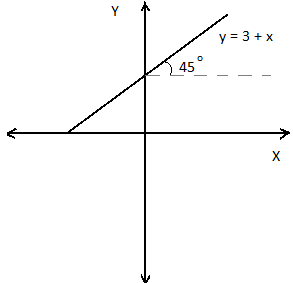
It's said in the question that that electric field is in the direction of the given line.
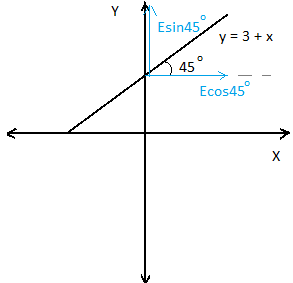
So the components of the electric field will be,
$ \Rightarrow \vec E = \left| E \right|\cos 45\hat i + \left| E \right|\sin 45\hat j$
Putting the value of $\left| E \right|$ in the above equation we get,
$ \Rightarrow \vec E = 100\cos 45\hat i + 100\sin 45\hat j$
$ \Rightarrow \vec E = 100 \times \dfrac{1}{{\sqrt 2 }}\hat i + 100 \times \dfrac{1}{{\sqrt 2 }}\hat j$
$ \Rightarrow \vec E = \dfrac{{100}}{{\sqrt 2 }}\hat i + \dfrac{{100}}{{\sqrt 2 }}\hat j$
In the question, it's given that we have found the potential difference between point $A\left( {3,1} \right)$ and $B\left( {1,3} \right)$. So the position vector will be,
$ \Rightarrow \vec r = \left( {{x_2} - {x_1}} \right)\hat i + \left( {{y_2} - {y_1}} \right)\hat j$
Here $\vec r$ is the position vector and $\left( {{x_1},{y_1}} \right)$ and $\left( {{x_2},{y_2}} \right)$ are the coordinates of two given points.
Substituting the value of the coordinates at point $A\left( {3,1} \right)$ and $B\left( {1,3} \right)$ we get,
$ \Rightarrow \vec r = \left( {1 - 3} \right)\hat i + \left( {3 - 1} \right)\hat j$
$ \Rightarrow \vec r = - 2\hat i + 2\hat j$
So applying the formulae
$ \Rightarrow V = \vec E.\vec r$
Where $V$ potential difference between two points, $\vec E$ is the electric field vector and $\vec r$ is the position vector, we get,
$ \Rightarrow V = \left( {\dfrac{{100}}{{\sqrt 2 }}\hat i + \dfrac{{100}}{{\sqrt 2 }}} \right).\left( { - 2\hat i + 2\hat j} \right)$
$ \Rightarrow V = \left( {\dfrac{{100}}{{\sqrt 2 }} \times - 2} \right) + \left( {\dfrac{{100}}{{\sqrt 2 }} \times 2} \right) = - \dfrac{{200}}{{\sqrt 2 }} + \dfrac{{200}}{{\sqrt 2 }} = 0$
Hence the electric field between the points $A\left( {3,1} \right)$ and $B\left( {1,3} \right)$ will be zero.
Hence option (D) is the correct option.
Note: The electric field can be defined as the gradient of potential difference. It is a vector quantity. So always remember to write it in vector form while solving. Also be careful with the directions. The potential difference also called as voltage is directly proportional to the magnitude of uniform electric field. This is true only for uniform electric fields and if the field was not uniform then this proportionality will not be valid.
Formulae used:
$y = mx + c$
Where $y$ is the Y-coordinate, $m$ is the slope of the line, $x$ is the X-coordinate of the line and $c$ is the y-intercept of the line.
$\vec r = \left( {{x_2} - {x_1}} \right)\hat i + \left( {{y_2} - {y_1}} \right)\hat j$
Here $\vec r$ is the position vector and $\left( {{x_1},{y_1}} \right)$and $\left( {{x_2},{y_2}} \right)$are the coordinates of two points.
$V = \vec E.\vec r$
Here $V$ potential difference between two points, $\vec E$ is the electric field vector and $\vec r$ is the position vector.
Complete step by step solution:
In the question equation of a straight line is given.
$y = 3 + x$
Let it be equation 1.
We know that,
$y = mx + c$
Where $y$ is the Y-coordinate, $m$ is the slope of the line, $x$ is the X-coordinate of the line and $c$ is the y-intercept of the line.
Comparing equation 1 with the equation of a straight line, we get
$ \Rightarrow m = 1 = \tan 45^\circ $ and
$ \Rightarrow c = 3$
Using the above values, we can plot the line
It's said in the question that that electric field is in the direction of the given line.
So the components of the electric field will be,
$ \Rightarrow \vec E = \left| E \right|\cos 45\hat i + \left| E \right|\sin 45\hat j$
Putting the value of $\left| E \right|$ in the above equation we get,
$ \Rightarrow \vec E = 100\cos 45\hat i + 100\sin 45\hat j$
$ \Rightarrow \vec E = 100 \times \dfrac{1}{{\sqrt 2 }}\hat i + 100 \times \dfrac{1}{{\sqrt 2 }}\hat j$
$ \Rightarrow \vec E = \dfrac{{100}}{{\sqrt 2 }}\hat i + \dfrac{{100}}{{\sqrt 2 }}\hat j$
In the question, it's given that we have found the potential difference between point $A\left( {3,1} \right)$ and $B\left( {1,3} \right)$. So the position vector will be,
$ \Rightarrow \vec r = \left( {{x_2} - {x_1}} \right)\hat i + \left( {{y_2} - {y_1}} \right)\hat j$
Here $\vec r$ is the position vector and $\left( {{x_1},{y_1}} \right)$ and $\left( {{x_2},{y_2}} \right)$ are the coordinates of two given points.
Substituting the value of the coordinates at point $A\left( {3,1} \right)$ and $B\left( {1,3} \right)$ we get,
$ \Rightarrow \vec r = \left( {1 - 3} \right)\hat i + \left( {3 - 1} \right)\hat j$
$ \Rightarrow \vec r = - 2\hat i + 2\hat j$
So applying the formulae
$ \Rightarrow V = \vec E.\vec r$
Where $V$ potential difference between two points, $\vec E$ is the electric field vector and $\vec r$ is the position vector, we get,
$ \Rightarrow V = \left( {\dfrac{{100}}{{\sqrt 2 }}\hat i + \dfrac{{100}}{{\sqrt 2 }}} \right).\left( { - 2\hat i + 2\hat j} \right)$
$ \Rightarrow V = \left( {\dfrac{{100}}{{\sqrt 2 }} \times - 2} \right) + \left( {\dfrac{{100}}{{\sqrt 2 }} \times 2} \right) = - \dfrac{{200}}{{\sqrt 2 }} + \dfrac{{200}}{{\sqrt 2 }} = 0$
Hence the electric field between the points $A\left( {3,1} \right)$ and $B\left( {1,3} \right)$ will be zero.
Hence option (D) is the correct option.
Note: The electric field can be defined as the gradient of potential difference. It is a vector quantity. So always remember to write it in vector form while solving. Also be careful with the directions. The potential difference also called as voltage is directly proportional to the magnitude of uniform electric field. This is true only for uniform electric fields and if the field was not uniform then this proportionality will not be valid.
Recently Updated Pages
Wheatstone Bridge – Principle, Formula, Diagram & Applications

Mass vs Weight: Key Differences Explained for Students
Circuit Switching vs Packet Switching: Key Differences Explained
Uniform Acceleration Explained: Formula, Examples & Graphs
Young’s Double Slit Experiment Derivation Explained
Classification of Drugs in Chemistry: Types, Examples & Exam Guide
Trending doubts
JEE Main 2026: Exam Dates, Session 2 Updates, City Slip, Admit Card & Latest News
JEE Main Participating Colleges 2026 - A Complete List of Top Colleges
Kinematics Mock Test for JEE Main 2025-26: Comprehensive Practice
Understanding the Electric Field of a Uniformly Charged Ring
Understanding Atomic Structure for Beginners
Derivation of Equation of Trajectory Explained for Students
Other Pages
CBSE Class 12 Physics Question Paper 2026: Download SET-wise PDF with Answer Key & Analysis
JEE Advanced 2026 Notification Out with Exam Date, Registration (Extended), Syllabus and More
JEE Advanced Percentile vs Marks 2026: JEE Main Cutoff, AIR & IIT Admission Guide
JEE Advanced Weightage Chapter Wise 2026 for Physics, Chemistry, and Mathematics
How to Convert a Galvanometer into an Ammeter or Voltmeter
Electron Gain Enthalpy and Electron Affinity Explained