




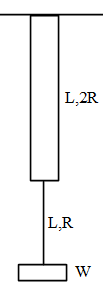
Two wires of the same material (young’s modulus Y) and same length L but radii R and 2R respectively are joined end to end and a weight W is suspended from the combination as shown in the figure. The elastic potential energy in the system in equilibrium is:
A) $\dfrac{{3{W^2}L}}{{4\pi {R^2}Y}}$.
B) $\dfrac{{3{W^2}L}}{{8\pi {R^2}Y}}$.
C) $\dfrac{{5{W^2}L}}{{8\pi {R^2}Y}}$.
D) $\dfrac{{{W^2}L}}{{\pi {R^2}Y}}$.
Answer
 Verified
249.3k+ views
Hint: The potential energy is the energy which is saved inside the wire and is caused due to the elongation of the wire. The young’s modulus of a material is defined as the ratio of the stress and strain and it is constant till the proportional limit.
Formula used: The formula of the potential energy is given by,
$ \Rightarrow E = \dfrac{{{F^2}L}}{{2AY}}$
Where force is F, the original length is L, the area is A and Young’s modulus is Y.
Complete step by step solution:
It is given in the problem that the two wires of the same material (young’s modulus Y) and same length L but radii R and 2R respectively are joined end to end and a weight W is suspended from the combination and we need to find the elastic potential energy in the system in equilibrium condition.
The formula of the potential energy is given by,
$ \Rightarrow E = \dfrac{{{F^2}L}}{{2AY}}$
Where force is F, the original length is L, the area is A and Young’s modulus is Y.
The potential energy of the wire is equal to,
$ \Rightarrow E = \dfrac{{{F^2}L}}{{2AY}}$
The elongation is taking place in the two parts of the wires.
The potential energy of the system is equal to,
$ \Rightarrow E = \dfrac{{{W^2}L}}{{2{A_1}Y}} + \dfrac{{{W^2}L}}{{2{A_2}Y}}$
$ \Rightarrow E = \dfrac{{{W^2}L}}{{2\left( {\pi {R^2}} \right)Y}} + \dfrac{{{W^2}L}}{{2\pi {{\left( {2R} \right)}^2}Y}}$
$ \Rightarrow E = \dfrac{{{W^2}L}}{{2\pi {R^2}Y}} + \dfrac{{{W^2}L}}{{8\pi {R^2}Y}}$
$ \Rightarrow E = \dfrac{{2{W^2}L + {W^2}L}}{{8\pi {R^2}Y}}$
$ \Rightarrow E = \dfrac{{3{W^2}L}}{{8\pi {R^2}Y}}$.
The potential energy of the wire is equal to $E = \dfrac{{3{W^2}L}}{{8\pi {R^2}Y}}$. The correct option for this problem is option B.
Note: The students are advised to understand and remember the formula of the potential energy of the wire as it is very useful in solving these kinds of problems. The change of the length happens due to the applied force or the load due to weight.
Formula used: The formula of the potential energy is given by,
$ \Rightarrow E = \dfrac{{{F^2}L}}{{2AY}}$
Where force is F, the original length is L, the area is A and Young’s modulus is Y.
Complete step by step solution:
It is given in the problem that the two wires of the same material (young’s modulus Y) and same length L but radii R and 2R respectively are joined end to end and a weight W is suspended from the combination and we need to find the elastic potential energy in the system in equilibrium condition.
The formula of the potential energy is given by,
$ \Rightarrow E = \dfrac{{{F^2}L}}{{2AY}}$
Where force is F, the original length is L, the area is A and Young’s modulus is Y.
The potential energy of the wire is equal to,
$ \Rightarrow E = \dfrac{{{F^2}L}}{{2AY}}$
The elongation is taking place in the two parts of the wires.
The potential energy of the system is equal to,
$ \Rightarrow E = \dfrac{{{W^2}L}}{{2{A_1}Y}} + \dfrac{{{W^2}L}}{{2{A_2}Y}}$
$ \Rightarrow E = \dfrac{{{W^2}L}}{{2\left( {\pi {R^2}} \right)Y}} + \dfrac{{{W^2}L}}{{2\pi {{\left( {2R} \right)}^2}Y}}$
$ \Rightarrow E = \dfrac{{{W^2}L}}{{2\pi {R^2}Y}} + \dfrac{{{W^2}L}}{{8\pi {R^2}Y}}$
$ \Rightarrow E = \dfrac{{2{W^2}L + {W^2}L}}{{8\pi {R^2}Y}}$
$ \Rightarrow E = \dfrac{{3{W^2}L}}{{8\pi {R^2}Y}}$.
The potential energy of the wire is equal to $E = \dfrac{{3{W^2}L}}{{8\pi {R^2}Y}}$. The correct option for this problem is option B.
Note: The students are advised to understand and remember the formula of the potential energy of the wire as it is very useful in solving these kinds of problems. The change of the length happens due to the applied force or the load due to weight.
Recently Updated Pages
JEE Isolation, Preparation and Properties of Non-metals Important Concepts and Tips for Exam Preparation

Isoelectronic Definition in Chemistry: Meaning, Examples & Trends
Ionisation Energy and Ionisation Potential Explained
Iodoform Reactions - Important Concepts and Tips for JEE
Introduction to Dimensions: Understanding the Basics
Instantaneous Velocity Explained: Formula, Examples & Graphs
Trending doubts
JEE Main 2026: Exam Dates, Session 2 Updates, City Slip, Admit Card & Latest News
Hybridisation in Chemistry – Concept, Types & Applications
JEE Main 2026 Application Login: Direct Link, Registration, Form Fill, and Steps
Understanding the Electric Field of a Uniformly Charged Ring
Derivation of Equation of Trajectory Explained for Students
JEE Main Marking Scheme 2026- Paper-Wise Marks Distribution and Negative Marking Details
Other Pages
JEE Advanced Marks vs Ranks 2025: Understanding Category-wise Qualifying Marks and Previous Year Cut-offs
JEE Advanced 2026 - Exam Date (Released), Syllabus, Registration, Eligibility, Preparation, and More
CBSE Notes Class 11 Physics Chapter 1 - Units And Measurements - 2025-26
Important Questions For Class 11 Physics Chapter 1 Units and Measurement - 2025-26
NCERT Solutions For Class 11 Physics Chapter 1 Units And Measurements - 2025-26
CBSE Notes Class 11 Physics Chapter 4 - Laws of Motion - 2025-26