




Two wires are made of the same material and have the same volume. However, wire $1$ has cross-sectional area $A$ and wire $2$ has cross-sectional area $3A$. If the length of wire $1$ increases by $\Delta x$ on applying force $F$, how much force is needed to stretch wire $2$ by the same amount?
(A) $4F$
(B) $6F$
(C) $9F$
(D) $F$
Answer
 Verified
265.8k+ views
Hint: As the two wires are the same material, So, we are using the Young’s modulus formula to determine the force required to stretch the second wire. The two wires are the same material, by equating the Young’s modulus equation of the two wires the force required can be determined.
Useful formula
Young’s modulus, $E = \dfrac{\sigma }{\varepsilon }$
Where $E$ is the Young’s modulus, $\sigma $ is the stress, $\varepsilon $ is the strain
Stress, $\sigma = \dfrac{F}{A}$
Where $\sigma $ is the stress, $F$ is the force,$A$ is the area
Strain, $\varepsilon = \dfrac{{\Delta l}}{l}$
Where $\varepsilon $ is the strain, $\Delta l$ is the change in length, $l$ is the original length
Complete step by step solution
Given data:
Area of wire $1$ is ${A_1} = A$,
Area of wire $2$ is ${A_2} = 3A$
The two-wire having same volume,
${A_1}{l_1} = {A_2}{l_2}$
Where ${A_1}$ is the area of the wire $1$, ${A_2}$ is the area of the wire $2$, ${l_1}$ is the length of the wire $1$, ${l_2}$ is the length of the wire $2$
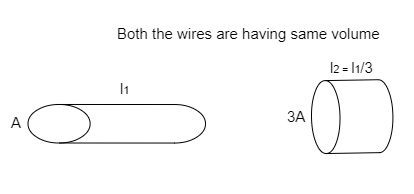
The two-wire having same volume,
$
{A_1}{l_1} = {A_2}{l_2} \\
{l_2} = \dfrac{{{A_1}{l_1}}}{{{A_2}}} \\
$
Substitute ${A_1}$ and ${A_2}$ in the above equation,
${l_2} = \dfrac{{A{l_1}}}{{3A}}$
By cancelling the same terms in the above equation,
${l_2} = \dfrac{{{l_1}}}{3}$
By rearranging the terms in the above equation,
$\dfrac{{{l_1}}}{{{l_2}}} = 3$
The length ratio of two wires, $\dfrac{{{l_1}}}{{{l_2}}} = 3$
By using Young’s modulus equation for wire $1$,
$Y = \dfrac{{{\sigma _1}}}{{{\varepsilon _1}}}$
Where,
${\sigma _1}$ is the stress in wire $1$
${\varepsilon _1}$ is the strain in wire $1$
Now,
$Y = \dfrac{{\left( {\dfrac{{{F_1}}}{{{A_1}}}} \right)}}{{\left( {\dfrac{{\Delta l}}{{{l_1}}}} \right)}}\,.....................\left( 1 \right)$
By using Young’s modulus equation for wire $2$,
$Y = \dfrac{{{\sigma _2}}}{{{\varepsilon _2}}}$
Where,
${\sigma _2}$ is the stress in wire $2$
${\varepsilon _2}$ is the strain in wire $2$
Now,
$Y = \dfrac{{\left( {\dfrac{{{F_2}}}{{{A_2}}}} \right)}}{{\left( {\dfrac{{\Delta l}}{{{l_2}}}} \right)}}\,.............................\left( 2 \right)$
Both the wires are the same material. So, the Young’s modulus is the same.
By equating the equation (1) and (2),
$\dfrac{{\left( {\dfrac{{{F_1}}}{{{A_1}}}} \right)}}{{\left( {\dfrac{{\Delta l}}{{{l_1}}}} \right)}} = \dfrac{{\left( {\dfrac{{{F_2}}}{{{A_2}}}} \right)}}{{\left( {\dfrac{{\Delta l}}{{{l_2}}}} \right)}}$
By substituting the area values in above equation,
$\dfrac{{\left( {\dfrac{{{F_1}}}{A}} \right)}}{{\left( {\dfrac{{\Delta l}}{{{l_1}}}} \right)}} = \dfrac{{\left( {\dfrac{{{F_2}}}{{3A}}} \right)}}{{\left( {\dfrac{{\Delta l}}{{{l_2}}}} \right)}}$
By rearranging the terms,
$\dfrac{{{F_1}}}{A} \times \dfrac{{{l_1}}}{{\Delta l}} = \dfrac{{{F_2}}}{{3A}} \times \dfrac{{{l_2}}}{{\Delta l}}$
By cancelling the same terms in the above equation,
${F_1}{l_1} = \dfrac{{{F_2}{l_2}}}{3}$
By taking ${F_2}$ on one side and other terms in other side,
$
{F_1}{l_1} = \dfrac{{{F_2}{l_2}}}{3} \\
{F_2} = \dfrac{{3{F_1}{l_1}}}{{{l_2}}} \\
$
By rearranging the above equation,
${F_2} = 3 \times {F_1} \times \left( {\dfrac{{{l_1}}}{{{l_2}}}} \right)$
Already we known the length ratio, $\dfrac{{{l_1}}}{{{l_2}}} = 3$ and substitute this ratio value in the above equation,
${F_2} = 3 \times {F_1} \times \left( 3 \right)$
On multiplying,
${F_2} = 9{F_1}$
Thus, the amount of force is required to stretch the wire $2$ is $9F$.
Hence, the option (C) is correct.
Note: Both the wires are the same volume, so the length ratio can be determined. And the change in length of the two wires are the same. Because both the wires are having the same volume. Both the wires are the same material and the Young’s modulus is the same for both wires.
Useful formula
Young’s modulus, $E = \dfrac{\sigma }{\varepsilon }$
Where $E$ is the Young’s modulus, $\sigma $ is the stress, $\varepsilon $ is the strain
Stress, $\sigma = \dfrac{F}{A}$
Where $\sigma $ is the stress, $F$ is the force,$A$ is the area
Strain, $\varepsilon = \dfrac{{\Delta l}}{l}$
Where $\varepsilon $ is the strain, $\Delta l$ is the change in length, $l$ is the original length
Complete step by step solution
Given data:
Area of wire $1$ is ${A_1} = A$,
Area of wire $2$ is ${A_2} = 3A$
The two-wire having same volume,
${A_1}{l_1} = {A_2}{l_2}$
Where ${A_1}$ is the area of the wire $1$, ${A_2}$ is the area of the wire $2$, ${l_1}$ is the length of the wire $1$, ${l_2}$ is the length of the wire $2$
The two-wire having same volume,
$
{A_1}{l_1} = {A_2}{l_2} \\
{l_2} = \dfrac{{{A_1}{l_1}}}{{{A_2}}} \\
$
Substitute ${A_1}$ and ${A_2}$ in the above equation,
${l_2} = \dfrac{{A{l_1}}}{{3A}}$
By cancelling the same terms in the above equation,
${l_2} = \dfrac{{{l_1}}}{3}$
By rearranging the terms in the above equation,
$\dfrac{{{l_1}}}{{{l_2}}} = 3$
The length ratio of two wires, $\dfrac{{{l_1}}}{{{l_2}}} = 3$
By using Young’s modulus equation for wire $1$,
$Y = \dfrac{{{\sigma _1}}}{{{\varepsilon _1}}}$
Where,
${\sigma _1}$ is the stress in wire $1$
${\varepsilon _1}$ is the strain in wire $1$
Now,
$Y = \dfrac{{\left( {\dfrac{{{F_1}}}{{{A_1}}}} \right)}}{{\left( {\dfrac{{\Delta l}}{{{l_1}}}} \right)}}\,.....................\left( 1 \right)$
By using Young’s modulus equation for wire $2$,
$Y = \dfrac{{{\sigma _2}}}{{{\varepsilon _2}}}$
Where,
${\sigma _2}$ is the stress in wire $2$
${\varepsilon _2}$ is the strain in wire $2$
Now,
$Y = \dfrac{{\left( {\dfrac{{{F_2}}}{{{A_2}}}} \right)}}{{\left( {\dfrac{{\Delta l}}{{{l_2}}}} \right)}}\,.............................\left( 2 \right)$
Both the wires are the same material. So, the Young’s modulus is the same.
By equating the equation (1) and (2),
$\dfrac{{\left( {\dfrac{{{F_1}}}{{{A_1}}}} \right)}}{{\left( {\dfrac{{\Delta l}}{{{l_1}}}} \right)}} = \dfrac{{\left( {\dfrac{{{F_2}}}{{{A_2}}}} \right)}}{{\left( {\dfrac{{\Delta l}}{{{l_2}}}} \right)}}$
By substituting the area values in above equation,
$\dfrac{{\left( {\dfrac{{{F_1}}}{A}} \right)}}{{\left( {\dfrac{{\Delta l}}{{{l_1}}}} \right)}} = \dfrac{{\left( {\dfrac{{{F_2}}}{{3A}}} \right)}}{{\left( {\dfrac{{\Delta l}}{{{l_2}}}} \right)}}$
By rearranging the terms,
$\dfrac{{{F_1}}}{A} \times \dfrac{{{l_1}}}{{\Delta l}} = \dfrac{{{F_2}}}{{3A}} \times \dfrac{{{l_2}}}{{\Delta l}}$
By cancelling the same terms in the above equation,
${F_1}{l_1} = \dfrac{{{F_2}{l_2}}}{3}$
By taking ${F_2}$ on one side and other terms in other side,
$
{F_1}{l_1} = \dfrac{{{F_2}{l_2}}}{3} \\
{F_2} = \dfrac{{3{F_1}{l_1}}}{{{l_2}}} \\
$
By rearranging the above equation,
${F_2} = 3 \times {F_1} \times \left( {\dfrac{{{l_1}}}{{{l_2}}}} \right)$
Already we known the length ratio, $\dfrac{{{l_1}}}{{{l_2}}} = 3$ and substitute this ratio value in the above equation,
${F_2} = 3 \times {F_1} \times \left( 3 \right)$
On multiplying,
${F_2} = 9{F_1}$
Thus, the amount of force is required to stretch the wire $2$ is $9F$.
Hence, the option (C) is correct.
Note: Both the wires are the same volume, so the length ratio can be determined. And the change in length of the two wires are the same. Because both the wires are having the same volume. Both the wires are the same material and the Young’s modulus is the same for both wires.
Recently Updated Pages
JEE Main Mock Test 2025-26: Principles Related To Practical

JEE Main 2025-26 Experimental Skills Mock Test – Free Practice
JEE Main 2025-26 Electronic Devices Mock Test: Free Practice Online
JEE Main 2025-26 Mock Tests: Free Practice Papers & Solutions
JEE Main 2025-26: Magnetic Effects of Current & Magnetism Mock Test
JEE Main Statistics and Probability Mock Test 2025-26
Trending doubts
JEE Main 2026: Exam Dates, Session 2 Updates, City Slip, Admit Card & Latest News
JEE Main Participating Colleges 2026 - A Complete List of Top Colleges
Hybridisation in Chemistry – Concept, Types & Applications
Understanding the Electric Field of a Uniformly Charged Ring
Derivation of Equation of Trajectory Explained for Students
Understanding Atomic Structure for Beginners
Other Pages
JEE Advanced 2026 Notification Out with Exam Date, Registration (Extended), Syllabus and More
JEE Advanced Percentile vs Marks 2026: JEE Main Cutoff, AIR & IIT Admission Guide
CBSE Notes Class 11 Physics Chapter 1 - Units And Measurements - 2025-26
JEE Advanced 2026 Marks vs Rank: Estimate IIT Rank from Your Score
NCERT Solutions For Class 11 Physics Chapter 1 Units And Measurements - 2025-26
Important Questions For Class 11 Physics Chapter 1 Units and Measurement - 2025-26