




Two particles $ A $ and $ B $ are projected simultaneously from ground towards each other as shown. If they collide in mid-air then, the height above the ground where they collide is:
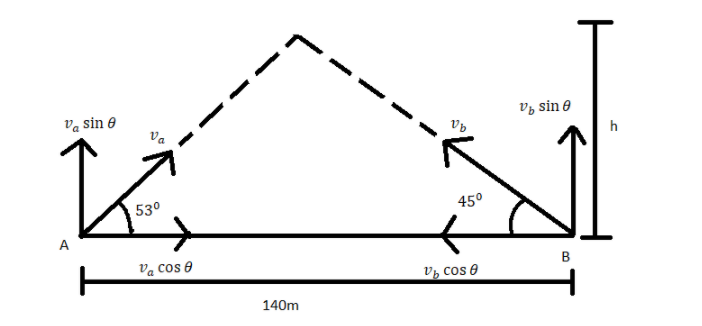
(A) $ 75m $
(B) $ 25m $
(C) $ 100m $
(D) $ 125m $
Answer
 Verified
233.1k+ views
Hint: We will solve this question with the help of basic equations of projectile motion and relative motion. Projectile motion is a form of motion experienced by an object or particle that is projected near the Earth's surface and moves along a curved path under the action of gravity only.
Formula Used:
The formula for height of the particle at any time $ t $ sec:
$ h = ut + \dfrac{1}{2}a{t^2} $
Where
$ t $ is time in seconds
$ h $ is height of the particle at any point of time
$ u $ is the initial speed of the particle
$ a $ is the acceleration due to gravity
Complete Step-by-Step Solution:
Let us suppose that both the particles meet at a height $ h $ from ground level.
Then in X-axis,
Distance between both the particles is $ 140m $
$ {v_a} $ in X-axis $ = 100\cos {53^\circ } $
$ = 100 \times \dfrac{3}{5} = 60m/s $
The relative velocity between the two particles is given by
$ {v_{ab}} = {v_a} - {v_b} $
$ \Rightarrow {v_{ab}} = 60 - ( - \dfrac{{{v_b}}}{{\sqrt 2 }}) $
Hence we get,
$ \Rightarrow {v_{ab}} = 60 + \dfrac{{{v_b}}}{{\sqrt 2 }} $
So, the time of collision, $ t = \dfrac{{140}}{{60 + \dfrac{{{v_b}}}{{\sqrt 2 }}}} $
In Y-axis
Height at which they collide is same as $ h $
$ h = {v_a}\sin {53^\circ } - \dfrac{1}{2}g{t^2} $ …………………. (i)
Also,
$ h = {v_b}\sin {45^\circ } - \dfrac{1}{2}g{t^2} $ …………………(ii)
$ \Rightarrow 100\sin {53^\circ } + ( - \dfrac{1}{2} \times 10 \times {t^2}) = {v_b}\sin 45 \times t - \dfrac{1}{2}g{t^2} $
Hence we get,
$ \Rightarrow 100 \times \dfrac{4}{5} = \dfrac{{{v_b}}}{{\sqrt 2 }} $
$ \therefore {v_b} = 80\sqrt 2 m/s $
Time of collision $ = \dfrac{{140}}{{60 + \dfrac{{80\sqrt 2 }}{{\sqrt 2 }}}} $ $ = 1\sec $
Now we put the values of $ t $ in equation (i), we get
$ h = 80 + ( - \dfrac{1}{2} \times 10 \times {t^2}) $
$ \Rightarrow h = 80 \times 1 - \dfrac{1}{2} \times 10 \times {1^2} $
Therefore we get,
$ \therefore h = 75cm $
Now we will conform our answer by putting the value in equation (ii)
$ \Rightarrow h = 80\sqrt 2 \times \dfrac{1}{{\sqrt 2 }} \times 1 - \dfrac{1}{2} \times 10 \times {1^2} $
$ \Rightarrow h = 80 - 5 = 75m $
Hence the correct answer is option A.
Note: We should always confirm the answer by putting the value of $ t $ in the equation (i) and (ii) obtained. This will correct our errors in case we have accidently made and our final answer will be more accurate.
Formula Used:
The formula for height of the particle at any time $ t $ sec:
$ h = ut + \dfrac{1}{2}a{t^2} $
Where
$ t $ is time in seconds
$ h $ is height of the particle at any point of time
$ u $ is the initial speed of the particle
$ a $ is the acceleration due to gravity
Complete Step-by-Step Solution:
Let us suppose that both the particles meet at a height $ h $ from ground level.
Then in X-axis,
Distance between both the particles is $ 140m $
$ {v_a} $ in X-axis $ = 100\cos {53^\circ } $
$ = 100 \times \dfrac{3}{5} = 60m/s $
The relative velocity between the two particles is given by
$ {v_{ab}} = {v_a} - {v_b} $
$ \Rightarrow {v_{ab}} = 60 - ( - \dfrac{{{v_b}}}{{\sqrt 2 }}) $
Hence we get,
$ \Rightarrow {v_{ab}} = 60 + \dfrac{{{v_b}}}{{\sqrt 2 }} $
So, the time of collision, $ t = \dfrac{{140}}{{60 + \dfrac{{{v_b}}}{{\sqrt 2 }}}} $
In Y-axis
Height at which they collide is same as $ h $
$ h = {v_a}\sin {53^\circ } - \dfrac{1}{2}g{t^2} $ …………………. (i)
Also,
$ h = {v_b}\sin {45^\circ } - \dfrac{1}{2}g{t^2} $ …………………(ii)
$ \Rightarrow 100\sin {53^\circ } + ( - \dfrac{1}{2} \times 10 \times {t^2}) = {v_b}\sin 45 \times t - \dfrac{1}{2}g{t^2} $
Hence we get,
$ \Rightarrow 100 \times \dfrac{4}{5} = \dfrac{{{v_b}}}{{\sqrt 2 }} $
$ \therefore {v_b} = 80\sqrt 2 m/s $
Time of collision $ = \dfrac{{140}}{{60 + \dfrac{{80\sqrt 2 }}{{\sqrt 2 }}}} $ $ = 1\sec $
Now we put the values of $ t $ in equation (i), we get
$ h = 80 + ( - \dfrac{1}{2} \times 10 \times {t^2}) $
$ \Rightarrow h = 80 \times 1 - \dfrac{1}{2} \times 10 \times {1^2} $
Therefore we get,
$ \therefore h = 75cm $
Now we will conform our answer by putting the value in equation (ii)
$ \Rightarrow h = 80\sqrt 2 \times \dfrac{1}{{\sqrt 2 }} \times 1 - \dfrac{1}{2} \times 10 \times {1^2} $
$ \Rightarrow h = 80 - 5 = 75m $
Hence the correct answer is option A.
Note: We should always confirm the answer by putting the value of $ t $ in the equation (i) and (ii) obtained. This will correct our errors in case we have accidently made and our final answer will be more accurate.
Recently Updated Pages
JEE Main 2023 April 6 Shift 1 Question Paper with Answer Key

JEE Main 2023 April 6 Shift 2 Question Paper with Answer Key
JEE Main 2023 (January 31 Evening Shift) Question Paper with Solutions [PDF]
JEE Main 2023 January 30 Shift 2 Question Paper with Answer Key
JEE Main 2023 January 25 Shift 1 Question Paper with Answer Key
JEE Main 2023 January 24 Shift 2 Question Paper with Answer Key
Trending doubts
JEE Main 2026: Session 2 Registration Open, City Intimation Slip, Exam Dates, Syllabus & Eligibility
JEE Main 2026 Application Login: Direct Link, Registration, Form Fill, and Steps
JEE Main Marking Scheme 2026- Paper-Wise Marks Distribution and Negative Marking Details
Understanding the Angle of Deviation in a Prism
Hybridisation in Chemistry – Concept, Types & Applications
How to Convert a Galvanometer into an Ammeter or Voltmeter
Other Pages
JEE Advanced Marks vs Ranks 2025: Understanding Category-wise Qualifying Marks and Previous Year Cut-offs
Laws of Motion Class 11 Physics Chapter 4 CBSE Notes - 2025-26
Waves Class 11 Physics Chapter 14 CBSE Notes - 2025-26
Mechanical Properties of Fluids Class 11 Physics Chapter 9 CBSE Notes - 2025-26
Thermodynamics Class 11 Physics Chapter 11 CBSE Notes - 2025-26
Units And Measurements Class 11 Physics Chapter 1 CBSE Notes - 2025-26