




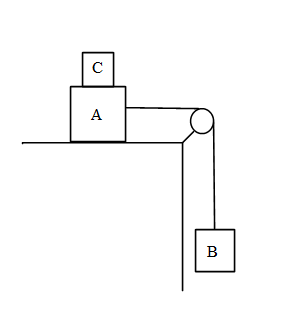
Two masses A and B of 10 kg and 5 kg respectively are connected with a string passing over a frictionless pulley fixed at the corner of a table as in figure. The coefficient of friction of A with the table is 0.2. The minimum mass of C that may be placed on A to prevent it from moving is equal to:
A) 20 kg.
B) 15 kg.
C) 10 kg.
D) 5 kg.
E) 0 kg.
Answer
 Verified
283.8k+ views
Hint: The friction is the resistive force which stops the movement of the body. The friction depends upon the coefficient of friction which is constant for a material and also it depends upon the roughness of the surface.
Formula used:
The formula of the weight is equal to,
$ \Rightarrow W = mg$
Where mass is m and acceleration due to gravity is g.
The formula of the friction is given by,
$ \Rightarrow f = \mu \times R$
Where the coefficient of friction is $\mu $ and the normal reaction is R.
Complete step by step solution:
In this problem it is given that two masses A and B of 10 kg and 5 kg respectively are connected with a string passing over a frictionless pulley fixed at the corner of a table as in figure the coefficient of friction of A with the table is 0.2 and we need to find the minimum mass of C that may be placed on A to prevent it from moving.
The free body diagram of the system.
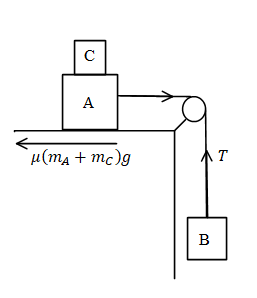
The tension in the string is equal to,
$ \Rightarrow T = {m_B}g$
$ \Rightarrow T = 5 \times 10$
$ \Rightarrow T = 50N$
The force that the combination of block A and C is 50 N.
$ \Rightarrow T = \mu \left( {{m_A} + {m_B}} \right)g$
$ \Rightarrow T = 0 \cdot 2 \times \left( {10 + {m_B}} \right) \times 10$
$ \Rightarrow T = 2 \times \left( {10 + {m_B}} \right)$
$ \Rightarrow T = 20 + 2{m_B}$
$ \Rightarrow 50 = 20 + 2{m_B}$
$ \Rightarrow 2{m_B} = 30$
$ \Rightarrow {m_B} = 15kg$
The minimum mass of the block B is equal to 15kg.
The correct answer for this problem is option B.
Note: The students are advised to understand and remember the formula of the friction and also the formula of the weight. The friction force should be equal to the tension of the string so that the combination of block A and C doesn’t move.
Formula used:
The formula of the weight is equal to,
$ \Rightarrow W = mg$
Where mass is m and acceleration due to gravity is g.
The formula of the friction is given by,
$ \Rightarrow f = \mu \times R$
Where the coefficient of friction is $\mu $ and the normal reaction is R.
Complete step by step solution:
In this problem it is given that two masses A and B of 10 kg and 5 kg respectively are connected with a string passing over a frictionless pulley fixed at the corner of a table as in figure the coefficient of friction of A with the table is 0.2 and we need to find the minimum mass of C that may be placed on A to prevent it from moving.
The free body diagram of the system.
The tension in the string is equal to,
$ \Rightarrow T = {m_B}g$
$ \Rightarrow T = 5 \times 10$
$ \Rightarrow T = 50N$
The force that the combination of block A and C is 50 N.
$ \Rightarrow T = \mu \left( {{m_A} + {m_B}} \right)g$
$ \Rightarrow T = 0 \cdot 2 \times \left( {10 + {m_B}} \right) \times 10$
$ \Rightarrow T = 2 \times \left( {10 + {m_B}} \right)$
$ \Rightarrow T = 20 + 2{m_B}$
$ \Rightarrow 50 = 20 + 2{m_B}$
$ \Rightarrow 2{m_B} = 30$
$ \Rightarrow {m_B} = 15kg$
The minimum mass of the block B is equal to 15kg.
The correct answer for this problem is option B.
Note: The students are advised to understand and remember the formula of the friction and also the formula of the weight. The friction force should be equal to the tension of the string so that the combination of block A and C doesn’t move.
Recently Updated Pages
How to Calculate Moment of Inertia: Step-by-Step Guide & Formulas

Dimensions of Charge: Dimensional Formula, Derivation, SI Units & Examples
JEE Main 2025-26 Mock Test: Binomial Theorem & Quick Practice
Properties of Solids and Liquids Mock Test 2025
JEE Main Mock Test 2025-26: Principles Related To Practical
JEE Main Mock Test 2025-26: Dual Nature of Matter & Radiation
Trending doubts
Understanding Uniform Acceleration in Physics
Understanding Electromagnetic Waves and Their Importance
Dimensions of Pressure: Complete Guide with Formula, Derivation & Examples
Understanding Instantaneous Velocity
Degree of Dissociation: Meaning, Formula, Calculation & Uses
Understanding How a Current Loop Acts as a Magnetic Dipole
Other Pages
JEE Advanced 2026 Notification Out with Exam Date, Registration (Extended), Syllabus and More
CBSE Notes Class 11 Physics Chapter 14 - Waves - 2026-27
Find the frictional force between the two blocks in class 11 physics JEE_MAIN
NCERT Solutions For Class 11 Physics In Hindi Chapter 1 Physical World - 2026-27
Understanding the Angle of Deviation in a Prism
Valentine Week 2026 Complete List, Dates, Quotes & Wishes