




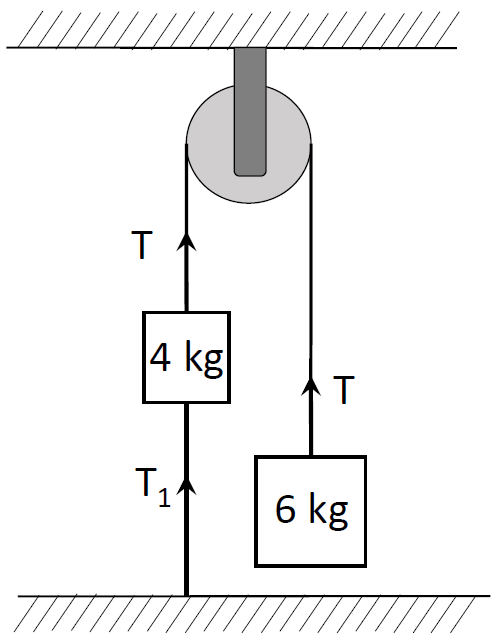
Two bodies of mass 4 and 6 kg are attached to the ends of a string passing over a pulley. The 4 kg mass is attached to the table top by another string. The tension in this string ${T_1}$ is equal to
Answer
 Verified
261.6k+ views
Hint: All the bodies are in a state of rest and the net force acting on each of them is zero. First find value of $T$ using force balance on 6 kg body and considering frictionless pulley use this value to find ${T_1}$ by considering force balance on 4 kg body.
Complete answer:
In the above system, all the bodies are in a state of rest. So there is no net acceleration on anybody and thus no net force is acting on both the masses. Let the tension in the string connecting both the masses be $T$. This tension will be an upward force acting on mass 6kg. If we consider the 6 kg mass then we have two forces acting on it. Tension, $T$ is balancing the weight of the mass in downward direction. Both these forces are in the opposite direction. Let the acceleration due to the gravity be $g = 9.8m/{s^2}$. Therefore,
$T = mg$ where $m = 6kg$.
$T = 6 \times 9.8 = 58.8N$
They have not specified any details about pulley, so we will assume it is frictionless and then consider that this tension remains same over it and acts on 4kg mass in the upward direction balancing the tension in the bottom string which connects the 4kg mass to the table and the weight of the mass. Therefore, we can write the force balance for 4kg mass as follows:
${T_1} + {m_1}g = T = 58.8N$, where ${m_1} = 4kg$
$
\Rightarrow {T_1} = 58.8 - 4 \times 9.8 \\
\Rightarrow {T_1} = 19.6N \\
$
Note: Many times, acceleration due to gravity is considered $10m/{s^2}$ for its simplicity in calculations. So better to carry the term till the end and substitute accordingly if the numerical value is required in multiple choice questions.
Complete answer:
In the above system, all the bodies are in a state of rest. So there is no net acceleration on anybody and thus no net force is acting on both the masses. Let the tension in the string connecting both the masses be $T$. This tension will be an upward force acting on mass 6kg. If we consider the 6 kg mass then we have two forces acting on it. Tension, $T$ is balancing the weight of the mass in downward direction. Both these forces are in the opposite direction. Let the acceleration due to the gravity be $g = 9.8m/{s^2}$. Therefore,
$T = mg$ where $m = 6kg$.
$T = 6 \times 9.8 = 58.8N$
They have not specified any details about pulley, so we will assume it is frictionless and then consider that this tension remains same over it and acts on 4kg mass in the upward direction balancing the tension in the bottom string which connects the 4kg mass to the table and the weight of the mass. Therefore, we can write the force balance for 4kg mass as follows:
${T_1} + {m_1}g = T = 58.8N$, where ${m_1} = 4kg$
$
\Rightarrow {T_1} = 58.8 - 4 \times 9.8 \\
\Rightarrow {T_1} = 19.6N \\
$
Note: Many times, acceleration due to gravity is considered $10m/{s^2}$ for its simplicity in calculations. So better to carry the term till the end and substitute accordingly if the numerical value is required in multiple choice questions.
Recently Updated Pages
Circuit Switching vs Packet Switching: Key Differences Explained

Dimensions of Pressure in Physics: Formula, Derivation & SI Unit
JEE Extractive Metallurgy Important Concepts and Tips for Exam Preparation
JEE Atomic Structure and Chemical Bonding important Concepts and Tips
JEE Amino Acids and Peptides Important Concepts and Tips for Exam Preparation
Electricity and Magnetism Explained: Key Concepts & Applications
Trending doubts
JEE Main 2026: Exam Dates, Session 2 Updates, City Slip, Admit Card & Latest News
JEE Main Participating Colleges 2026 - A Complete List of Top Colleges
Hybridisation in Chemistry – Concept, Types & Applications
Understanding the Electric Field of a Uniformly Charged Ring
Derivation of Equation of Trajectory Explained for Students
Understanding Atomic Structure for Beginners
Other Pages
JEE Advanced 2026 Notification Out with Exam Date, Registration (Extended), Syllabus and More
JEE Advanced Marks vs Ranks 2025: Understanding Category-wise Qualifying Marks and Previous Year Cut-offs
CBSE Notes Class 11 Physics Chapter 1 - Units And Measurements - 2025-26
NCERT Solutions For Class 11 Physics Chapter 1 Units And Measurements - 2025-26
Important Questions For Class 11 Physics Chapter 1 Units and Measurement - 2025-26
JEE Advanced Weightage Chapter Wise 2026 for Physics, Chemistry, and Mathematics