




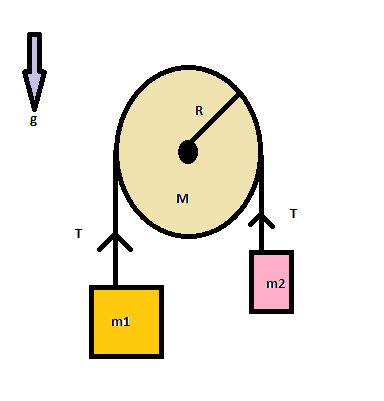
Two bodies \[{m_1}\] and \[{m_2}\]are attached to the two ends of a string figure. The string passes over a pulley of mass \[M\] and radius \[R\]. If \[{m_1} > {m_2}\], then the acceleration of the system is
(A) \[\dfrac{{({m_1} - {m_2} + M)g}}{{{m_1} + {m_2} + M}}\]
(B) \[\dfrac{{({m_1} - {m_2})g}}{{{m_1} + {m_2}}}\]
(C) \[\dfrac{{({m_1} + {m_2})g}}{{{m_1} - {m_2}}}\]
(D) \[\dfrac{{({m_1} - {m_2})g}}{{{m_1} - {m_2} - M/2}}\]
Answer
 Verified
249.6k+ views
Hint Since it is given in the question that \[{m_1} > {m_2}\], the system of the two bodies connected by the string (assumed massless) will have a net acceleration such that \[{m_2}\] rises upwards. We can balance forces on the two blocks separately such that they have the same acceleration with opposite signs. This is because if they have different accelerations, then either the string will slacken or tear apart which is not allowed.
Complete Step by step solution We assume that the tension in the string is \[T\]. This tension is the same at all places in the same string with proper directions. Also we have to assume that the heavier block \[{m_1}\] is moving downwards with an acceleration \[a\].
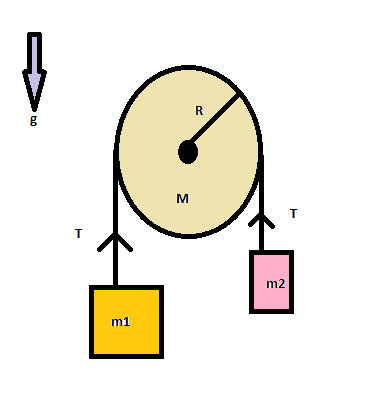
Now using Newton’s \[{2^{nd}}\] Law on \[{m_2}\], we get
\[T - {m_2}g = {m_2}a\], since \[{m_2}\] is going up with acceleration \[a\] (i)
Again using Newton’s \[{2^{nd}}\] Law on \[{m_1}\], we get
\[{m_1}g - T = {m_1}a\], since \[{m_1}\] is going down with acceleration \[a\] (ii)
Eliminating \[T\] from the above equations (i) & (ii), we get
\[{m_1}g - {m_2}g - {m_2}a = {m_1}a\], such that we get
\[a = \dfrac{{({m_1} - {m_2})g}}{{{m_1} + {m_2}}}\].
\[\therefore \] Option \[(B)\] is correct.
Note The tension \[T\] in the same string is always uniform everywhere on the same string at an instant of time and the string has an acceleration \[a\] everywhere. We will assume all strings to be massless. We will also have to assume that the center of the pulley is hinged at some point otherwise the entire system, i.e. the blocks and the pulley will have an acceleration of \[g = 9.80432\,m/{s^2}\], i.e. they will fall freely under gravitational attraction. The string should be assumed massless so that the tension is uniform in the string, otherwise tension in the string will vary since the mass of the string at different points will add to the net mass being supported by the string at different points.
Complete Step by step solution We assume that the tension in the string is \[T\]. This tension is the same at all places in the same string with proper directions. Also we have to assume that the heavier block \[{m_1}\] is moving downwards with an acceleration \[a\].
Now using Newton’s \[{2^{nd}}\] Law on \[{m_2}\], we get
\[T - {m_2}g = {m_2}a\], since \[{m_2}\] is going up with acceleration \[a\] (i)
Again using Newton’s \[{2^{nd}}\] Law on \[{m_1}\], we get
\[{m_1}g - T = {m_1}a\], since \[{m_1}\] is going down with acceleration \[a\] (ii)
Eliminating \[T\] from the above equations (i) & (ii), we get
\[{m_1}g - {m_2}g - {m_2}a = {m_1}a\], such that we get
\[a = \dfrac{{({m_1} - {m_2})g}}{{{m_1} + {m_2}}}\].
\[\therefore \] Option \[(B)\] is correct.
Note The tension \[T\] in the same string is always uniform everywhere on the same string at an instant of time and the string has an acceleration \[a\] everywhere. We will assume all strings to be massless. We will also have to assume that the center of the pulley is hinged at some point otherwise the entire system, i.e. the blocks and the pulley will have an acceleration of \[g = 9.80432\,m/{s^2}\], i.e. they will fall freely under gravitational attraction. The string should be assumed massless so that the tension is uniform in the string, otherwise tension in the string will vary since the mass of the string at different points will add to the net mass being supported by the string at different points.
Recently Updated Pages
JEE Isolation, Preparation and Properties of Non-metals Important Concepts and Tips for Exam Preparation

Isoelectronic Definition in Chemistry: Meaning, Examples & Trends
Ionisation Energy and Ionisation Potential Explained
Iodoform Reactions - Important Concepts and Tips for JEE
Introduction to Dimensions: Understanding the Basics
Instantaneous Velocity Explained: Formula, Examples & Graphs
Trending doubts
JEE Main 2026: Exam Dates, Session 2 Updates, City Slip, Admit Card & Latest News
Hybridisation in Chemistry – Concept, Types & Applications
JEE Main 2026 Application Login: Direct Link, Registration, Form Fill, and Steps
Understanding the Electric Field of a Uniformly Charged Ring
Derivation of Equation of Trajectory Explained for Students
JEE Main Marking Scheme 2026- Paper-Wise Marks Distribution and Negative Marking Details
Other Pages
JEE Advanced Marks vs Ranks 2025: Understanding Category-wise Qualifying Marks and Previous Year Cut-offs
JEE Advanced 2026 - Exam Date (Released), Syllabus, Registration, Eligibility, Preparation, and More
CBSE Notes Class 11 Physics Chapter 1 - Units And Measurements - 2025-26
Important Questions For Class 11 Physics Chapter 1 Units and Measurement - 2025-26
NCERT Solutions For Class 11 Physics Chapter 1 Units And Measurements - 2025-26
CBSE Notes Class 11 Physics Chapter 4 - Laws of Motion - 2025-26