




Three identical balls numbered as I, II and III are placed on a smooth floor on a straight line at a separation of $10 \mathrm{m}$ between balls as shown in figure. Initially balls are stationary. Ball I is given velocity of $10 \mathrm{m} / \mathrm{s}$ towards ball II, collision between ball I and II is inelastic with coefficient of restitution 0.5 but collision between ball II and III is perfectly elastic. What is the time interval between two consecutive collisions between I and II?
(A) $4 \mathrm{sec}$
(B) $24 \mathrm{sec}$
(C) $14 \mathrm{sec}$
(D) $44 \mathrm{sec}$
Answer
 Verified
232.8k+ views
Hint: We should know that a collision is the event in which two or more bodies exert forces on each other in about a relatively short time. Although the most common use of the word collision refers to incidents in which two or more objects collide with great force, the scientific use of the term implies nothing about the magnitude of the force. Consider the situation where two bodies collide with each other. During the collision, each body exerts a force on the other. This force is called an impulsive force, because it acts for a short period of time compared to the whole motion of the objects, and its value is usually large.
Complete step by step answer
We know that momentum is a physics term that refers to the quantity of motion that an object has. A sports team that is on the move has the momentum. If an object is in motion (on the move) then it has momentum. One example is the use of air bags in automobiles. Air bags are used in automobile.s because they are able to minimize the effect of the force on an object involved in a collision. Air bags accomplish this by extending the time required to stop the momentum of the driver and passenger. Momentum is mass in motion, and any moving object can have momentum. An object's change in momentum is equal to its impulse. Impulse is a quantity of force times the time interval. Impulse is not equal to momentum itself; rather, it's the increase or decrease of an object's momentum. Based on this concept we have to solve this question
The diagram for this question is given as:
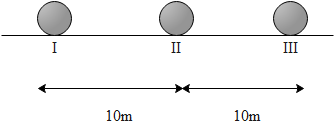
Let the mass of each ball be $\mathrm{m}$.
Collision of ball I with II
Let the velocity of Ball I be $\mathrm{v}_{1}$ and that of ball II be $\mathrm{v}_{2}$ after collision
The coefficient of restitution $\mathrm{e}=0.5$
Velocity of ball I before collision $\mathrm{u}_{1}=10 \mathrm{m} / \mathrm{s}$
Therefore; $\mathrm{e}=\dfrac{\mathrm{v}_{2}-\mathrm{v}_{1}}{\mathrm{u}_{1}-\mathrm{u}_{2}}$
$0.5=\dfrac{\mathrm{v}_{2}-\mathrm{v}_{1}}{10-0}$
By the conservation of momentum:
$\mathrm{m}(10)=\mathrm{m}\left(\mathrm{v}_{1}\right)+\mathrm{m}\left(\mathrm{v}_{2}\right)$
$\mathrm{v}_{1}+\mathrm{v}_{2}=10$
Therefore,
$\mathrm{v}_{2}=7.5 \mathrm{m} / \mathrm{s}$
$\mathrm{v}_{1}=2.5 \mathrm{m} / \mathrm{s}$
The collision between balls II and III is elastic:
Therefore, after collision, ball II becomes at rest at the distance 20m from ball I.
Thus,
Time taken to reach the ball I to ball II will be $\mathrm{t}=\dfrac{10}{2.5}=4 \mathrm{s}$
Note: We should know that a projectile is an object upon which the only force is gravity. Gravity acts to influence the vertical motion of the projectile, thus causing a vertical acceleration. The horizontal motion of the projectile is the result of the tendency of any object in motion to remain in motion at constant velocity. Projectile motion is the motion of an object thrown or projected into the air, subject to only the acceleration of gravity. The object is called a projectile, and its path is called its trajectory. A projectile is any object that has been thrown, shot, or launched, and ballistics is the study of projectile motion. Examples of projectiles range from a golf ball in flight, to a curve ball thrown by a baseball pitcher to a rocket fired into space.
Complete step by step answer
We know that momentum is a physics term that refers to the quantity of motion that an object has. A sports team that is on the move has the momentum. If an object is in motion (on the move) then it has momentum. One example is the use of air bags in automobiles. Air bags are used in automobile.s because they are able to minimize the effect of the force on an object involved in a collision. Air bags accomplish this by extending the time required to stop the momentum of the driver and passenger. Momentum is mass in motion, and any moving object can have momentum. An object's change in momentum is equal to its impulse. Impulse is a quantity of force times the time interval. Impulse is not equal to momentum itself; rather, it's the increase or decrease of an object's momentum. Based on this concept we have to solve this question
The diagram for this question is given as:
Let the mass of each ball be $\mathrm{m}$.
Collision of ball I with II
Let the velocity of Ball I be $\mathrm{v}_{1}$ and that of ball II be $\mathrm{v}_{2}$ after collision
The coefficient of restitution $\mathrm{e}=0.5$
Velocity of ball I before collision $\mathrm{u}_{1}=10 \mathrm{m} / \mathrm{s}$
Therefore; $\mathrm{e}=\dfrac{\mathrm{v}_{2}-\mathrm{v}_{1}}{\mathrm{u}_{1}-\mathrm{u}_{2}}$
$0.5=\dfrac{\mathrm{v}_{2}-\mathrm{v}_{1}}{10-0}$
By the conservation of momentum:
$\mathrm{m}(10)=\mathrm{m}\left(\mathrm{v}_{1}\right)+\mathrm{m}\left(\mathrm{v}_{2}\right)$
$\mathrm{v}_{1}+\mathrm{v}_{2}=10$
Therefore,
$\mathrm{v}_{2}=7.5 \mathrm{m} / \mathrm{s}$
$\mathrm{v}_{1}=2.5 \mathrm{m} / \mathrm{s}$
The collision between balls II and III is elastic:
Therefore, after collision, ball II becomes at rest at the distance 20m from ball I.
Thus,
Time taken to reach the ball I to ball II will be $\mathrm{t}=\dfrac{10}{2.5}=4 \mathrm{s}$
Note: We should know that a projectile is an object upon which the only force is gravity. Gravity acts to influence the vertical motion of the projectile, thus causing a vertical acceleration. The horizontal motion of the projectile is the result of the tendency of any object in motion to remain in motion at constant velocity. Projectile motion is the motion of an object thrown or projected into the air, subject to only the acceleration of gravity. The object is called a projectile, and its path is called its trajectory. A projectile is any object that has been thrown, shot, or launched, and ballistics is the study of projectile motion. Examples of projectiles range from a golf ball in flight, to a curve ball thrown by a baseball pitcher to a rocket fired into space.
Recently Updated Pages
JEE Main 2023 April 6 Shift 1 Question Paper with Answer Key

JEE Main 2023 April 6 Shift 2 Question Paper with Answer Key
JEE Main 2023 (January 31 Evening Shift) Question Paper with Solutions [PDF]
JEE Main 2023 January 30 Shift 2 Question Paper with Answer Key
JEE Main 2023 January 25 Shift 1 Question Paper with Answer Key
JEE Main 2023 January 24 Shift 2 Question Paper with Answer Key
Trending doubts
JEE Main 2026: Session 2 Registration Open, City Intimation Slip, Exam Dates, Syllabus & Eligibility
JEE Main 2026 Application Login: Direct Link, Registration, Form Fill, and Steps
Understanding the Angle of Deviation in a Prism
Hybridisation in Chemistry – Concept, Types & Applications
How to Convert a Galvanometer into an Ammeter or Voltmeter
Understanding Uniform Acceleration in Physics
Other Pages
JEE Advanced Marks vs Ranks 2025: Understanding Category-wise Qualifying Marks and Previous Year Cut-offs
Laws of Motion Class 11 Physics Chapter 4 CBSE Notes - 2025-26
Waves Class 11 Physics Chapter 14 CBSE Notes - 2025-26
Mechanical Properties of Fluids Class 11 Physics Chapter 9 CBSE Notes - 2025-26
Thermodynamics Class 11 Physics Chapter 11 CBSE Notes - 2025-26
Units And Measurements Class 11 Physics Chapter 1 CBSE Notes - 2025-26