




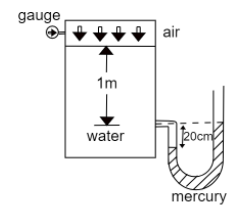
The pressure gauge reading in metre of water column shown in the given figure will be:
(A) $3.20m$
(B) $2.72m$
(C) $2.52m$
(D) $1.52m$
Answer
 Verified
264k+ views
Hint: In the given figure, the air exerts a pressure on the water, which in turn exerts pressure on the mercury, causing it to rise inside the U- tube. The gauge tells the differential pressure in the water column by relating it to the pressure head of the water.
Formula used:
$P = \rho gh$
Where $\rho $ is the density of the fluid.
$g$ is the acceleration due to gravity.
$h$ is the height of the column.
Complete step by step solution:
Here, the height of the column corresponds to the pressure of the different fluids present.
The pressure in the mercury column is equal to the pressure in water column, and is given by-
$P = \rho gh$
Let the pressure in the mercury column be ${P_1}$ and that in the water column be ${P_2}$. Then, assuming no pressure loss we have-
${P_1} = {P_2}$
Which can be written as-
${\rho _1}{h_1}g = {\rho _2}{h_2}g$
Where ${\rho _1}$is the density of mercury at room temperature which is about $13534kg/{m^3}$.
${\rho _2}$is the density of water at room temperature which is about $997.77kg/{m^3}$.
It is given that the height of the mercury column, ${h_1} = 20cm = 0.2m$
On equating both the quantities, we get-
$13534 \times 0.2 = 997.77{h_2}$
Where ${h_2}$ is the height of the water in the column.
${h_2} = \dfrac{{13534}}{{997.77}} \times 0.2$
${h_2} = 2.712m \approx 2.72m$
This reading will be shown by the gauge.
Hence, Option (B) is correct.
Note: Pressure head refers to the representation of pressure in terms of height of fluid raised or fallen. The common pressure measuring term in fluid mechanics, the $mm - Hg$represents pressure head because it tells the height of liquid mercury which would rise in a column provided the same pressure. The gauge here also tells the pressure head, as the meters of water are raised.
Formula used:
$P = \rho gh$
Where $\rho $ is the density of the fluid.
$g$ is the acceleration due to gravity.
$h$ is the height of the column.
Complete step by step solution:
Here, the height of the column corresponds to the pressure of the different fluids present.
The pressure in the mercury column is equal to the pressure in water column, and is given by-
$P = \rho gh$
Let the pressure in the mercury column be ${P_1}$ and that in the water column be ${P_2}$. Then, assuming no pressure loss we have-
${P_1} = {P_2}$
Which can be written as-
${\rho _1}{h_1}g = {\rho _2}{h_2}g$
Where ${\rho _1}$is the density of mercury at room temperature which is about $13534kg/{m^3}$.
${\rho _2}$is the density of water at room temperature which is about $997.77kg/{m^3}$.
It is given that the height of the mercury column, ${h_1} = 20cm = 0.2m$
On equating both the quantities, we get-
$13534 \times 0.2 = 997.77{h_2}$
Where ${h_2}$ is the height of the water in the column.
${h_2} = \dfrac{{13534}}{{997.77}} \times 0.2$
${h_2} = 2.712m \approx 2.72m$
This reading will be shown by the gauge.
Hence, Option (B) is correct.
Note: Pressure head refers to the representation of pressure in terms of height of fluid raised or fallen. The common pressure measuring term in fluid mechanics, the $mm - Hg$represents pressure head because it tells the height of liquid mercury which would rise in a column provided the same pressure. The gauge here also tells the pressure head, as the meters of water are raised.
Recently Updated Pages
JEE Main Mock Test 2025-26: Principles Related To Practical

JEE Main 2025-26 Experimental Skills Mock Test – Free Practice
JEE Main 2025-26 Electronic Devices Mock Test: Free Practice Online
JEE Main 2025-26 Mock Tests: Free Practice Papers & Solutions
JEE Main 2025-26: Magnetic Effects of Current & Magnetism Mock Test
JEE Main Statistics and Probability Mock Test 2025-26
Trending doubts
JEE Main 2026: Exam Dates, Session 2 Updates, City Slip, Admit Card & Latest News
JEE Main Participating Colleges 2026 - A Complete List of Top Colleges
Hybridisation in Chemistry – Concept, Types & Applications
Understanding the Electric Field of a Uniformly Charged Ring
Derivation of Equation of Trajectory Explained for Students
Understanding Atomic Structure for Beginners
Other Pages
JEE Advanced 2026 Notification Out with Exam Date, Registration (Extended), Syllabus and More
JEE Advanced Marks vs Ranks 2025: Understanding Category-wise Qualifying Marks and Previous Year Cut-offs
CBSE Notes Class 11 Physics Chapter 1 - Units And Measurements - 2025-26
NCERT Solutions For Class 11 Physics Chapter 1 Units And Measurements - 2025-26
Important Questions For Class 11 Physics Chapter 1 Units and Measurement - 2025-26
JEE Advanced Weightage Chapter Wise 2026 for Physics, Chemistry, and Mathematics