




The number of isomers in ${C_4}{H_{10}}O$ are:
a.)7
b.)8
c.)6
d.)5
Answer
 Verified
292.5k+ views
Hint:
Draw the different structures possible using this formula. The number is the sum of isomers both with alcohol as a functional group and ether.
Complete step by step answer:
This question is about the number of isomers in ${C_4}{H_{10}}O$. First, let’s see what structural isomers are:
The structural isomers are those in which atoms remain same while they differ in bonding with each other. The number of atoms of each type are the same. Now, for the compound given to us which is a four-carbon compound with one Oxygen atom. We know that for such a compound two functional groups are possible which are alcohol and ether.
Now, let’s start drawing the structure of alcohol first.
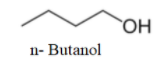
The first molecule, we will draw with all four carbons in a single chain. It will be n- Butanol.
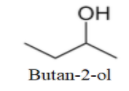
We can see that one more molecule with straight chain can be drawn as-
Now, as no more straight chain molecule can be formed; so, we will make branched molecules as-
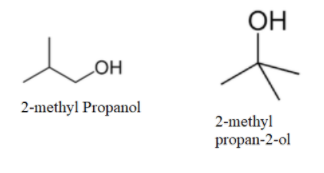
We can see that no more molecule with alcohol as a functional group can be made. So, now we will make ethers as-
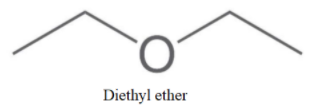
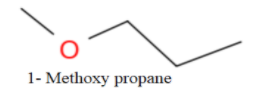
Now, no more straight chain ether is possible, So, we will form branching as-
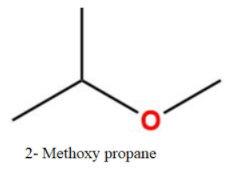
Thus, the total number of isomers are-
Alcohols=4
Ethers=3
Total isomers=7
So, option a.) is the correct answer.
Note:
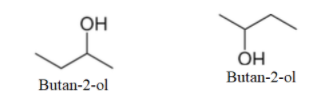
If we try to make more number of straight chain alcohol, it will form the same molecule only. Example is-
Both these will form one molecule only.
Draw the different structures possible using this formula. The number is the sum of isomers both with alcohol as a functional group and ether.
Complete step by step answer:
This question is about the number of isomers in ${C_4}{H_{10}}O$. First, let’s see what structural isomers are:
The structural isomers are those in which atoms remain same while they differ in bonding with each other. The number of atoms of each type are the same. Now, for the compound given to us which is a four-carbon compound with one Oxygen atom. We know that for such a compound two functional groups are possible which are alcohol and ether.
Now, let’s start drawing the structure of alcohol first.
The first molecule, we will draw with all four carbons in a single chain. It will be n- Butanol.
We can see that one more molecule with straight chain can be drawn as-
Now, as no more straight chain molecule can be formed; so, we will make branched molecules as-
We can see that no more molecule with alcohol as a functional group can be made. So, now we will make ethers as-
Now, no more straight chain ether is possible, So, we will form branching as-
Thus, the total number of isomers are-
Alcohols=4
Ethers=3
Total isomers=7
So, option a.) is the correct answer.
Note:
If we try to make more number of straight chain alcohol, it will form the same molecule only. Example is-
Both these will form one molecule only.
Recently Updated Pages
Atomic Structure JEE Main Mock Test 2026-27: Free Practice Online

JEE Main 2025-26 Mock Test: Classification of Elements & Periodicity
JEE Main Mock Test 2025-26: Free Practice, Analysis & Tips
JEE Main Mock Test 2026-27: Some Basic Concepts in Chemistry
Class 12 Chemistry Mock Test Series for JEE Main – Free Online Practice
Classification of Drugs in Chemistry: Types, Examples & Exam Guide
Trending doubts
JEE Main 2026: Exam Dates, Session 2 Updates, City Slip, Admit Card & Latest News
Understanding the Electric Field of a Uniformly Charged Ring
Understanding Atomic Structure for Beginners
Electron Gain Enthalpy and Electron Affinity Explained
Derivation of Equation of Trajectory Explained for Students
Understanding the Different Types of Solutions in Chemistry
Other Pages
NCERT Solutions For Class 12 Chemistry Chapter 2 Electrochemistry - 2026-27 Free PDF Download (Sign-in Required)
NCERT Solutions For Class 12 Chemistry Chapter 1 Solutions - 2026-27 Free PDF Download (Sign-in Required)
NCERT Solutions For Class 12 Chemistry Chapter 3 Chemical Kinetics - 2026-27 Free PDF Download (Login Required)
CBSE Notes Class 12 Chemistry Chapter 1 - Solutions - 2026-27 PDF Download (Login Required)
NCERT Solutions for Class 12 Chemistry Chapter 6 Haloalkanes and Haloarenes - 2026-27 Free PDF Download (Sign-In Required)
NCERT Solutions For Class 12 Chemistry Chapter 7 Alcohol Phenol And Ether - 2026-27 Free PDF Download (Login Required)
NCERT Solutions For Class 12 Chemistry Chapter 2 Electrochemistry - 2026-27 Free PDF Download (Sign-in Required)
NCERT Solutions For Class 12 Chemistry Chapter 1 Solutions - 2026-27 Free PDF Download (Sign-in Required)
NCERT Solutions For Class 12 Chemistry Chapter 3 Chemical Kinetics - 2026-27 Free PDF Download (Login Required)