




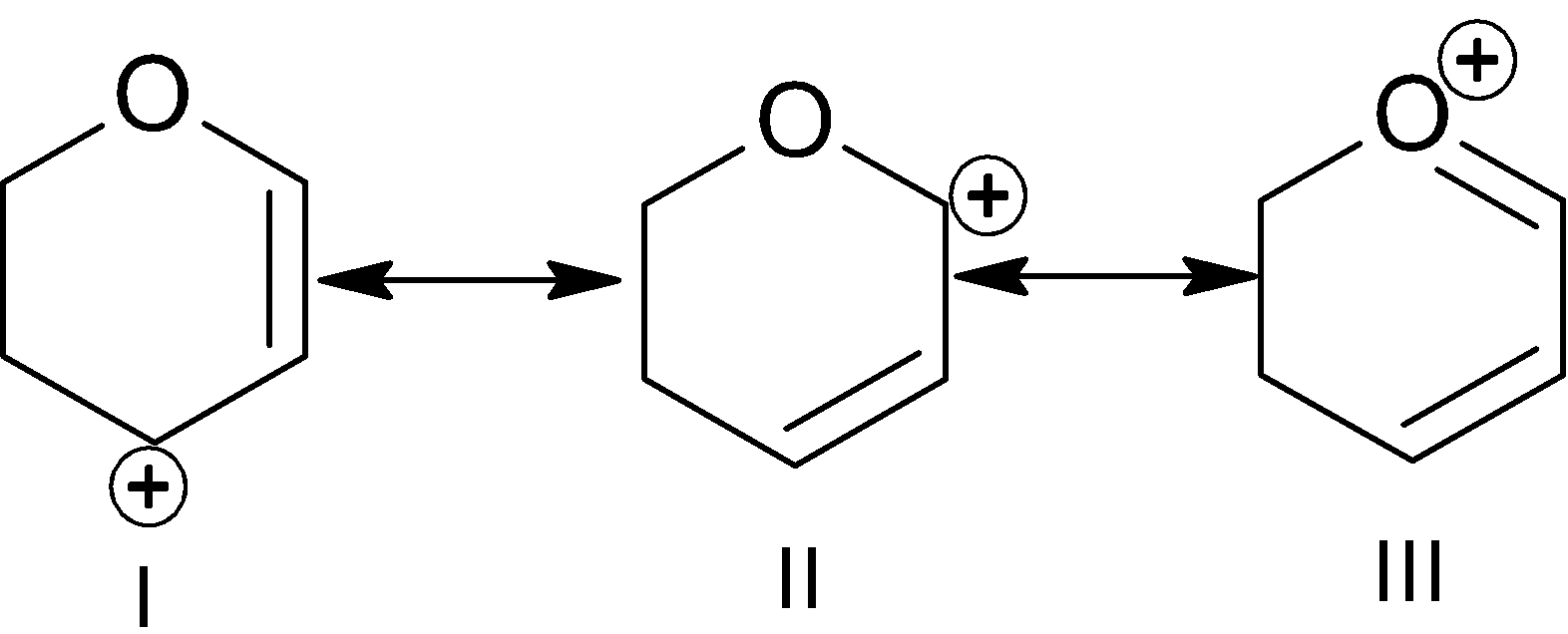
The most stable canonical structure among the given structure is:
A. I
B. II
C. III
D. All are equally stable
Answer
 Verified
270.6k+ views
Hint: There are many factors for deciding stability of canonical structures like resonance is the major factor, inductive effect, number of \[\pi \] bonds, \[\pi \]-lone pair conjugation, position of charges etc. So, by using these effects we can check the stability order of canonical structures.
Complete step-by-step answer:
Canonical structures are a way of representing or describing the delocalized electrons within certain molecules or polyatomic ions like in phosphate ions. Here all three are resonance structures. In this example many effects work like inductive effect, number of \[\pi \]bonds, positive charge - lone pair conjugation, position of charge etc.
In the 1st structure \[-I\] effect of oxygen, incomplete octet of cation.
In the 2nd structure \[-I\] effect of oxygen, incomplete octet of cation.
In the 3rd structure \[\pi \] bonds are more than 1st and 2nd, octet is complete, and positive charge is present on the most electronegative element which makes it highly unstable.
Conclusion from the above three factors is that the 3rd structure is unstable than other 2 structures because of positive charge on the most electronegative atom. In the 1st part \[-I\] effect is less than the 2nd part which makes cation less stable than the 1st part.
So, the stability order is:
$III < II < I$
So, “A” is the correct answer.
Note: You should know which effect is dominating where. In the 3rd structure there is positive charge on the most electronegative atom.
Complete step-by-step answer:
Canonical structures are a way of representing or describing the delocalized electrons within certain molecules or polyatomic ions like in phosphate ions. Here all three are resonance structures. In this example many effects work like inductive effect, number of \[\pi \]bonds, positive charge - lone pair conjugation, position of charge etc.
In the 1st structure \[-I\] effect of oxygen, incomplete octet of cation.
In the 2nd structure \[-I\] effect of oxygen, incomplete octet of cation.
In the 3rd structure \[\pi \] bonds are more than 1st and 2nd, octet is complete, and positive charge is present on the most electronegative element which makes it highly unstable.
Conclusion from the above three factors is that the 3rd structure is unstable than other 2 structures because of positive charge on the most electronegative atom. In the 1st part \[-I\] effect is less than the 2nd part which makes cation less stable than the 1st part.
So, the stability order is:
$III < II < I$
So, “A” is the correct answer.
Note: You should know which effect is dominating where. In the 3rd structure there is positive charge on the most electronegative atom.
Recently Updated Pages
Disproportionation Reaction: Definition, Example & JEE Guide

Hess Law of Constant Heat Summation: Definition, Formula & Applications
JEE General Topics in Chemistry Important Concepts and Tips
JEE Extractive Metallurgy Important Concepts and Tips for Exam Preparation
JEE Atomic Structure and Chemical Bonding important Concepts and Tips
JEE Amino Acids and Peptides Important Concepts and Tips for Exam Preparation
Trending doubts
JEE Main 2026: Exam Dates, Session 2 Updates, City Slip, Admit Card & Latest News
JEE Main Participating Colleges 2026 - A Complete List of Top Colleges
Understanding the Electric Field of a Uniformly Charged Ring
Understanding Atomic Structure for Beginners
Derivation of Equation of Trajectory Explained for Students
JEE Main Marking Scheme 2026- Paper-Wise Marks Distribution and Negative Marking Details
Other Pages
JEE Advanced 2026 Notification Out with Exam Date, Registration (Extended), Syllabus and More
JEE Advanced Percentile vs Marks 2026: JEE Main Cutoff, AIR & IIT Admission Guide
JEE Advanced Weightage Chapter Wise 2026 for Physics, Chemistry, and Mathematics
Understanding the Different Types of Solutions in Chemistry
NCERT Solutions For Class 11 Chemistry In Hindi Chapter 1 Some Basic Concepts Of Chemistry - 2025-26
How to Convert a Galvanometer into an Ammeter or Voltmeter