




The monomer used in Novolac; a polymer used in paints is:
A. Butadiene and styrene
B. Phenol and formaldehyde
C. Butadiene and acrylo nitrile
D. Melamine and formaldehyde
Answer
 Verified
310.8k+ views
Hint: There are different classes of polymers. Novolac is a phenolic resin type of polymer. It is extensively used in microelectronics.
Complete step by step answer: A polymer is a large molecule formed by continuous linking of many small subunits called Monomers. Basically, it is a repetition of monomers.
Another name for novolac is phenolic resin or phenol formaldehyde resin. As this suggests, the two monomers needed to form novolac are phenol and formaldehyde.
The reaction that occurs is –
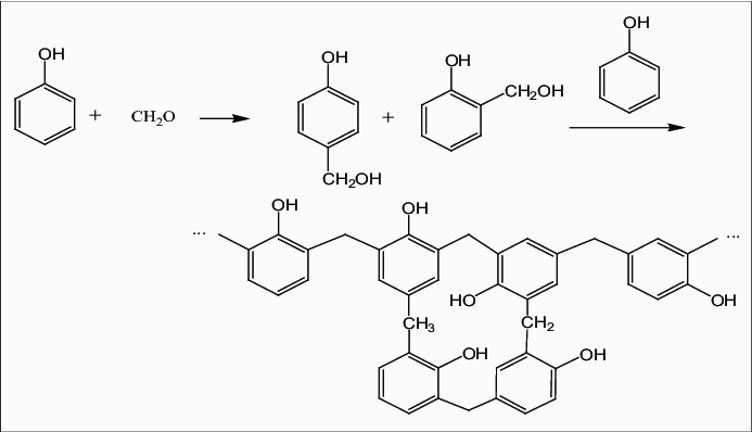
The reaction stops when the formaldehyde reactant is exhausted, often leaving up to 10% of un-reacted phenol.
So, B is the correct option.
Additional information: There are two types of polymers, natural and artificial. Natural polymers are found in plants. Apart from natural and manmade, polymers are classified in various other ways.
Based on the type of monomer used and mechanism of polymerization, there are different types of polymers. Novolac is a cross linked polymer formed by condensation polymerisation. During preparation of novolac, as a general rule phenol gets substituted on both ortho and para positions. But we know that para position is almost twice as reactive as ortho. But there are twice as many ortho sites (two per phenol molecule) so the fractions of ortho-ortho, para-para and ortho-para bridges are approximately equal. In this reaction, a water molecule gets eliminated. Hence the type of polymerization mechanism is condensation. Distillation of the molten resin during manufacturing removes the excess phenol and water.
Note: To remember this easily, we can keep in mind that novolac is a phenolic resin type of polymer. It has a cross linked structure and is formed by condensation polymerization.
Complete step by step answer: A polymer is a large molecule formed by continuous linking of many small subunits called Monomers. Basically, it is a repetition of monomers.
Another name for novolac is phenolic resin or phenol formaldehyde resin. As this suggests, the two monomers needed to form novolac are phenol and formaldehyde.
The reaction that occurs is –
The reaction stops when the formaldehyde reactant is exhausted, often leaving up to 10% of un-reacted phenol.
So, B is the correct option.
Additional information: There are two types of polymers, natural and artificial. Natural polymers are found in plants. Apart from natural and manmade, polymers are classified in various other ways.
Based on the type of monomer used and mechanism of polymerization, there are different types of polymers. Novolac is a cross linked polymer formed by condensation polymerisation. During preparation of novolac, as a general rule phenol gets substituted on both ortho and para positions. But we know that para position is almost twice as reactive as ortho. But there are twice as many ortho sites (two per phenol molecule) so the fractions of ortho-ortho, para-para and ortho-para bridges are approximately equal. In this reaction, a water molecule gets eliminated. Hence the type of polymerization mechanism is condensation. Distillation of the molten resin during manufacturing removes the excess phenol and water.
Note: To remember this easily, we can keep in mind that novolac is a phenolic resin type of polymer. It has a cross linked structure and is formed by condensation polymerization.
Recently Updated Pages
Hybridization of BrF3 (Bromine Trifluoride) – Definition and Characteristics

JEE Main 2023 (February 1st Shift 2) Physics Question Paper with Answer Key
JEE Main 2023 (February 1st Shift 1) Physics Question Paper with Answer Key
JEE Main 2023 (February 1st Shift 1) Maths Question Paper with Answer Key
Electrocardiogram (ECG) – Definition, Mechanism and FAQs
Apparent Frequency Explained: Formula, Uses & Examples
Trending doubts
JEE Main 2026: Exam Dates, Session 2 Updates, City Slip, Admit Card & Latest News
Understanding the Electric Field of a Uniformly Charged Ring
Derivation of Equation of Trajectory Explained for Students
Understanding Atomic Structure for Beginners
Electron Gain Enthalpy and Electron Affinity Explained
Hybridisation in Chemistry – Concept, Types & Applications
Other Pages
CBSE Class 12 Physics Question Paper 2026: Download SET-wise PDF with Answer Key & Analysis
NCERT Solutions For Class 12 Chemistry Chapter 2 Electrochemistry - 2026-27 Free PDF Download (Sign-in Required)
NCERT Solutions For Class 12 Chemistry Chapter 1 Solutions - 2026-27 Free PDF Download (Sign-in Required)
NCERT Solutions For Class 12 Hindi Aroh (Poem) Chapter 1 Aatmaparichay, Ek Geet - 2026-27 Free PDF Download (Login Required)
NCERT Solutions For Class 12 Chemistry Chapter 3 Chemical Kinetics - 2026-27 Free PDF Download (Login Required)
CBSE Notes Class 12 Chemistry Chapter 1 - Solutions - 2026-27 PDF Download (Login Required)
CBSE Class 12 Physics Question Paper 2026: Download SET-wise PDF with Answer Key & Analysis
NCERT Solutions For Class 12 Chemistry Chapter 2 Electrochemistry - 2026-27 Free PDF Download (Sign-in Required)
NCERT Solutions For Class 12 Chemistry Chapter 1 Solutions - 2026-27 Free PDF Download (Sign-in Required)