




The magnetic lines of force inside a bar magnet:
(A) Are from north-pole to south-pole of the magnet
(B) Do not exist
(C) Depends upon the area of cross-section of the bar magnet
(D) Are from south-pole to north-pole of the magnet
Answer
 Verified
269.4k+ views
Hint: - The magnetic forces around the area of a magnet is known as a magnetic field. In a bar magnet, the magnetic fields are durable at either pole of the magnet. It is also just as strong at the north-pole when compared with the south-pole. At the center of the magnet and in between the poles, the force is weaker.
Complete Step-by-step solution:
General properties of magnetic field lines:
(1) The magnetic lines of force always make closed loops.
(2) When going from an area of higher permeability to an area of lower permeability the field lines tend to bulge out i.e. when going from the surface of the magnet to the air density of the field line decreases.
(3) Every field line has the same strength.
(4) They never cross each other.
(5) By convention, these field lines seem to originate from the north pole & end into the south pole of a bar magnet.
(6) The direction inverses inside the magnet i.e. they appear to move from the south pole towards the north pole.
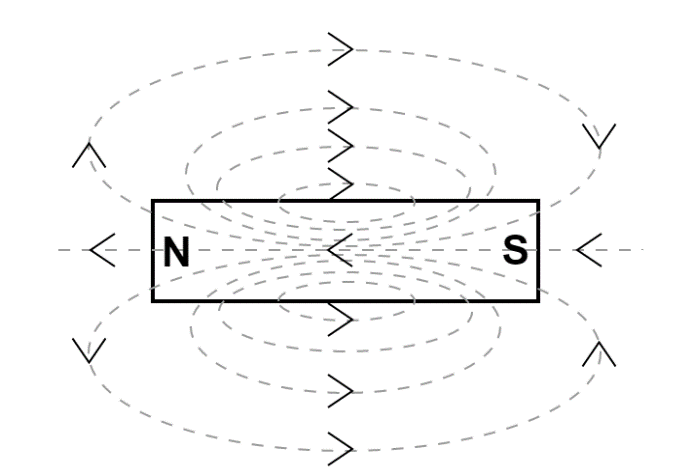
For that reason, the magnetic lines of forces inside a bar magnet are from south-pole to north-pole of the magnet.
Thus, the correct option is (D) Are from south-pole to north-pole of the magnet.
Additional Information: Magnetic lines of force are imaginary lines to indicate their magnetic field. It helps to understand the density of the magnetic field lines; hence magnetism will be easier to understand. Magnetic flux is the term used to define the number of lines of force passing through the unit area.
Note: The magnetic field lines are almost parallel to each other, as the bar magnet is made up of uniform ferromagnetic material with constant permeability throughout its length & bulge out as the lines move reverse to the poles & pass through air. Inside the bar magnet, the magnetic lines are ongoing their journey to the opposite end.
Complete Step-by-step solution:
General properties of magnetic field lines:
(1) The magnetic lines of force always make closed loops.
(2) When going from an area of higher permeability to an area of lower permeability the field lines tend to bulge out i.e. when going from the surface of the magnet to the air density of the field line decreases.
(3) Every field line has the same strength.
(4) They never cross each other.
(5) By convention, these field lines seem to originate from the north pole & end into the south pole of a bar magnet.
(6) The direction inverses inside the magnet i.e. they appear to move from the south pole towards the north pole.
For that reason, the magnetic lines of forces inside a bar magnet are from south-pole to north-pole of the magnet.
Thus, the correct option is (D) Are from south-pole to north-pole of the magnet.
Additional Information: Magnetic lines of force are imaginary lines to indicate their magnetic field. It helps to understand the density of the magnetic field lines; hence magnetism will be easier to understand. Magnetic flux is the term used to define the number of lines of force passing through the unit area.
Note: The magnetic field lines are almost parallel to each other, as the bar magnet is made up of uniform ferromagnetic material with constant permeability throughout its length & bulge out as the lines move reverse to the poles & pass through air. Inside the bar magnet, the magnetic lines are ongoing their journey to the opposite end.
Recently Updated Pages
Circuit Switching vs Packet Switching: Key Differences Explained

JEE General Topics in Chemistry Important Concepts and Tips
JEE Extractive Metallurgy Important Concepts and Tips for Exam Preparation
JEE Atomic Structure and Chemical Bonding important Concepts and Tips
JEE Amino Acids and Peptides Important Concepts and Tips for Exam Preparation
Electricity and Magnetism Explained: Key Concepts & Applications
Trending doubts
JEE Main 2026: Exam Dates, Session 2 Updates, City Slip, Admit Card & Latest News
JEE Main Participating Colleges 2026 - A Complete List of Top Colleges
Kinematics Mock Test for JEE Main 2025-26: Comprehensive Practice
Understanding the Electric Field of a Uniformly Charged Ring
Derivation of Equation of Trajectory Explained for Students
Understanding Atomic Structure for Beginners
Other Pages
CBSE Class 12 Physics Question Paper 2026: Download SET-wise PDF with Answer Key & Analysis
JEE Advanced 2026 Notification Out with Exam Date, Registration (Extended), Syllabus and More
JEE Advanced Percentile vs Marks 2026: JEE Main Cutoff, AIR & IIT Admission Guide
JEE Advanced 2026 Marks vs Rank: Estimate IIT Rank from Your Score
JEE Advanced Weightage Chapter Wise 2026 for Physics, Chemistry, and Mathematics
JEE Main Marking Scheme 2026- Paper-Wise Marks Distribution and Negative Marking Details