




The line of action of a force $\overrightarrow F = \left( { - 3\hat i + \hat j + 5\hat k} \right)N$ passes through a point $\left( {7,3,1} \right)$. The moment of force $\left( {\overrightarrow \tau = \overrightarrow r \times \overrightarrow F } \right)$ about the origin is given by:
(A) $\left( {14\hat i + 38\hat j + 16\hat k} \right)$
(B) $\left( {14\hat i + 38\hat j – 16\hat k} \right)$
(C) $\left( {14\hat i - 38\hat j + 16\hat k} \right)$
(D) $\left( {14\hat i - 38\hat j - 16\hat k} \right)$
Answer
 Verified
261.6k+ views
Hint: Moment of Force $\left( {\overrightarrow \tau } \right)$ is defined as the vector product of position vector $\left( {\overrightarrow r } \right)$ and Force vector $\left( {\overrightarrow F } \right)$. The $x,y,z$ coordinates of any point work as coefficients of $\hat i,\hat j,\hat k$ respectively to find the position vector of any point.
Complete step by step answer:
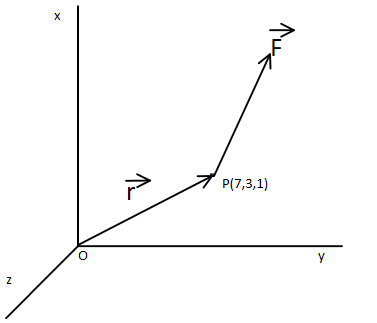
In the figure we can see that the force $\overrightarrow F $ is passing through point $P$ with the given coordinates. A position vector is drawn from origin $\left( O \right)$ to $P$.
The moment of Force or Torque $\left( \tau \right)$ is defined as the cross product or vector product between the position vector $\left( {\overrightarrow r } \right)$ and Force vector $\overrightarrow {\left( F \right)} $.
The vector product or cross product of two vectors is defined as a vector having magnitude equal to the product of the magnitudes of said two vectors with the sine of angle between them, and direction perpendicular to the plane containing the two vectors in accordance with right hand thumb rule.
Let’s assume that there are two vectors $\overrightarrow A $ and $\overrightarrow B $, and their cross product is $\overrightarrow C $.Then
$\Rightarrow \overrightarrow C = \overrightarrow A \times \overrightarrow B $
$\Rightarrow \overrightarrow C = AB\sin \theta \hat n$
Where the direction of $\overrightarrow C $ is given by the unit vector $\hat n$.
When the vectors are written in the form of $\hat i,\hat j,\hat k$ the cross product can be calculated as,
$\overrightarrow C = \left| {\begin{array}{*{20}{c}}
{\hat i}&{\hat j}&{\hat k} \\
{{A_x}}&{{A_y}}&{{A_z}} \\
{{B_x}}&{{B_y}}&{{B_z}}
\end{array}} \right|$
$\Rightarrow \overrightarrow C = \hat i\left( {{A_y}{B_z} - {A_z}{B_y}} \right) + \hat j\left( {{A_z}{B_x} - {A_x}{B_z}} \right) + \hat k\left( {{A_x}{B_y} - {A_y}{B_x}} \right)$
In the above case,
$\Rightarrow \overrightarrow \tau = \overrightarrow r \times \overrightarrow F $, where
$\Rightarrow \overrightarrow r = 7\hat i + 3\hat j + \hat k$ and
$\Rightarrow \overrightarrow F = - 3\hat i + \hat j + 5\hat k$.
Using the above formulae,
$\Rightarrow \overrightarrow \tau = \left| {\begin{array}{*{20}{c}}
{\hat i}&{\hat j}&{\hat k} \\
7&3&1 \\
{ - 3}&1&5
\end{array}} \right|$
$\Rightarrow \overrightarrow \tau = \hat i\left( {3 \times 5 - 1 \times 1} \right) + \hat j\left[ {1 \times \left( { - 3} \right) - 7 \times 5} \right] + \hat k\left[ {7 \times 1 - 3 \times \left( { - 3} \right)} \right]$
$\Rightarrow \overrightarrow \tau = \hat i\left( {15 - 1} \right) + \hat j\left( { - 3 - 35} \right) + \hat k\left[ {7 - \left( { - 9} \right)} \right]$
$\overrightarrow \tau = 14\hat i - 38\hat j + 16\hat k$
Hence option C is the correct answer.
Note: Vector product of any two vectors is always a vector perpendicular to the plane containing these two vectors, that is orthogonal to both the vectors though the vector may not be orthogonal to each other. The cross product of any two vectors always produces a vector quantity whereas the scalar product or dot product of any two vectors always produces a scalar quantity.
Complete step by step answer:
In the figure we can see that the force $\overrightarrow F $ is passing through point $P$ with the given coordinates. A position vector is drawn from origin $\left( O \right)$ to $P$.
The moment of Force or Torque $\left( \tau \right)$ is defined as the cross product or vector product between the position vector $\left( {\overrightarrow r } \right)$ and Force vector $\overrightarrow {\left( F \right)} $.
The vector product or cross product of two vectors is defined as a vector having magnitude equal to the product of the magnitudes of said two vectors with the sine of angle between them, and direction perpendicular to the plane containing the two vectors in accordance with right hand thumb rule.
Let’s assume that there are two vectors $\overrightarrow A $ and $\overrightarrow B $, and their cross product is $\overrightarrow C $.Then
$\Rightarrow \overrightarrow C = \overrightarrow A \times \overrightarrow B $
$\Rightarrow \overrightarrow C = AB\sin \theta \hat n$
Where the direction of $\overrightarrow C $ is given by the unit vector $\hat n$.
When the vectors are written in the form of $\hat i,\hat j,\hat k$ the cross product can be calculated as,
$\overrightarrow C = \left| {\begin{array}{*{20}{c}}
{\hat i}&{\hat j}&{\hat k} \\
{{A_x}}&{{A_y}}&{{A_z}} \\
{{B_x}}&{{B_y}}&{{B_z}}
\end{array}} \right|$
$\Rightarrow \overrightarrow C = \hat i\left( {{A_y}{B_z} - {A_z}{B_y}} \right) + \hat j\left( {{A_z}{B_x} - {A_x}{B_z}} \right) + \hat k\left( {{A_x}{B_y} - {A_y}{B_x}} \right)$
In the above case,
$\Rightarrow \overrightarrow \tau = \overrightarrow r \times \overrightarrow F $, where
$\Rightarrow \overrightarrow r = 7\hat i + 3\hat j + \hat k$ and
$\Rightarrow \overrightarrow F = - 3\hat i + \hat j + 5\hat k$.
Using the above formulae,
$\Rightarrow \overrightarrow \tau = \left| {\begin{array}{*{20}{c}}
{\hat i}&{\hat j}&{\hat k} \\
7&3&1 \\
{ - 3}&1&5
\end{array}} \right|$
$\Rightarrow \overrightarrow \tau = \hat i\left( {3 \times 5 - 1 \times 1} \right) + \hat j\left[ {1 \times \left( { - 3} \right) - 7 \times 5} \right] + \hat k\left[ {7 \times 1 - 3 \times \left( { - 3} \right)} \right]$
$\Rightarrow \overrightarrow \tau = \hat i\left( {15 - 1} \right) + \hat j\left( { - 3 - 35} \right) + \hat k\left[ {7 - \left( { - 9} \right)} \right]$
$\overrightarrow \tau = 14\hat i - 38\hat j + 16\hat k$
Hence option C is the correct answer.
Note: Vector product of any two vectors is always a vector perpendicular to the plane containing these two vectors, that is orthogonal to both the vectors though the vector may not be orthogonal to each other. The cross product of any two vectors always produces a vector quantity whereas the scalar product or dot product of any two vectors always produces a scalar quantity.
Recently Updated Pages
Circuit Switching vs Packet Switching: Key Differences Explained

Dimensions of Pressure in Physics: Formula, Derivation & SI Unit
JEE Extractive Metallurgy Important Concepts and Tips for Exam Preparation
JEE Atomic Structure and Chemical Bonding important Concepts and Tips
JEE Amino Acids and Peptides Important Concepts and Tips for Exam Preparation
Electricity and Magnetism Explained: Key Concepts & Applications
Trending doubts
JEE Main 2026: Exam Dates, Session 2 Updates, City Slip, Admit Card & Latest News
JEE Main Participating Colleges 2026 - A Complete List of Top Colleges
Hybridisation in Chemistry – Concept, Types & Applications
Understanding the Electric Field of a Uniformly Charged Ring
Derivation of Equation of Trajectory Explained for Students
Understanding Atomic Structure for Beginners
Other Pages
JEE Advanced 2026 Notification Out with Exam Date, Registration (Extended), Syllabus and More
JEE Advanced Marks vs Ranks 2025: Understanding Category-wise Qualifying Marks and Previous Year Cut-offs
CBSE Notes Class 11 Physics Chapter 1 - Units And Measurements - 2025-26
NCERT Solutions For Class 11 Physics Chapter 1 Units And Measurements - 2025-26
Important Questions For Class 11 Physics Chapter 1 Units and Measurement - 2025-26
JEE Advanced Weightage Chapter Wise 2026 for Physics, Chemistry, and Mathematics