




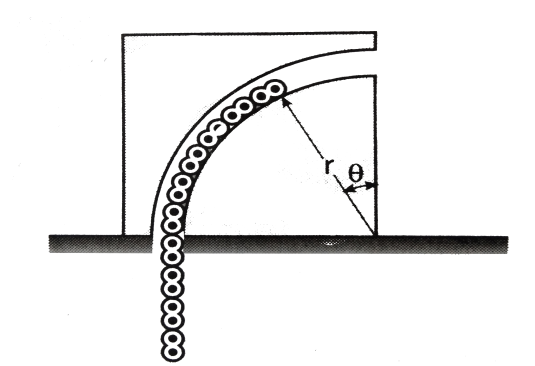
The flexible bicycle type chain of length \[\dfrac{\pi }{2}\] and mass per unit length \[\rho \] is released from rest with \[\theta = 0^\circ \] .In the smooth circular channel and falls through the hole in the supporting surface, Determine the velocity v of the chain as the last link leaves the slot.
(A) \[\sqrt {gr(\dfrac{\pi }{3} + \dfrac{4}{\pi })} \]
(B) \[\sqrt {gr(\dfrac{\pi }{2} + \dfrac{4}{\pi })} \]
(C) \[\sqrt {gr(\dfrac{\pi }{2} + \dfrac{3}{\pi })} \]
(D) \[\sqrt {gr(\dfrac{\pi }{3} + \dfrac{3}{\pi })} \]
Answer
 Verified
233.1k+ views
Hint: We will have to find the velocity of the chain when it leaves the slot. For this we will take a small part of the chain and for that small part we will calculate the length, mass and height from the reference line.
After that we will find the potential energy of the chain using the formula \[du = mgh\] , where u is the potential energy, m is mass, g is gravity and h is height of the chain.
To find the gravitational potential energy we will integrate the du with respect to \[d\theta \] , and after that we will find the gain in kinetic energy and loss in potential energy and equate them (to find the velocity) as Gain in kinetic energy = Loss in potential energy .
Complete step by step answer
We have to find the potential energy of the chain, for this we take a small part of the chain.
Let the small part’s length is ds and the angle of this part is \[d\theta \] . So, we know that \[ds = rd\theta \] .
Also for the small part we have taken, it’s mass i.e. \[dm = \rho ds\]
Substituting the value of \[ds = rd\theta \] in the dm equation we get that \[dm = \rho rd\theta \] .
Now if we take base as a reference, let the height of the small part of chain is h. And the angle of the small part with respect to the reference line is \[90 - \theta \] .
So we can find that \[h = r\sin (90 - \theta )\] , we know that \[\sin (90 - \theta ) = \cos \theta \] . So, \[h = r\cos \theta \] .
Now we have to find gravitational potential energy of the chain i.e. du, according to potential formula
\[du = dmgh\]
Now we put the value of dm and h into this equation and we get \[du = \rho rd\theta r\cos \theta g\]
To find the potential u we have to integrate du with respect to \[d\theta \] .
\[u = \int_0^{\dfrac{\pi }{2}} {\rho g{r^2}\cos \theta d\theta } \] , then after integration we get
\[u = \rho g{r^2}\left[ {\sin \theta } \right]_0^{\dfrac{\pi }{2}} = \rho g{r^2}\] , as \[\sin \dfrac{\pi }{2} = 1\] and \[\sin 0^\circ = 0\] .
When the chain leaves the slot, the center of mass of the chain is at a distance of \[\dfrac{{\pi r}}{4}\] from the reference.
Thus the gravitational potential energy of the chain is \[ - (\rho \dfrac{{\pi r}}{2})g(\dfrac{{\pi r}}{4})\] \[ = - (\dfrac{{\rho {\pi ^2}{r^2}g}}{8})\] .
Thus loss in potential energy of chain \[ = \rho {r^2}g(1 + \dfrac{{{\pi ^2}}}{8}){\text{ }}\]
Gain in kinetic energy of the chain is \[ = \dfrac{1}{2}m{v^2} = \dfrac{1}{2}(\rho \dfrac{{\pi r}}{2}){v^2}\] and according to work-energy theorem Gain in kinetic energy = Loss in potential energy
So, \[\dfrac{1}{2}(\rho \dfrac{{\pi r}}{2}){v^2} = \rho {r^2}g(1 + \dfrac{{{\pi ^2}}}{8}){\text{ }}\]
After equating this equation we get \[\sqrt {gr(\dfrac{\pi }{2} + \dfrac{4}{\pi })} \] , which is option B. So option B is the correct option.
Note: Work-energy theorem says that gravitational potential energy can be converted to other forms of energy, such as kinetic energy. If we release the mass, the gravitational force will do an amount of work equal to mgh on it, thereby increasing its kinetic energy by that same amount.
Also remember the equation \[u = mgh\] applies for any path that has a change in height of h, not just when the mass is lifted straight up.
Remember work done by or against the gravitational force depends only on the starting and ending points, and not on the path between, allowing us to define the simplifying concept of gravitational potential energy.
After that we will find the potential energy of the chain using the formula \[du = mgh\] , where u is the potential energy, m is mass, g is gravity and h is height of the chain.
To find the gravitational potential energy we will integrate the du with respect to \[d\theta \] , and after that we will find the gain in kinetic energy and loss in potential energy and equate them (to find the velocity) as Gain in kinetic energy = Loss in potential energy .
Complete step by step answer
We have to find the potential energy of the chain, for this we take a small part of the chain.
Let the small part’s length is ds and the angle of this part is \[d\theta \] . So, we know that \[ds = rd\theta \] .
Also for the small part we have taken, it’s mass i.e. \[dm = \rho ds\]
Substituting the value of \[ds = rd\theta \] in the dm equation we get that \[dm = \rho rd\theta \] .
Now if we take base as a reference, let the height of the small part of chain is h. And the angle of the small part with respect to the reference line is \[90 - \theta \] .
So we can find that \[h = r\sin (90 - \theta )\] , we know that \[\sin (90 - \theta ) = \cos \theta \] . So, \[h = r\cos \theta \] .
Now we have to find gravitational potential energy of the chain i.e. du, according to potential formula
\[du = dmgh\]
Now we put the value of dm and h into this equation and we get \[du = \rho rd\theta r\cos \theta g\]
To find the potential u we have to integrate du with respect to \[d\theta \] .
\[u = \int_0^{\dfrac{\pi }{2}} {\rho g{r^2}\cos \theta d\theta } \] , then after integration we get
\[u = \rho g{r^2}\left[ {\sin \theta } \right]_0^{\dfrac{\pi }{2}} = \rho g{r^2}\] , as \[\sin \dfrac{\pi }{2} = 1\] and \[\sin 0^\circ = 0\] .
When the chain leaves the slot, the center of mass of the chain is at a distance of \[\dfrac{{\pi r}}{4}\] from the reference.
Thus the gravitational potential energy of the chain is \[ - (\rho \dfrac{{\pi r}}{2})g(\dfrac{{\pi r}}{4})\] \[ = - (\dfrac{{\rho {\pi ^2}{r^2}g}}{8})\] .
Thus loss in potential energy of chain \[ = \rho {r^2}g(1 + \dfrac{{{\pi ^2}}}{8}){\text{ }}\]
Gain in kinetic energy of the chain is \[ = \dfrac{1}{2}m{v^2} = \dfrac{1}{2}(\rho \dfrac{{\pi r}}{2}){v^2}\] and according to work-energy theorem Gain in kinetic energy = Loss in potential energy
So, \[\dfrac{1}{2}(\rho \dfrac{{\pi r}}{2}){v^2} = \rho {r^2}g(1 + \dfrac{{{\pi ^2}}}{8}){\text{ }}\]
After equating this equation we get \[\sqrt {gr(\dfrac{\pi }{2} + \dfrac{4}{\pi })} \] , which is option B. So option B is the correct option.
Note: Work-energy theorem says that gravitational potential energy can be converted to other forms of energy, such as kinetic energy. If we release the mass, the gravitational force will do an amount of work equal to mgh on it, thereby increasing its kinetic energy by that same amount.
Also remember the equation \[u = mgh\] applies for any path that has a change in height of h, not just when the mass is lifted straight up.
Remember work done by or against the gravitational force depends only on the starting and ending points, and not on the path between, allowing us to define the simplifying concept of gravitational potential energy.
Recently Updated Pages
JEE Main 2023 April 6 Shift 1 Question Paper with Answer Key

JEE Main 2023 April 6 Shift 2 Question Paper with Answer Key
JEE Main 2023 (January 31 Evening Shift) Question Paper with Solutions [PDF]
JEE Main 2023 January 30 Shift 2 Question Paper with Answer Key
JEE Main 2023 January 25 Shift 1 Question Paper with Answer Key
JEE Main 2023 January 24 Shift 2 Question Paper with Answer Key
Trending doubts
JEE Main 2026: Session 2 Registration Open, City Intimation Slip, Exam Dates, Syllabus & Eligibility
JEE Main 2026 Application Login: Direct Link, Registration, Form Fill, and Steps
Understanding the Angle of Deviation in a Prism
Hybridisation in Chemistry – Concept, Types & Applications
How to Convert a Galvanometer into an Ammeter or Voltmeter
Understanding Uniform Acceleration in Physics
Other Pages
JEE Advanced Marks vs Ranks 2025: Understanding Category-wise Qualifying Marks and Previous Year Cut-offs
Laws of Motion Class 11 Physics Chapter 4 CBSE Notes - 2025-26
Waves Class 11 Physics Chapter 14 CBSE Notes - 2025-26
Mechanical Properties of Fluids Class 11 Physics Chapter 9 CBSE Notes - 2025-26
Thermodynamics Class 11 Physics Chapter 11 CBSE Notes - 2025-26
Units And Measurements Class 11 Physics Chapter 1 CBSE Notes - 2025-26