




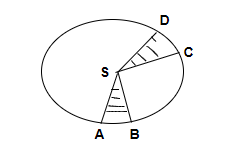
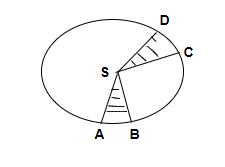
The figure represents an elliptical orbit of a planet around the sun. The planet takes time \[\mathop T\nolimits_1 \] to travel from A to B and it takes time \[\mathop T\nolimits_2 \] to travel from C to D. If the area CSD is double that of area ASB, then
(A) \[\mathop T\nolimits_1 = \mathop T\nolimits_2 \]
(B) \[\mathop T\nolimits_1 = \mathop {2T}\nolimits_2 \]
(C) \[\mathop T\nolimits_1 = \mathop {0.5T}\nolimits_2 \]
(D) Data insufficient
Answer
 Verified
232.8k+ views
Hint: The given problem can be carried out by the consideration of the Kepler’s law of planetary motion. There are three laws of planetary motion given by the Kepler by the analysis of the whole astronomical data on the basis of Copernicus theory.
Complete step by step answer:
Step 1:
The three laws of planetary motion given by the Kepler are as given below –
A) Kepler’s First law (Law of orbits): Every planet revolves around the sun in an elliptical orbit. The sun is situated at one foci of the ellipse.
B) Kepler’s Second law (Law of Areas): The line joining a planet to the sun sweeps out equal areas in equal intervals of time, i.e., the areal velocity of the planet around the sun is constant.
C)Kepler’s Third law (Law of periods): The square of the time period of revolution of a planet around the sun is directly proportional to the cube of semi major axis of its elliptical orbit,
i.e., \[\mathop T\nolimits^2 \propto \mathop R\nolimits^3 \]
Where, \[T = \] time taken by the planet to go once around the sun,
\[R = \] semi major axis of the elliptical orbit.
Step 2: This given can be solved using the Kepler’s second law i.e., the law of areas. As given in the problem, the planet takes time \[\mathop T\nolimits_1 \] to travel from A to B and it takes time \[\mathop T\nolimits_2 \] to travel from C to D.
So, according to second law, it can be seen that –
The area sweeps out by the planet in time \[\mathop T\nolimits_1 \] i.e., ASB is equal to the area sweeps out by the planet in time \[\mathop T\nolimits_2 \] i.e., CSD.
So, from the second law time will be equal so, \[\mathop T\nolimits_1 = \mathop T\nolimits_2 \] (1)
Now as per given condition if the area CSD is doubled that of area ASB i.e., area CSD = 2 (area ASB)
So, as per given by the law if the area is doubled then time taken by the planet to sweep out that area will be doubled.
\[\mathop T\nolimits_2 = 2\mathop T\nolimits_1 \]
On rearranging this equation, we will get –
\[\mathop T\nolimits_1 = \mathop {0.5T}\nolimits_2 \]
So, the option (C) is correct.
Note:
1) Kepler’s second law is based on the law of conservation of angular momentum.
2) The linear speed of the planet when the planet is closer to the sun is more than its linear speed when the planet is away from the sun.
Complete step by step answer:
Step 1:
The three laws of planetary motion given by the Kepler are as given below –
A) Kepler’s First law (Law of orbits): Every planet revolves around the sun in an elliptical orbit. The sun is situated at one foci of the ellipse.
B) Kepler’s Second law (Law of Areas): The line joining a planet to the sun sweeps out equal areas in equal intervals of time, i.e., the areal velocity of the planet around the sun is constant.
C)Kepler’s Third law (Law of periods): The square of the time period of revolution of a planet around the sun is directly proportional to the cube of semi major axis of its elliptical orbit,
i.e., \[\mathop T\nolimits^2 \propto \mathop R\nolimits^3 \]
Where, \[T = \] time taken by the planet to go once around the sun,
\[R = \] semi major axis of the elliptical orbit.
Step 2: This given can be solved using the Kepler’s second law i.e., the law of areas. As given in the problem, the planet takes time \[\mathop T\nolimits_1 \] to travel from A to B and it takes time \[\mathop T\nolimits_2 \] to travel from C to D.
So, according to second law, it can be seen that –
The area sweeps out by the planet in time \[\mathop T\nolimits_1 \] i.e., ASB is equal to the area sweeps out by the planet in time \[\mathop T\nolimits_2 \] i.e., CSD.
So, from the second law time will be equal so, \[\mathop T\nolimits_1 = \mathop T\nolimits_2 \] (1)
Now as per given condition if the area CSD is doubled that of area ASB i.e., area CSD = 2 (area ASB)
So, as per given by the law if the area is doubled then time taken by the planet to sweep out that area will be doubled.
\[\mathop T\nolimits_2 = 2\mathop T\nolimits_1 \]
On rearranging this equation, we will get –
\[\mathop T\nolimits_1 = \mathop {0.5T}\nolimits_2 \]
So, the option (C) is correct.
Note:
1) Kepler’s second law is based on the law of conservation of angular momentum.
2) The linear speed of the planet when the planet is closer to the sun is more than its linear speed when the planet is away from the sun.
Recently Updated Pages
JEE Main 2023 April 6 Shift 1 Question Paper with Answer Key

JEE Main 2023 April 6 Shift 2 Question Paper with Answer Key
JEE Main 2023 (January 31 Evening Shift) Question Paper with Solutions [PDF]
JEE Main 2023 January 30 Shift 2 Question Paper with Answer Key
JEE Main 2023 January 25 Shift 1 Question Paper with Answer Key
JEE Main 2023 January 24 Shift 2 Question Paper with Answer Key
Trending doubts
JEE Main 2026: Session 2 Registration Open, City Intimation Slip, Exam Dates, Syllabus & Eligibility
JEE Main 2026 Application Login: Direct Link, Registration, Form Fill, and Steps
Understanding the Angle of Deviation in a Prism
Hybridisation in Chemistry – Concept, Types & Applications
How to Convert a Galvanometer into an Ammeter or Voltmeter
Understanding Uniform Acceleration in Physics
Other Pages
JEE Advanced Marks vs Ranks 2025: Understanding Category-wise Qualifying Marks and Previous Year Cut-offs
Laws of Motion Class 11 Physics Chapter 4 CBSE Notes - 2025-26
Waves Class 11 Physics Chapter 14 CBSE Notes - 2025-26
Mechanical Properties of Fluids Class 11 Physics Chapter 9 CBSE Notes - 2025-26
Thermodynamics Class 11 Physics Chapter 11 CBSE Notes - 2025-26
Units And Measurements Class 11 Physics Chapter 1 CBSE Notes - 2025-26