




The difference between amylase and amylopectin is __________.
(a)- \[Amylopectin\text{ }have\text{ }1\to 4\alpha -linkage\text{ }and\text{ }1\to 6\beta -linkage\]
(b)- \[Amylopectin\text{ }have\text{ }1\to 4\alpha -linkage\text{ }and\text{ }1\to 6\alpha -linkage\]
(c)- Amylose is made up of glucose and galactose.
(d)- \[Amylose\text{ }have\text{ }1\to 4\alpha -linkage\text{ }and\text{ }1\to 6\beta -linkage\]
Answer
 Verified
273.6k+ views
Hint: One of the following has the branched-chain structure and one has the linear chain structure. Both of them are made up of glucose components only.
Complete step by step answer:
Starch is not only a single compound but is a mixture of two components-a water-soluble components called amylose (15-20%) and a water-insoluble component called amylopectin (80-85%). The aqueous solution of amylose gives a blue color with an iodine solution. Amylopectin, on the other hand, does not give blue color with iodine solution.
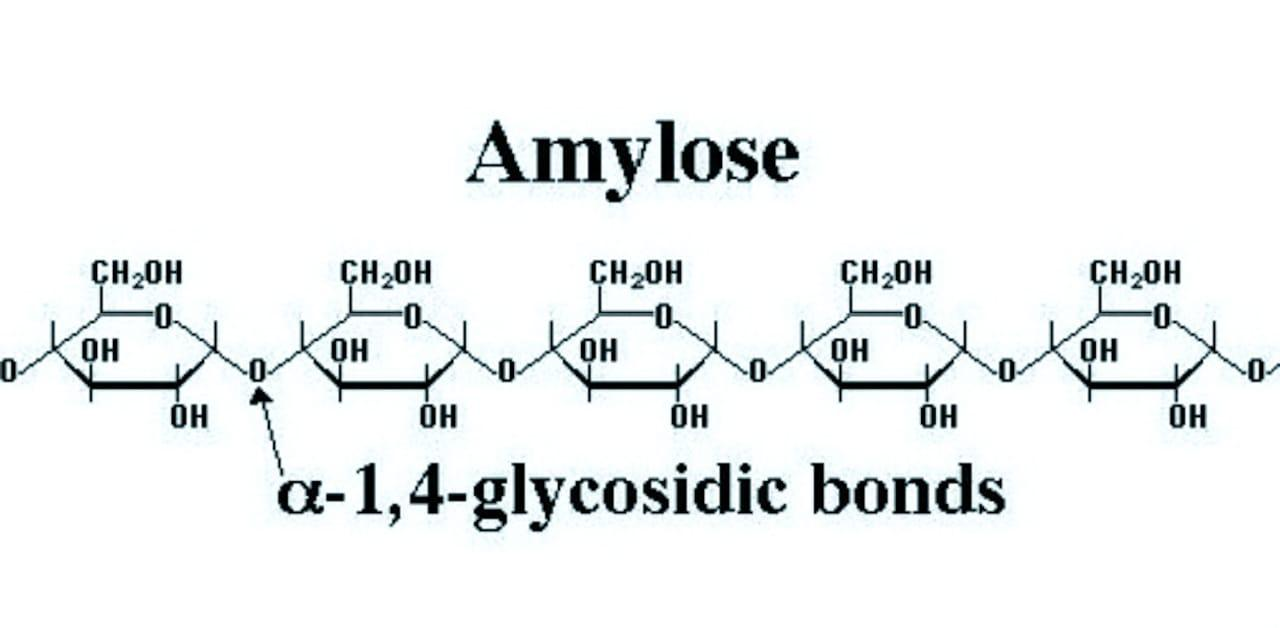
Structure of amylose: It is a linear polymer of \[\alpha -D-glu\cos e\] in which\[{{C}_{1}}\] of one glucose unit is attached to\[{{C}_{4}}\] of the other through\[\alpha -gly\cos idic\] linkage.
Structure of amylopectin: Amylopectin, on the other hand, is a highly branched polymer. It consists of a large number of short chains each containing 20-25 glucose units which are joined together through \[\alpha -gly\cos idic\] linkage involving \[{{C}_{1}}\] of one glucose unit with\[{{C}_{4}}\] of the other. The \[{{C}_{1}}\]of the terminal glucose unit in each chain is further linked to\[{{C}_{6}}\] of some other glucose unit in the next chain through \[{{C}_{1}}-{{C}_{6}}\]\[\alpha -gly\cos idic\] linkage. This gives amylopectin a highly branched structure.
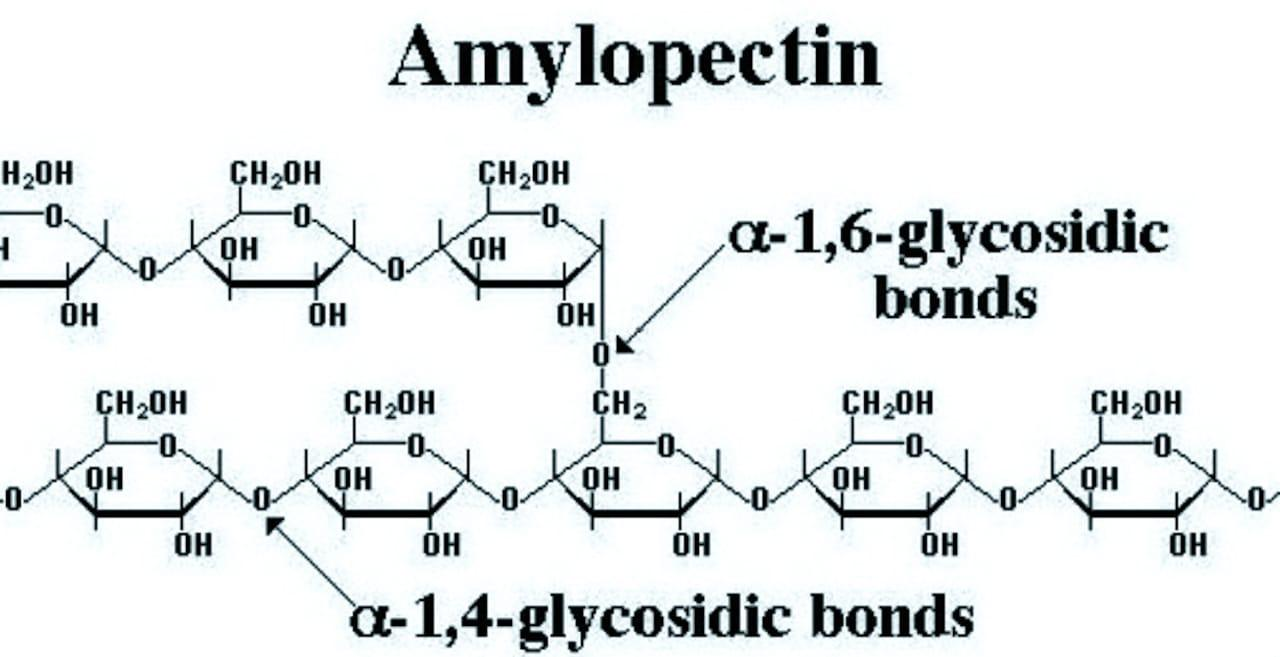
Hence, from the above discussion option (b) is correct.
Note: You may get confused between \[\alpha -linkage\] and \[\beta -linkage\]. \[\alpha -linkage\] is formed when the bond is formed on the same side and \[\beta -linkage\]is formed when the bond is formed between the opposite side.
Complete step by step answer:
Starch is not only a single compound but is a mixture of two components-a water-soluble components called amylose (15-20%) and a water-insoluble component called amylopectin (80-85%). The aqueous solution of amylose gives a blue color with an iodine solution. Amylopectin, on the other hand, does not give blue color with iodine solution.
Structure of amylose: It is a linear polymer of \[\alpha -D-glu\cos e\] in which\[{{C}_{1}}\] of one glucose unit is attached to\[{{C}_{4}}\] of the other through\[\alpha -gly\cos idic\] linkage.
Structure of amylopectin: Amylopectin, on the other hand, is a highly branched polymer. It consists of a large number of short chains each containing 20-25 glucose units which are joined together through \[\alpha -gly\cos idic\] linkage involving \[{{C}_{1}}\] of one glucose unit with\[{{C}_{4}}\] of the other. The \[{{C}_{1}}\]of the terminal glucose unit in each chain is further linked to\[{{C}_{6}}\] of some other glucose unit in the next chain through \[{{C}_{1}}-{{C}_{6}}\]\[\alpha -gly\cos idic\] linkage. This gives amylopectin a highly branched structure.
Hence, from the above discussion option (b) is correct.
Note: You may get confused between \[\alpha -linkage\] and \[\beta -linkage\]. \[\alpha -linkage\] is formed when the bond is formed on the same side and \[\beta -linkage\]is formed when the bond is formed between the opposite side.
Recently Updated Pages
WBJEE 2026 Result Live: Important Dates, Last Date Apply Online 2026

JoSAA Counselling 2026: JoSAA 2026 Mock Seat Allotment LIVE: Round 2 Result Released, Registration, Choice Filling and Ranks
JEE General Topics in Chemistry Important Concepts and Tips
JEE Extractive Metallurgy Important Concepts and Tips for Exam Preparation
JEE Atomic Structure and Chemical Bonding important Concepts and Tips
JEE Amino Acids and Peptides Important Concepts and Tips for Exam Preparation
Trending doubts
JEE Main 2026: Exam Dates, Session 2 Updates, City Slip, Admit Card & Latest News
JEE Main Participating Colleges 2026 - A Complete List of Top Colleges
Understanding the Electric Field of a Uniformly Charged Ring
Understanding Atomic Structure for Beginners
Derivation of Equation of Trajectory Explained for Students
Understanding the Different Types of Solutions in Chemistry
Other Pages
JEE Advanced 2026 Notification Out with Exam Date, Registration (Extended), Syllabus and More
JEE Advanced Percentile vs Marks 2026: JEE Main Cutoff, AIR & IIT Admission Guide
CBSE Class 12 Chemistry Question Paper 2026 PDF Download (All Sets) with Answer Key
NCERT Solutions For Class 12 Chemistry Chapter 2 Electrochemistry - 2025-26
NCERT Solutions For Class 12 Chemistry Chapter 1 Solutions - 2025-26
NCERT Solutions For Class 12 Chemistry Chapter 3 Chemical Kinetics - 2025-26