




The condition for obtaining secondary maxima in the diffraction pattern due to single slit is:
A) $a\sin \theta = \dfrac{{n\lambda }}{2}$
B) $a\sin \theta = \dfrac{{(2n - 1)\lambda }}{2}$
C) $a\sin \theta = n\lambda $
D) $a\sin \theta = (2n - 1)\lambda $
Answer
 Verified
261.6k+ views
Hint: Diffraction of light is the property of light bending around the corners such that it spreads out and illuminates areas. Diffraction is really hard to distinguish from interference as both occur simultaneously.
Complete answer:
The diffraction from a single slit gives a characteristics pattern. Diffusion effects are usually noticeable with the slit with size not very much larger than the wavelength.
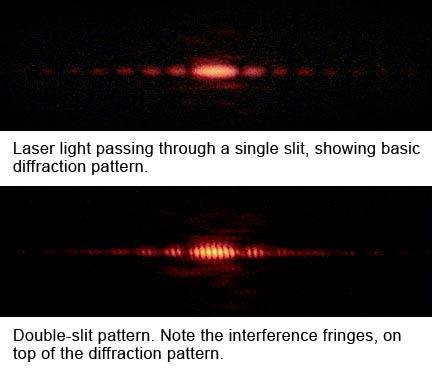
The above diagram represents a laser illuminating a single slit and a double slit and the resultant pattern is projected on the screen. The pattern is maximum at centre as the light travels from an equal distance from the slit .The central pattern is broad and is equally spaced from either side with weaker maxima.
For calculating first order minima, assuming a slit width a and divide it in two equal halves .From Huygens principle and considering parallel rays from the both sides at angle to the axis of symmetry.
The ray that will come from a distance of a/2 from below will travel extra distance $\left( {a\sin \dfrac{\theta }{2}} \right)$ when the distance is half the wavelength then $a\sin \theta = \lambda .$
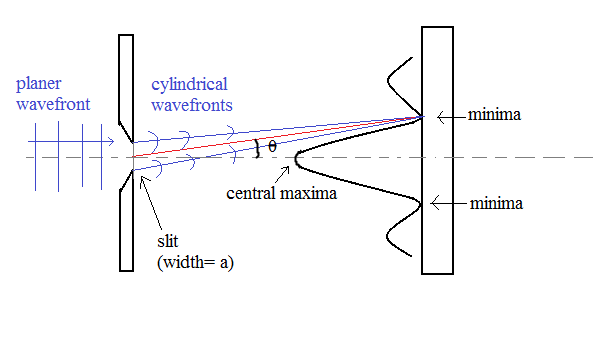 For maxima, the distance between two nth second maxima with central maxima is calculated
as: ${x_n} = D\theta = \dfrac{{(2n + 1)}}{{2b}} = \dfrac{{(2n + 1)\lambda f}}{{2b}}$
Where \[b = a\] (width of the slit)
Therefore the diffraction pattern due to single slit for secondary maxima is:
$a\sin \theta = (2n - 1)\dfrac{\lambda }{2}$
Where, $n = 2,3,4,..$
Hence option (B) is the correct option.
Note: Diffractions are only observed with waves travelling in two dimension or three dimension. Diffraction is interference phenomenon where interference of an infinite number of waves emitted by a continuous distribution of source points in two or three dimensions.
Complete answer:
The diffraction from a single slit gives a characteristics pattern. Diffusion effects are usually noticeable with the slit with size not very much larger than the wavelength.
The above diagram represents a laser illuminating a single slit and a double slit and the resultant pattern is projected on the screen. The pattern is maximum at centre as the light travels from an equal distance from the slit .The central pattern is broad and is equally spaced from either side with weaker maxima.
For calculating first order minima, assuming a slit width a and divide it in two equal halves .From Huygens principle and considering parallel rays from the both sides at angle to the axis of symmetry.
The ray that will come from a distance of a/2 from below will travel extra distance $\left( {a\sin \dfrac{\theta }{2}} \right)$ when the distance is half the wavelength then $a\sin \theta = \lambda .$
For maxima, the distance between two nth second maxima with central maxima is calculated as: ${x_n} = D\theta = \dfrac{{(2n + 1)}}{{2b}} = \dfrac{{(2n + 1)\lambda f}}{{2b}}$
Where \[b = a\] (width of the slit)
Therefore the diffraction pattern due to single slit for secondary maxima is:
$a\sin \theta = (2n - 1)\dfrac{\lambda }{2}$
Where, $n = 2,3,4,..$
Hence option (B) is the correct option.
Note: Diffractions are only observed with waves travelling in two dimension or three dimension. Diffraction is interference phenomenon where interference of an infinite number of waves emitted by a continuous distribution of source points in two or three dimensions.
Recently Updated Pages
Circuit Switching vs Packet Switching: Key Differences Explained

JEE Extractive Metallurgy Important Concepts and Tips for Exam Preparation
JEE Atomic Structure and Chemical Bonding important Concepts and Tips
JEE Amino Acids and Peptides Important Concepts and Tips for Exam Preparation
Electricity and Magnetism Explained: Key Concepts & Applications
JEE Energetics Important Concepts and Tips for Exam Preparation
Trending doubts
JEE Main 2026: Exam Dates, Session 2 Updates, City Slip, Admit Card & Latest News
JEE Main Participating Colleges 2026 - A Complete List of Top Colleges
Hybridisation in Chemistry – Concept, Types & Applications
Understanding the Electric Field of a Uniformly Charged Ring
Derivation of Equation of Trajectory Explained for Students
Understanding Atomic Structure for Beginners
Other Pages
CBSE Class 12 Physics Question Paper 2026: Download SET-wise PDF with Answer Key & Analysis
JEE Advanced 2026 Notification Out with Exam Date, Registration (Extended), Syllabus and More
JEE Advanced Marks vs Ranks 2025: Understanding Category-wise Qualifying Marks and Previous Year Cut-offs
JEE Advanced Weightage Chapter Wise 2026 for Physics, Chemistry, and Mathematics
JEE Advanced Marks vs Rank 2025 - Predict Your IIT Rank Based on Score
How to Convert a Galvanometer into an Ammeter or Voltmeter