




The colour of caustic soda turns pink when phenolphthalein is added.
A. True
B. False
Answer
 Verified
261.9k+ views
Hint: Phenolphthalein is generally used as an indicator in acid–base titrations. It turns colourless when added to an acid and pink when added to basic solutions. Caustic soda is a strong base and will ionise more when phenolphthalein is added into it.
Complete step-by-step answer:
Caustic soda is a chemical compound named sodium hydroxide, NaOH. It is a strong alkali used in many things such as water treatment, metal processing, food, etc. It is also called Lye. It is corrosive in nature and has a wide range of applications. It is also used as a cleansing agent, in the production of washing soda. It can be prepared by many methods. One such method is the Castner-Kellner method. In this method, electrolysis of brine solution (aqueous NaCl) is performed in order to get sodium hydroxide.
Phenolphthalein is another chemical compound organically synthesised as \[{C_{20}}{H_{14}}{O_4}\]. It is used in laboratories as an acid-base indicator in various titrations performed. It is colourless below pH 8.5 i.e. in acidic solutions and attains a pink to deep red hue above pH 9.0 i.e. in basic solutions.
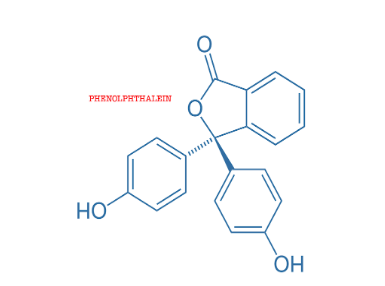
Therefore, when phenolphthalein is added to caustic soda which is a strong base, it turns pink in colour. This is because the compound in aqueous form has anions present in it. It is itself a weak acid and does not react with acid and thus remains colourless. But being a weak acid, it reacts with a strong base, resulting in partial dissociation of the base.
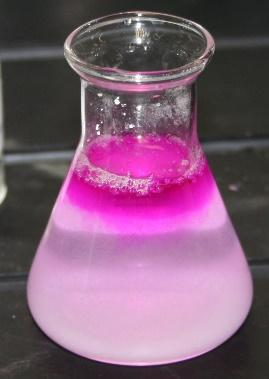
This is a true statement. Hence, the correct option is (A).
Note: Since it is a weak acid, it loses protons in solution form. It is less soluble in water and usually dissolved in alcohols when used in laboratories. In titration, it acts as an indicator that tells us the end point, a point where the reaction completes.
Complete step-by-step answer:
Caustic soda is a chemical compound named sodium hydroxide, NaOH. It is a strong alkali used in many things such as water treatment, metal processing, food, etc. It is also called Lye. It is corrosive in nature and has a wide range of applications. It is also used as a cleansing agent, in the production of washing soda. It can be prepared by many methods. One such method is the Castner-Kellner method. In this method, electrolysis of brine solution (aqueous NaCl) is performed in order to get sodium hydroxide.
Phenolphthalein is another chemical compound organically synthesised as \[{C_{20}}{H_{14}}{O_4}\]. It is used in laboratories as an acid-base indicator in various titrations performed. It is colourless below pH 8.5 i.e. in acidic solutions and attains a pink to deep red hue above pH 9.0 i.e. in basic solutions.
Therefore, when phenolphthalein is added to caustic soda which is a strong base, it turns pink in colour. This is because the compound in aqueous form has anions present in it. It is itself a weak acid and does not react with acid and thus remains colourless. But being a weak acid, it reacts with a strong base, resulting in partial dissociation of the base.
This is a true statement. Hence, the correct option is (A).
Note: Since it is a weak acid, it loses protons in solution form. It is less soluble in water and usually dissolved in alcohols when used in laboratories. In titration, it acts as an indicator that tells us the end point, a point where the reaction completes.
Recently Updated Pages
JEE Extractive Metallurgy Important Concepts and Tips for Exam Preparation

JEE Atomic Structure and Chemical Bonding important Concepts and Tips
JEE Amino Acids and Peptides Important Concepts and Tips for Exam Preparation
Electricity and Magnetism Explained: Key Concepts & Applications
JEE Energetics Important Concepts and Tips for Exam Preparation
JEE Isolation, Preparation and Properties of Non-metals Important Concepts and Tips for Exam Preparation
Trending doubts
JEE Main 2026: Exam Dates, Session 2 Updates, City Slip, Admit Card & Latest News
JEE Main Participating Colleges 2026 - A Complete List of Top Colleges
Hybridisation in Chemistry – Concept, Types & Applications
Understanding the Electric Field of a Uniformly Charged Ring
Understanding the Different Types of Solutions in Chemistry
Derivation of Equation of Trajectory Explained for Students
Other Pages
JEE Advanced 2026 Notification Out with Exam Date, Registration (Extended), Syllabus and More
JEE Advanced Marks vs Ranks 2025: Understanding Category-wise Qualifying Marks and Previous Year Cut-offs
CBSE Notes Class 11 Chemistry Chapter 5 - Thermodynamics - 2025-26
JEE Advanced Weightage Chapter Wise 2026 for Physics, Chemistry, and Mathematics
Understanding Atomic Structure for Beginners
NCERT Solutions For Class 11 Chemistry In Hindi Chapter 1 Some Basic Concepts Of Chemistry - 2025-26