




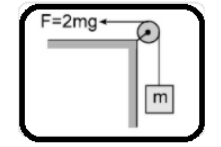
The block of mass $m$ equal to $100kg$ is being pulled by a horizontal force $F = 2mg$ applied to a string as shown in figure (take $g = 10m/{s^2}$). The pulley is massless and is fixed at the edge of an immovable table. What is the value of force exerted by the supporting cable (rod) on the pulley ( in newton).
(A) $2mg$
(B) $\sqrt 2 mg$
(C) $2\sqrt 2 mg$
(D) $3\sqrt 2 mg$
Answer
 Verified
233.1k+ views
Hint: Since the supporting rod is at rest we draw a free body diagram showing all the forces acting at the point of the supporting rod. The forces that are acting are the horizontal tension force, vertical tension force, and the force exerted by the support on the massless pulley. These forces are vectors ( direction based ) so we do vector addition. Adding all the three forces on the free body diagram we get zero as the system is at rest.
Complete step by step solution:
Taking ${T_1}, {T_2}, {F_S}$ As the tension force vertically, tension force horizontally, and force of support.
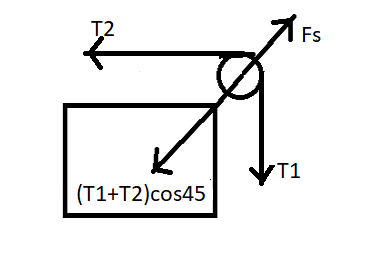
Adding all the three forces we get ,$ {{\vec T}_1} + {{\vec T}_2} + {{\vec F}_S} = 0 $
The angle between the sum of the 2 tension forces and each tension force is $45^\circ$,
$ \left| {{{\vec F}_S}} \right| = \left| {{{\vec T}_1} + {{\vec T}_2}} \right|$
${T_1} = {T_2} $
${F_S} = 4mg\cos (45^\circ ) $
$ {F_s} = 2\sqrt 2 mg $
The unit of the force acting on the support is newton which is equal to mass times gravity.
Hence the answer is (C), $2\sqrt 2 mg$.
Additional information: Tension force is the force that is transmitted through a cable, rope, wire, or string when it is pulled tight by forces acting from opposite ends. It is directed along the length of the cable and pulls equally on the objects on the opposite ends of the wire. The tension on an object is equal to the product of the mass of the object and gravitational force added to the product of the mass and acceleration.
Note: We can also use vector addition instead if using $\cos (45°)$ which would lead us to the same answer. As,$\overrightarrow A + \overrightarrow B = \sqrt {{A^2} + {B^2} + 2ABCos\theta } $ as the angle between the two tension forces is 90° we still get the same answer at the end.
Complete step by step solution:
Taking ${T_1}, {T_2}, {F_S}$ As the tension force vertically, tension force horizontally, and force of support.
Adding all the three forces we get ,$ {{\vec T}_1} + {{\vec T}_2} + {{\vec F}_S} = 0 $
The angle between the sum of the 2 tension forces and each tension force is $45^\circ$,
$ \left| {{{\vec F}_S}} \right| = \left| {{{\vec T}_1} + {{\vec T}_2}} \right|$
${T_1} = {T_2} $
${F_S} = 4mg\cos (45^\circ ) $
$ {F_s} = 2\sqrt 2 mg $
The unit of the force acting on the support is newton which is equal to mass times gravity.
Hence the answer is (C), $2\sqrt 2 mg$.
Additional information: Tension force is the force that is transmitted through a cable, rope, wire, or string when it is pulled tight by forces acting from opposite ends. It is directed along the length of the cable and pulls equally on the objects on the opposite ends of the wire. The tension on an object is equal to the product of the mass of the object and gravitational force added to the product of the mass and acceleration.
Note: We can also use vector addition instead if using $\cos (45°)$ which would lead us to the same answer. As,$\overrightarrow A + \overrightarrow B = \sqrt {{A^2} + {B^2} + 2ABCos\theta } $ as the angle between the two tension forces is 90° we still get the same answer at the end.
Recently Updated Pages
JEE Main 2023 April 6 Shift 1 Question Paper with Answer Key

JEE Main 2023 April 6 Shift 2 Question Paper with Answer Key
JEE Main 2023 (January 31 Evening Shift) Question Paper with Solutions [PDF]
JEE Main 2023 January 30 Shift 2 Question Paper with Answer Key
JEE Main 2023 January 25 Shift 1 Question Paper with Answer Key
JEE Main 2023 January 24 Shift 2 Question Paper with Answer Key
Trending doubts
JEE Main 2026: Session 2 Registration Open, City Intimation Slip, Exam Dates, Syllabus & Eligibility
JEE Main 2026 Application Login: Direct Link, Registration, Form Fill, and Steps
Understanding the Angle of Deviation in a Prism
Hybridisation in Chemistry – Concept, Types & Applications
How to Convert a Galvanometer into an Ammeter or Voltmeter
Understanding Uniform Acceleration in Physics
Other Pages
JEE Advanced Marks vs Ranks 2025: Understanding Category-wise Qualifying Marks and Previous Year Cut-offs
Laws of Motion Class 11 Physics Chapter 4 CBSE Notes - 2025-26
Waves Class 11 Physics Chapter 14 CBSE Notes - 2025-26
Mechanical Properties of Fluids Class 11 Physics Chapter 9 CBSE Notes - 2025-26
Thermodynamics Class 11 Physics Chapter 11 CBSE Notes - 2025-26
Units And Measurements Class 11 Physics Chapter 1 CBSE Notes - 2025-26